Bedroom Laundry Hamper Placement for Easier Routines
Choose a bedroom hamper location that fits changing clothes, closet access, ventilation, basket lifting, and the route to your washing machine.
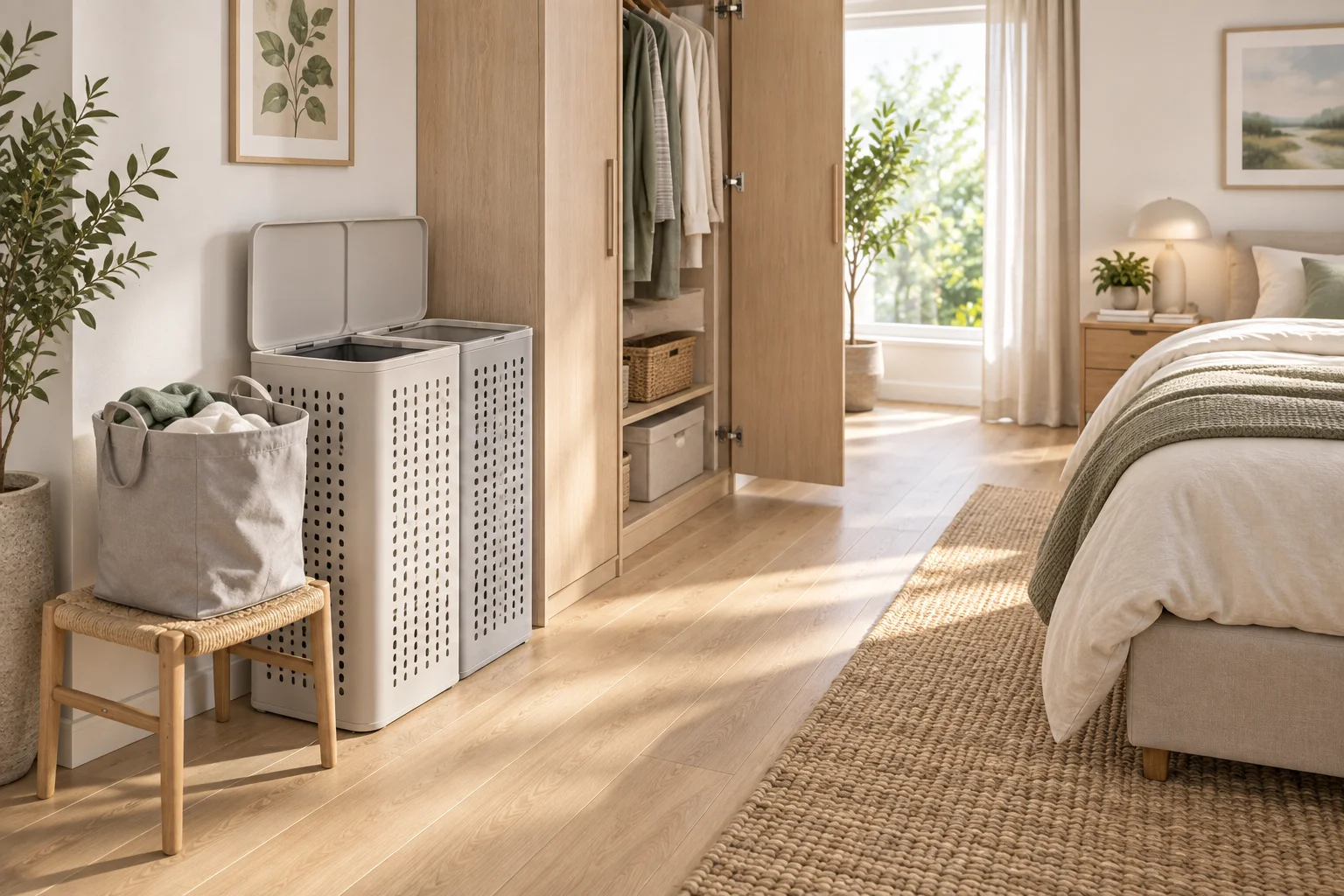
The best place for a bedroom laundry hamper is usually close to where clothes come off, but that does not mean the nearest empty corner. A useful location must let you drop in clothing, open the container, lift out a full load, and carry it to the laundry area without moving other furniture. It also needs to keep damp textiles out of enclosed storage.
Instead of choosing a basket by appearance, map the sequence from getting dressed to starting a wash. A hamper is one stop in that sequence. When the stop is inconvenient, clothes collect on chairs and the floor even in a beautifully organized room.
Observe Where Clothes Actually Come Off
For three evenings, notice whether clothing is removed beside the bed, in front of the wardrobe, or in an attached bathroom. Ask each person sharing the room to describe the routine rather than assuming it is identical. Someone who changes immediately after work may need a different location from someone who changes after showering.
Separate dirty clothing from items that will be worn again. A chair often becomes overloaded because both categories have no assigned home. A small hook or rail for reusable clothing can keep the hamper reserved for laundry, reducing unnecessary washing and making the room easier to reset.
Measure the Container in Use
Product dimensions normally describe a closed, empty hamper. Record its maximum width and depth, the lid opening, handles, and any removable liner. A fabric basket may bulge when full. A rigid basket might fit under a shelf but become impossible to lift because the handle needs extra height.
For example, a hamper measuring 40 by 35 centimeters occupies only 0.14 square meters. However, a front-pull version extending 35 centimeters into the room has a much larger operating footprint. Add a standing position and the space needed to lift the loaded liner. Test with the actual product whenever possible.
Do not assume a narrow gap is convenient because the basket can be pushed into it. If reaching it requires twisting between the bed and wardrobe, a slightly larger basket in a more open position may be the easier choice.
Compare the Three Most Useful Locations
Beside the Wardrobe
A hamper near the place where you change can shorten the daily routine. Check every wardrobe door and drawer with the basket present. Hinged doors should reach their intended opening angle, while sliding doors must still provide access to the relevant compartment. Keep the hamper away from clothes that hang low enough to touch its contents.
This location is particularly useful when a separate reusable-clothing rail sits nearby. It allows a quick decision: wash, wear again, or put away. Avoid forcing all three categories into one covered container.
Inside a Ventilated Wardrobe Bay
A dedicated bay can make the room visually quieter, but it needs adequate ventilation and a practical extraction method. Never treat an unventilated cabinet as a drying space. Damp towels, wet sportswear, and rain-soaked clothing should dry appropriately before entering ordinary enclosed laundry storage.
Measure shelf heights against the full lifting motion. If a liner must be lifted 25 centimeters before it clears its frame, that vertical space is part of the design. Check the manufacturer's requirements for any installed pullout mechanism and confirm the cabinet can support it.
Near the Bedroom Exit
A location near the door can make carrying laundry out easier, especially when the washer is on another floor. It works only if it does not obstruct the door swing, nighttime route, or required passage. The basket should not become a temporary doorstop or an object that must be moved during an urgent exit.
Protect the Bedside Route
A hamper between the bed and wall often steals the space used when making the bed or walking in the dark. Begin with the actual bedside clearance, then subtract the basket's fullest width. Include bedding that hangs over the mattress and any projecting bedside cabinet handles.
In a 300 by 330 centimeter bedroom, a 150 centimeter bed and two 45 centimeter bedside zones already use 240 centimeters across one direction. Adding a 35 centimeter basket into one of those zones may make that side unpleasant to use. A shallow position near the wardrobe can be more successful even if it is farther from the bed.
These measurements are an illustration, not a recommended minimum for every room. Mobility aids, caregiver assistance, local requirements, and individual comfort may require substantially different clearances. Test the household's real movements before finalizing a location.
Size Capacity to the Washing Schedule
A large hamper encourages longer storage, while a small one may overflow before the next wash. Estimate how many days of laundry the room generates and how often loads actually move to the washing machine. Do not buy separate compartments unless someone will maintain the intended sorting system.
For one person who washes twice a week, a single removable bag may work better than a wide three-section sorter. For two people with distinct workwear needs, two smaller containers can simplify handling. Keep heavy loads manageable; a container that fits a week's clothing may still be uncomfortable to carry downstairs.
Keep Damp Laundry on a Different Path
Humidity and airflow matter more than a decorative lid. Give wet towels and exercise clothing an appropriate drying location before storage, following garment and household care needs. Do not block a heating appliance, ventilation grille, or air return with a basket.
Choose a container that can be cleaned and dried. Removable washable liners can be convenient, but they still need regular care. A basket placed directly against a cold exterior wall may hide condensation or make cleaning difficult; leave the wall accessible and investigate persistent moisture rather than concealing it.
Rehearse Collection Day
Fill a similar bag with a realistic load, then lift it from the proposed position. Walk to the washing machine, opening every door you normally encounter. Check the turn at the bedroom exit, stair handrail access, and the landing space beside the washer. Keep loads small enough to carry safely while retaining necessary support.
If the route is awkward, choose a lighter removable liner, two smaller containers, or a transfer basket that lives near the laundry area. A hamper on wheels is useful only when floor transitions, rugs, and stairs allow it. Wheels do not solve an unsuitable route automatically.
Model the Entire Routine
Place the bed, wardrobe, hamper, open lid, and occupied standing space in the room planner. Compare a wardrobe-side position with an exit-side position. Use simple shapes to show a pulled-out liner and nearby open drawers when exact models are unavailable.
Review the room from the doorway in the 3D demo. The interior planner can help coordinate finishes, but prioritize access and ventilation over hiding the container completely. Save both options with notes from a real laundry-day test.
Final Placement Checklist
- Dirty and reusable clothing have separate destinations.
- The lid, liner, and handles can move fully.
- Wardrobe doors and drawers remain accessible.
- The basket does not narrow the essential bedside or exit route.
- Damp items have a suitable drying step before storage.
- A full load can be lifted and carried comfortably.
- Cleaning the basket, floor, and adjacent wall remains straightforward.