Dining High Chair Placement for Everyday Family Meals
Plan a dining high chair position with caregiver access, safe reach zones, tray removal, cleanup space, and a clear family route through a compact dining room.
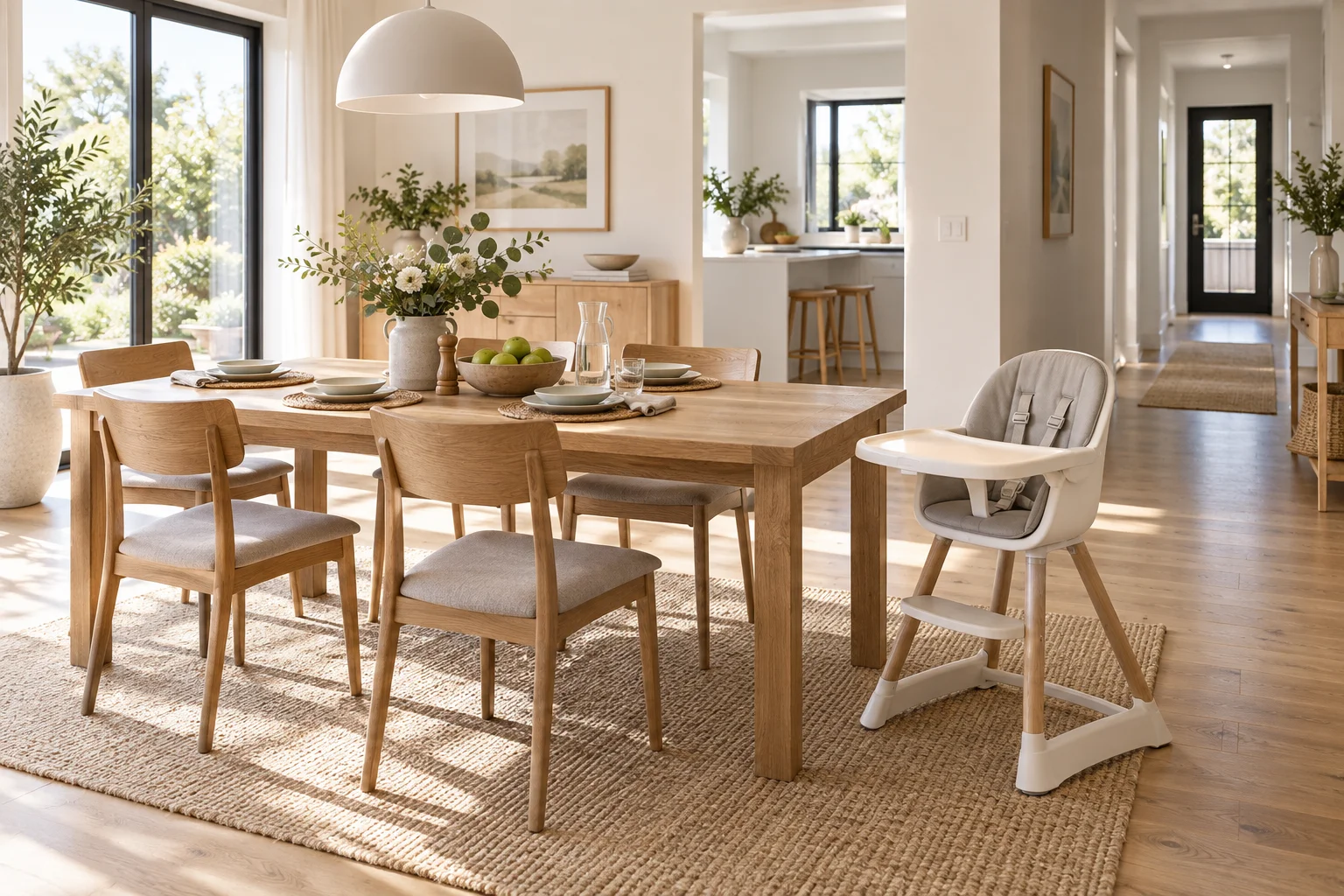
A dining high chair changes the way a room works during the busiest twenty minutes of the day. Someone carries food from the kitchen, another person pulls out a dining chair, a toddler drops a spoon, and a caregiver needs to reach the harness without stepping into a passage. A position that looks tidy when every seat is empty can become awkward once the family sits down. Plan around the complete meal routine rather than the high chair's folded footprint.
Measure the Chair in Its Actual Meal Configuration
Record the widest spacing between the feet, the tray projection, the backrest, and any manufacturer-required clearances. Some high chairs have splayed legs that extend considerably beyond the seat. Measure with the tray installed and with the intended height settings selected. Follow the manufacturer's instructions for assembly, age and weight suitability, restraint use, and where the chair may be placed.
A hypothetical chair might occupy 60 by 75 cm at floor level even though its seat looks narrow. Do not use those example dimensions to select a product or declare a position safe. Trace the actual base with removable tape, then add the space needed for your hands to release the tray. A chair that fits below the tabletop may still collide with the table apron or an adult's feet.
Map Three Routes Before Choosing a Seat
Draw the kitchen-to-table route, the everyday route through the room, and the caregiver's approach to the child. Ideally, the high chair sits beside a caregiver without becoming the obstacle everyone walks around. An end position may make the child easier to reach, but it can also occupy the route between a kitchen doorway and the living room.
As a planning comparison, test a 90 cm clear walking strip beside the dining arrangement, then repeat the test with chairs occupied and pulled out. This is not a universal safety or accessibility standard. Your household's mobility needs, actual furniture, and local requirements may call for a different arrangement. Measure from the furthest chair leg or tray edge, not from the table edge.
Compare the Short End and the Long Side
At the short end
The end of a rectangular table often gives a caregiver a straightforward approach from either side. Check whether the adult at the adjacent corner can turn, stand, and assist without striking the high chair base. If the table normally seats six, removing one dining chair may be more effective than squeezing an extra chair into the existing layout.
The end is a poor choice when it faces a busy doorway, blocks a cabinet, or leaves hot serving dishes within reach. Check the table overhang: a child may be able to push against a nearby surface. Follow the chair maker's placement guidance rather than assuming a heavy table prevents tipping.
Along the long side
A side position can keep the main passage open and bring the child closer to the caregiver. However, wide high chair legs may overlap neighboring dining chair legs. Slide both adult chairs out to their real occupied position. If adults have to lift their feet over the base, the arrangement needs more room or fewer seats.
Do not solve a tight fit by placing the high chair on a rug edge, platform, or improvised riser. The base needs the stable, level surface specified by the manufacturer. Keep the chair away from stairs and other hazards, and never substitute room layout for supervision.
Separate Serving Space From the Child's Reach
Look at the arrangement from the child's seated height. Hot cups, pans, knives, glassware, tablecloth edges, blind cords, and appliance cables should not be within reach. A table runner that hangs beside the chair can pull objects down with it. A convenient serving station for adults is not necessarily a suitable location beside the child.
Give hot dishes a separate adult-controlled landing area that does not require reaching across the high chair. For example, a sideboard on the kitchen side of the room may support serving if it does not narrow the route or introduce climbable access. Treat this as a placement exercise, not a claim that any particular distance makes hot objects safe.
Rehearse Tray Removal and Cleanup
Practice the routine with the chair empty. Approach from the position where the caregiver normally sits, operate the restraint according to instructions, remove the tray, and carry it to the sink. Find out whether a tray needs to slide forward, lift upward, or release from both sides. A wall that seems harmless can block that movement.
Now rehearse wiping the floor. Food often lands beyond the footprint, particularly toward the caregiver. A washable mat may help, but its edges must not create a trip hazard or interfere with chair stability. Check the flooring and chair instructions before adding one. Keep cleaning products stored securely elsewhere, rather than creating an accessible cleanup basket beside the seat.
A Compact Dining Room Example
Consider a 280 by 320 cm dining area with a 140 by 80 cm table and a kitchen opening on one long wall. First test the high chair at the end nearest the kitchen. Its tray might allow easy serving, while its legs obstruct everyone entering the room. Turn the comparison around: remove one side chair and place the high chair along the opposite long side, beside the caregiver.
The second layout may preserve the doorway route, but only if the table is moved enough to allow the caregiver to stand. Tape both arrangements on the floor and rehearse them with empty furniture. If neither works, consider a smaller table or reducing everyday seating rather than treating the child's place as leftover space.
Plan for the Chair Between Meals
Some families leave the high chair ready all day; others fold it. If your model is designed to fold, identify a stable storage location and follow its locking instructions. Do not assume a folded chair can lean safely against a wall. Keep it out of exit routes and away from places where a child could pull it over.
A useful drawing includes both the eating position and the parked position. You can compare the overall furniture arrangement with the room planner guide, then use the demo scene to explore how a dining zone relates to the adjoining room. Confirm product-specific details with the real chair.
Final Family Meal Checklist
- The chair suits the child and is assembled and used according to its instructions.
- The entire base sits on an appropriate stable surface.
- A caregiver can approach and use the restraint without moving other occupied seats.
- Kitchen traffic does not pass through the high chair's working space.
- Hot items, sharp objects, cords, and pullable cloths remain out of reach.
- Tray removal and cleaning have been rehearsed with the chair empty.
- The everyday and stored arrangements keep exits clear.
The best position is the one that supports attentive supervision and a repeatable meal routine. Revisit it as the child grows, the chair configuration changes, or a different person takes over feeding.