Dog Crate Placement in Small Apartments: Layout Guide
Place a dog crate in a small apartment without blocking doors, airflow, or daily traffic. Compare room zones, noise, safety, storage, and routines.
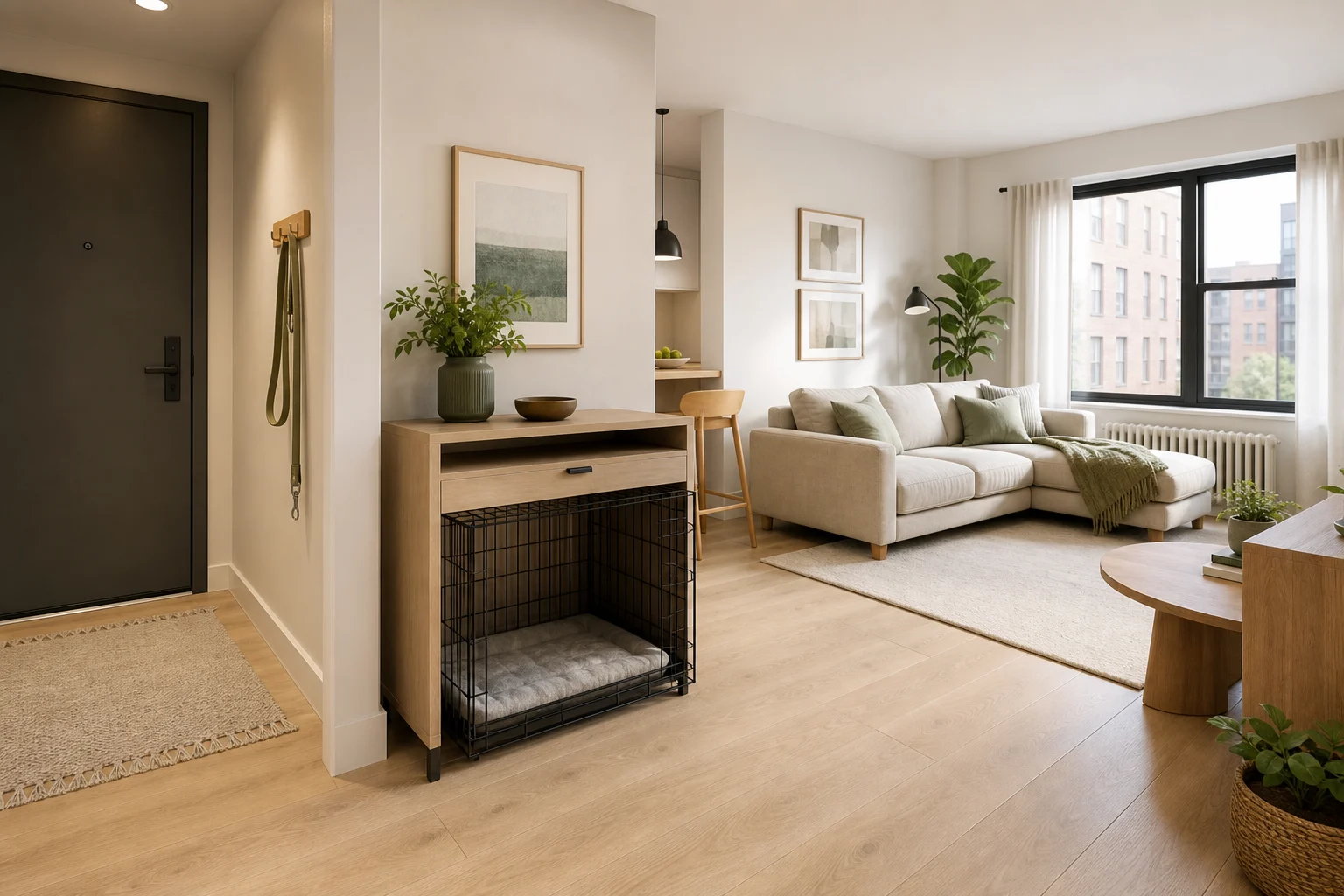
A dog crate occupies more than its outside dimensions. The door needs room to open, a person needs space to kneel, bedding must be removed for washing, and the dog needs a calm approach that does not cross a busy doorway. In a small apartment, those operating zones can collide with furniture, heaters, curtains, deliveries, and the route between the entrance, kitchen, and bathroom. The best location supports rest and supervision without turning the crate into an obstacle.
Measure the Crate as an Operating Zone
Record the crate's full width, depth, and height, including feet, handles, latches, and any furniture-style surround. Open the door completely and add the space required for the dog's body to turn and enter without squeezing past a table leg. A side-opening model and an end-opening model can behave very differently in the same 90 cm gap.
Also draw the human task. Allow space to refill water, clip a lead, change bedding, clean the tray, and lift the crate if it folds. If a 76 cm deep crate has a 76 cm door, the practical footprint can approach 150 cm while the door is open. Do not judge fit from the closed rectangle alone.
Choose a Calm Zone With Useful Visibility
Many dogs settle better when they can see ordinary household activity without sitting inside its fastest route. A living-room edge, wide hall alcove, or the end of a console wall may work better than the center of an open plan. The crate should not become a place where every visitor steps over the threshold or every dining chair scrapes past the door.
Observe the apartment at breakfast, during work calls, at dinner, and after dark. Refrigerators, lifts, trash rooms, plumbing stacks, television speakers, and shared corridors create different noise patterns. A spot that looks quiet at noon may be the loudest point when neighbors return home.
Keep Entrances and Escape Routes Clear
Never narrow the required route from a bedroom to an exit, obstruct a door swing, cover a utility panel, or occupy an area that local fire and building rules require to remain open. At the apartment entrance, preserve room for a person carrying groceries and for the door to open without striking the crate.
A crate beside the front door can simplify walks, but it may also expose the dog to every delivery and corridor sound. If the entry is the only option, place the crate beyond the direct door swing and create a visual buffer with a fixed console or side panel that cannot fall. Confirm that the latch remains reachable when shoes, bags, and coats accumulate.
Check Heat, Airflow, Sun, and Cords
Keep the crate away from hot radiators, portable heaters, cooking appliances, and strong supply-air drafts. Direct afternoon sun through glass can overheat a small enclosed area even when the room feels comfortable. Test the location on a sunny day and through a normal heating cycle rather than relying on a single temperature reading.
Do not let blind cords, charging cables, power strips, curtain hems, or plant leaves hang through the bars. Protect nearby outlets and route cords in fixed covers outside reach. Ventilation must remain open on the sides specified by the crate manufacturer; wrapping all faces to hide the crate can reduce airflow.
Fit the Crate Into Furniture Without Disguising Risk
A purpose-built console surround can make a crate feel intentional and provide a landing surface for keys or dog supplies. It should not carry loads on the crate itself unless designed for that purpose. Leave ventilation gaps, prevent objects from falling through the top, and keep cleaning access. A heavy stone lamp above an energetic dog is a poor trade for visual polish.
If using a side table or bench nearby, keep its legs outside the door path. Avoid deep shelves above the crate that require standing in the dog's entry zone. Store food in sealed containers, and separate medicine, cleaning products, and waste bags from accessible baskets.
Plan Storage Around the Routine
Place the lead, harness, towel, waste bags, and paw-cleaning supplies near the route to the door. Bedding and spare covers need dry storage close enough to support frequent washing. Food may belong nearer the kitchen, while grooming tools can stay with bathroom cleaning supplies. One giant pet cabinet is less useful than storage placed at each task.
Keep a clear parking place for a travel carrier or folded exercise pen. If the crate must occasionally move, measure the path through every doorway and around the sofa. Felt pads or locking casters can protect flooring, but the crate must remain stable when occupied.
Compare Three Locations With the Same Crate
Model the measured apartment in the Aedifex room planner, then place the identical crate at the living-room edge, entry transition, and bedroom wall. Add the open crate door, apartment doors, sofa, dining chairs, and a 60–75 cm human body marker. Comparing identical geometry prevents a visually attractive but undersized substitute from winning.
Use the 3D demo viewpoint at dog eye level and seated human eye level. Check whether the dog can see the entrance, whether sunlight reaches the enclosure, and whether the crate dominates the room. A top-down plan reveals collisions; a normal-height view reveals exposure and visual weight.
Run a Daily-Routine Test
Simulate returning with groceries, clipping the lead, opening the crate, filling water, hosting a visitor, pulling out dining chairs, vacuuming, and changing bedding. Keep the crate door open during the test. If someone must close it to pass, the location does not support the real operating state.
Watch how people actually take shortcuts. A nominal 90 cm passage may fail if a chair, shoe tray, or open cabinet steals 20 cm. Test nighttime access without bright overhead lights, especially if the route crosses a sleeping area.
Dog Crate Placement Checklist
- Measure the crate, open door, dog turn, and human kneeling zones.
- Keep required exits, apartment doors, panels, and utilities unobstructed.
- Compare noise and household traffic at several times of day.
- Avoid radiators, direct sun, strong drafts, cords, and curtain loops.
- Preserve ventilation and cleaning access around any furniture surround.
- Store walking, cleaning, bedding, and feeding supplies near their tasks.
- Test the crate door open during normal circulation and deliveries.
- Review the apartment from both human and dog eye level.
Once the safest location works, refine materials in the interior planner and register to save alternate crate-and-furniture arrangements.