Entryway Stroller Storage Layout for Everyday Trips
Plan stroller parking near your entry with folded dimensions, door clearance, wet-wheel storage, bag access, and a practical route for daily trips.
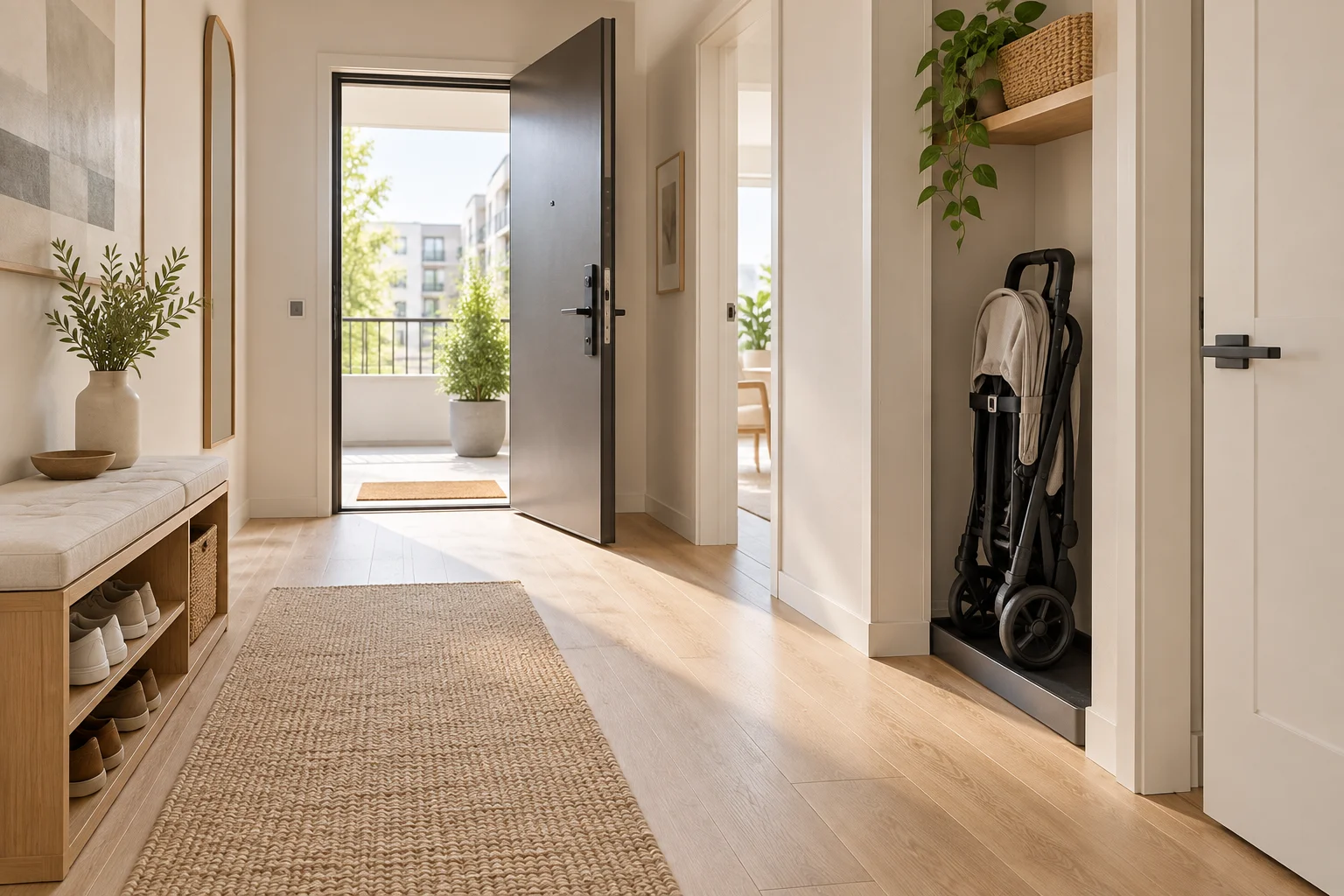
A stroller can dominate an entryway even when it folds into a compact package. The challenge is not only storing it between trips. Someone must arrive with a child and bags, open the door, secure the stroller as instructed, unload, and move everything inside. On the way out, that sequence runs in reverse while shoes, keys, and coats compete for the same space.
Plan stroller storage as a sequence of states: arrival, unloading, parking, preparation, and departure. The best position may be a little farther from the door if it allows these steps without blocking the household's essential route.
Measure the Exact Stroller, Including Accessories
Record the unfolded width, length, and handle height, then measure the folded form using the manufacturer's intended folding method. Include wheels, baskets, attached adapters, and accessories that normally stay installed. Product dimensions may describe a configuration different from the one your family uses.
Check whether the folded stroller stands independently and how it must be secured. Some designs balance only in a particular orientation, while others need to lie down. Do not assume that a narrow upright shape is stable enough to lean against a wall. Follow the product's storage and folding instructions.
If the family uses a double stroller or switches between a carrycot and seat, measure every regular configuration. The smallest folded state is not the right planning basis if reaching it requires removing parts you do not intend to remove each day.
Map Arrival Before Designing the Cabinet
Walk through a typical return from a rainy outing. Where can you stop while opening the door? Where does the shopping bag go? Is there a suitable place for another adult to stand? Follow the stroller manufacturer's instructions for brakes, child restraint, folding, and unloading throughout the sequence.
Never make the layout depend on leaving a child unattended in the stroller or placing bags where they affect its stability. A storage plan should support safe handling rather than inventing a shortcut to compensate for limited space. Provide an appropriate place for the child and a separate landing surface for bags according to the household's needs.
Keep the Main Door Fully Usable
Draw the complete door swing, handles, closer, and any second door or security gate. A folded stroller behind the door can prevent the leaf from opening fully, even when the entry appears clear in a photograph. Test the door with the stroller in its normal parked position.
Required exit routes must remain clear without moving stored equipment first. In an apartment building, do not assume a common corridor or stair landing can serve as private stroller parking. Check building rules and applicable fire-safety requirements. If storage outside the apartment is not permitted, design an indoor solution rather than relying on informal tolerance.
Compare Parked Depth With Remaining Passage
Suppose an internal entry zone is 150 centimeters wide and a folded stroller projects 45 centimeters from one wall. That leaves 105 centimeters before considering handles, coat hooks, skirting, or a shoe rack opposite. Add a 30 centimeter deep shoe cabinet on the other wall and the remaining strip falls to 75 centimeters.
These figures show how competing storage adds up; they are not a universal acceptable passage width. Applicable egress and accessibility requirements, the actual door opening, and household mobility needs take priority. Measure the narrowest point and the turn into the next room, not merely the width beside the parked stroller.
An unfolded stroller measuring 65 by 100 centimeters may need more space to turn than its footprint suggests. Mark the wheels and handles, then roll it through the route. Avoid assuming it can pivot tightly in place unless that is realistic with the exact model and load state.
Choose the Storage State You Can Maintain
Daily Unfolded Parking
This is convenient when the entry has enough dedicated floor area and the route stays clear. It avoids repeated folding but requires the largest permanent footprint. Mark a specific parking boundary so bags and shoes do not gradually push the stroller into the passage.
Folded Parking in a Shallow Niche
A niche can work well for a stroller that folds easily and stores securely in the intended orientation. Confirm access to the latch and handles. Include the space needed to unfold it outside the niche; the folded dimensions alone cannot describe the whole routine.
A Nearby Interior Storage Room
When the entrance is too tight, a utility room or indoor storage area may be more suitable. Check the complete transfer route, including thresholds and doors, and confirm the room environment meets the product's care instructions. The extra distance may be worthwhile if it keeps the entrance usable for everyone.
Give Wet Wheels a Manageable Landing
Wet wheels bring water and grit indoors. Use a stable, suitable floor-protection arrangement that does not create a raised trip edge or interfere with parking stability. Test whether a tray's rim prevents the stroller from rolling into position or changes how the folded frame rests.
Clean and dry the stroller according to its care instructions before enclosed storage where needed. Do not seal a wet fabric seat inside an unventilated cupboard. Leave a practical way to clean the floor and inspect nearby surfaces; hidden dampness is harder to manage than a visible washable zone.
Keep cleaning products and small maintenance items stored appropriately away from children. A wheel-cleaning station should simplify care without introducing loose objects into the main route.
Separate Bags, Shoes, and Folding Space
A small landing shelf can help with keys and bags, but its projection must be included in the route. Avoid placing hooks where hanging bags swing into the stroller or door. Put everyday shoes in a defined location rather than the temporary area required for folding.
Rehearse a departure with the actual items you carry. If a bag must be moved three times before the stroller can unfold, change the storage order or shelf position. Keep the folding area free during ordinary use; a rectangle that exists only after clearing household clutter is not a dependable solution.
Test the Route With a Second Person
Have one adult prepare the stroller while another enters or leaves. Check whether the front door, shoe storage, and coat cupboard can be used without conflict. Include the moment when someone bends to fasten shoes or reaches for a coat, since both movements occupy more space than standing still.
If two-person use cannot work, define a practical sequence that still preserves required access. Do not reduce a mandatory exit route to gain storage. A smaller shoe unit or a different stroller parking room may deliver more value than a custom cabinet squeezed into the entrance.
Compare the States in a Room Model
Build the entry, door swing, stroller in both forms, bag landing, and shoe storage in the room planner. Basic blocks can represent the stroller and people where exact models are unavailable. Keep folded and unfolded alternatives clearly labeled so their footprints are not confused.
Inspect the approach in the 3D demo, then coordinate durable finishes with the interior planner. Save the layout together with measured dimensions and the arrival sequence. Recheck it when changing stroller configuration or adding another child's equipment.
Before You Buy Entryway Storage
- Measure the real folded and unfolded configurations.
- Confirm stable storage and handling under the product instructions.
- Preserve door operation and all required exit routes.
- Check building rules before using any shared area.
- Include wet-wheel care, bag unloading, and unfolding space.
- Test two-person use and the turn into the next room.
- Choose a routine that works without repeatedly moving unrelated furniture.