Guest Room Luggage Rack Placement for Easy Unpacking
Choose a guest room luggage rack position that supports an open suitcase, preserves the route to bed, and keeps wardrobe doors and useful outlets accessible.
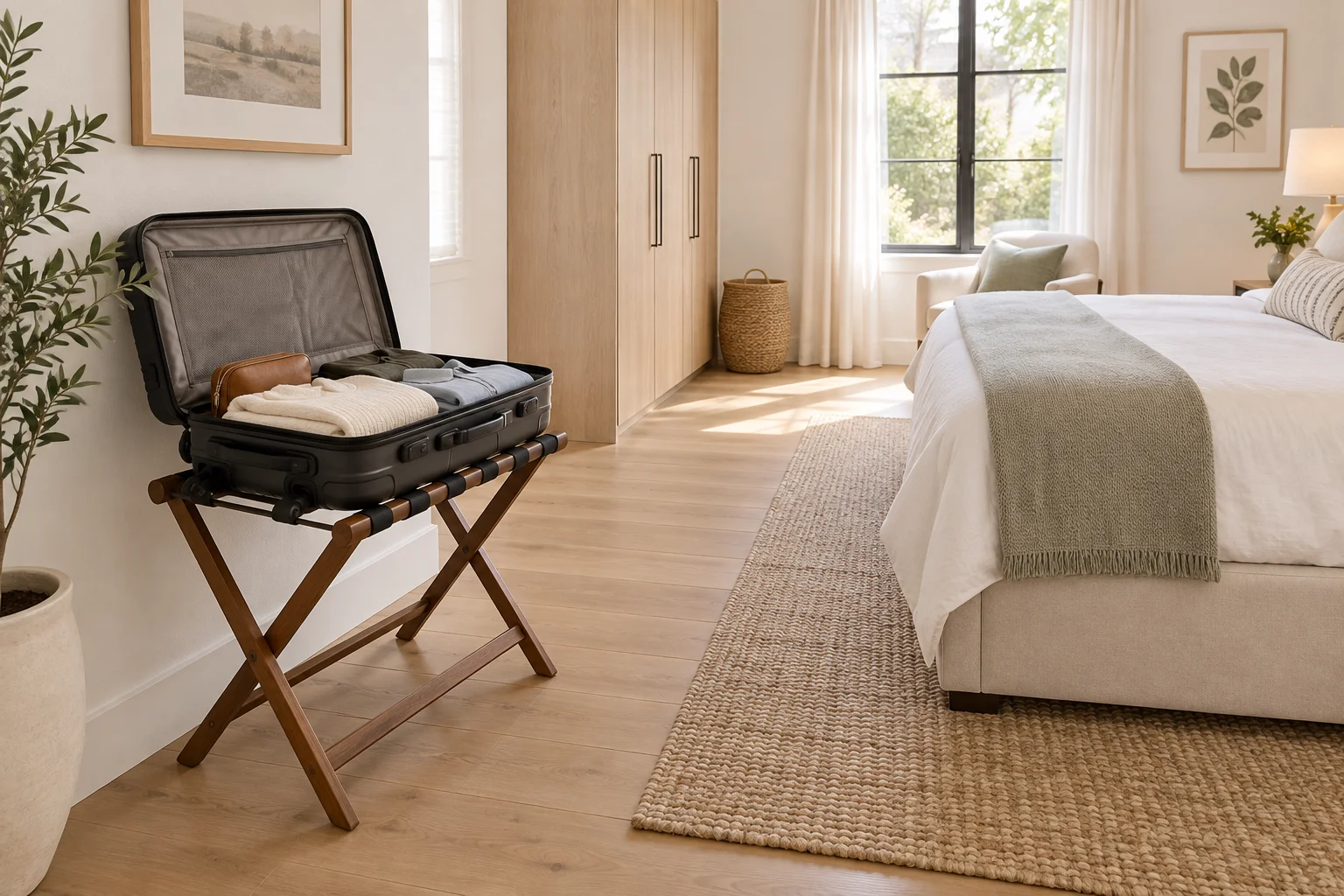
A luggage rack is a small piece of furniture with a surprisingly large operating footprint. The folded stand may fit behind a door, yet the suitcase it supports can block a wardrobe or open across the only route to the bed. Good placement starts with the open bag, the person using it, and the length of the stay, rather than the rack's catalog dimensions alone.
This guide uses example measurements to compare positions in an ordinary guest bedroom. They are not universal safety, ergonomic, or accessibility requirements. Follow the rack manufacturer's load and setup instructions, and adapt the arrangement to the visitor's reach, balance, luggage, and mobility needs.
Ask What Kind of Suitcase Will Be Used
A soft suitcase with one opening lid behaves differently from a rigid clamshell case. The first may need a stable upright lid and access from one long side. The second may spread into two substantial halves, each holding clothing. A narrow rack that supports only one half can leave the other half hanging unsupported.
Do not assume that every stand sold as a luggage rack can hold an open clamshell suitcase. Check its support area, strap arrangement, rated capacity, and intended use. If the open case does not sit securely, use a suitable larger platform or give the visitor accessible unpacking storage. Do not improvise an unsupported bridge between unrelated furniture pieces.
For two guests, ask whether they normally bring one shared bag or two independent cases. One rack is not automatically enough for a double room. A second usable surface or a clear shelf may be more helpful than a decorative chair.
Measure the Working Envelope
Begin with the stand fully unfolded and locked as instructed. Measure its width, depth, height, and any projecting feet. Then place the intended suitcase on it and measure again in the open position. Include wheels, handles, pockets, and the lid's resting angle.
As an example, a folded stand might occupy only 12 cm in depth against a wall. Unfolded, its base could be 45 cm deep, while the open case needs an 80 cm deep envelope. In that example, budgeting only the stand depth misses 35 cm before adding any room for the guest to stand. Use the actual product and bag rather than adopting these illustrative numbers.
Mark the working envelope with removable tape. Place another strip where the visitor's feet will go. Ask them to reach into both ends of the case, lift an item out, and turn toward the wardrobe. If they must lean across an unsupported lid or stand in the doorway, revise the position.
Compare Three Useful Locations
Beside the Wardrobe
This shortens the unpacking sequence: open the bag, transfer clothes, and put shoes away. It works best when the rack sits beyond the wardrobe door swing or sliding door access zone. Remember that a sliding door does not eliminate the need for standing space in front of the storage.
Check the lowest drawer as well as the main door. A rack can allow hanging clothes to remain accessible while preventing the drawer beneath them from opening. Leave the guest a genuinely usable shelf and hangers instead of expecting them to work around household storage.
Along a Clear Side Wall
A side wall can keep the suitcase out of the bed approach. Choose a position away from the door swing, heaters, curtain movement, and required access to windows. Check whether the open lid touches the wall. A scuff-resistant surface may be practical, but wall protection should not be used to justify an unstable bag position.
Provide nearby light so dark clothing is visible inside the case. Avoid running a lamp cable across the standing area. An existing wall light or a safely placed lamp on a separate stable surface may work better than adding another floor object.
Near the Foot of the Bed
This position is convenient in a generous room but often fails in a compact guest bedroom. The rack, open case, and standing person all occupy the passage across the bed's foot. Measure the remaining route with the suitcase open, not zipped shut.
If the room also has a bench, decide which item earns that footprint. A bench can replace a rack only if its dimensions, finish, stability, and load capacity suit the luggage. The bedroom bench clearance guide helps check the underlying circulation problem.
Do Not Hide the Rack Behind an Active Door
Behind-door storage can be useful while a folding rack is empty and properly stored. It is a poor operating location when the room door strikes the open case or prevents someone entering fully. Trace the door handle as well as the leaf, because the handle can catch fabric or hit a suitcase lid before the door itself reaches it.
The entrance-to-bed route should remain obvious after unpacking. Guests are unfamiliar with the room and may move in low light. Keep the rack out of the most direct nighttime route to the bathroom, and avoid placing shoes or loose shopping bags beneath it where feet naturally land.
Plan for a Multi-Night Stay
A visitor staying one night may keep almost everything in the bag. For a longer stay, a few cleared drawers reduce repeated bending and make the room easier to use. Ask which arrangement the guest prefers instead of assuming everyone wants to unpack completely.
Consider the empty case too. If it will move into a wardrobe after unpacking, check that the compartment actually accepts its wheels and handle. Do not place heavy luggage overhead or ask visitors to lift it onto an unsuitable high shelf. If under-bed storage is proposed, check the clearance and how the case will be retrieved without awkward pulling.
Check Cleaning and Storage Between Visits
A folding rack needs a defined storage spot that does not damage its straps or obstruct a door. Follow its maintenance instructions and inspect loose hardware before use. Put the rack on a stable surface and keep it away from a rug edge that could leave one foot uneven.
Keep upholstered bedding separate from the unpacking surface where possible. A dedicated luggage position also stops the bed becoming the only convenient place to spread a suitcase. For the rest of the room, consult the small guest bedroom layout guide.
Test the Complete Arrival Routine
Walk into the room carrying a bag, put it down, open it, take out nightwear, hang a coat, and move to the bed. Repeat with a second case if two people will stay. The test should include the wardrobe door, the bedroom door, and any bedside charging cables in their normal positions.
You can compare the furniture arrangement through the room planner introduction and explore the Aedifex demo. Confirm luggage support and stability physically; a room visualization cannot determine whether a particular suitcase is secure on a particular rack.
A successful placement gives the bag a stable home while allowing the visitor to move naturally. When the choice is between a decorative extra seat and a usable unpacking area, prioritize the activity that otherwise ends up blocking the bed or the doorway.