Home Office Shredder Placement: Access and Clearance
Place a home office shredder with room for feeding paper, emptying the bin, cooling, cables, and safe storage without crowding your desk or exit.
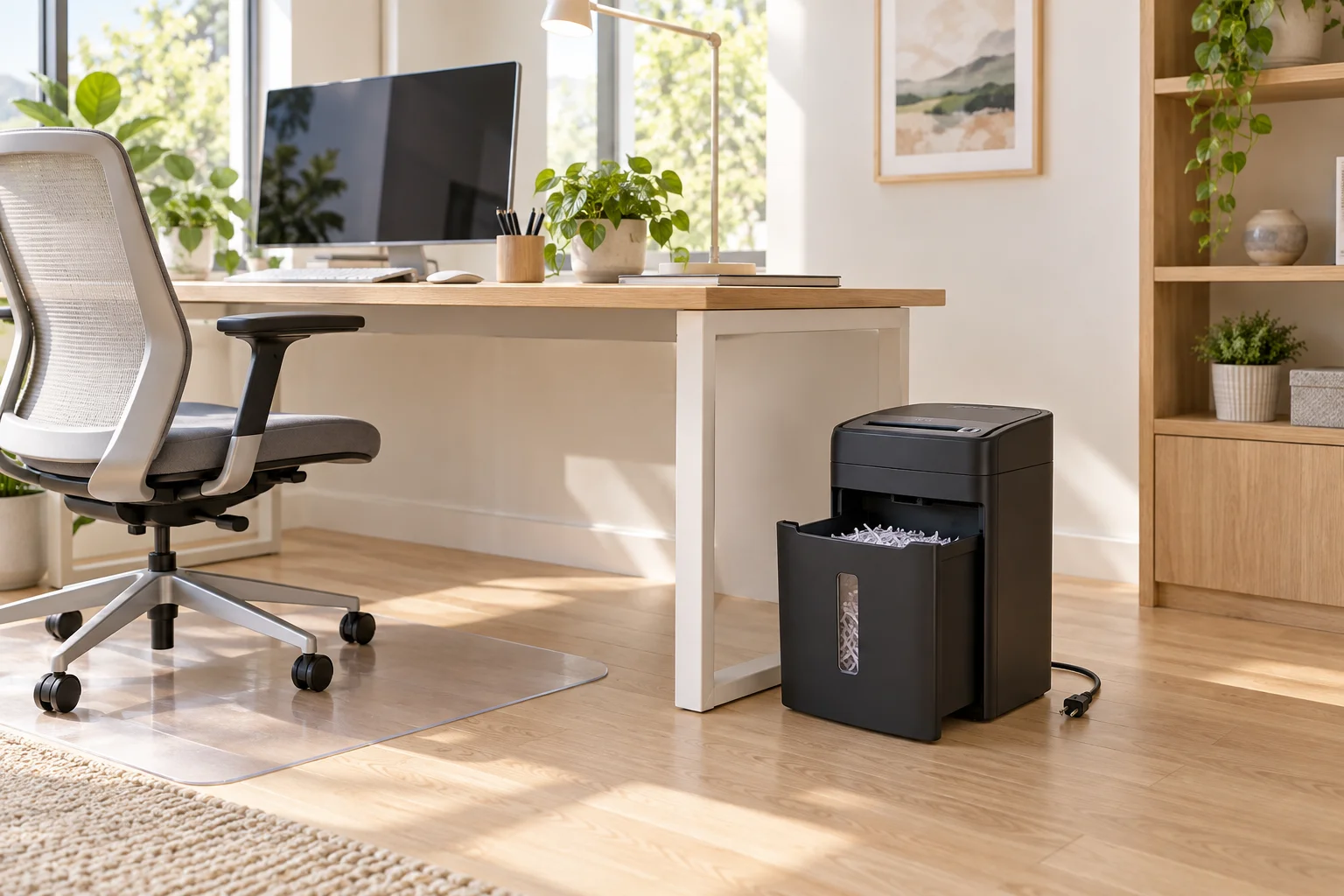
A paper shredder has a small floor footprint but several different operating states. Paper enters from above, a bin may pull out toward the user, heat leaves through ventilation openings, and someone must carry the waste away. Sliding the machine into the last gap under a desk can make all four tasks harder.
Good placement begins with the specific model and the household routine. Some people shred a few envelopes each day; others process a weekly stack of documents. The aim is to create a deliberate, manageable step between reviewing paperwork and disposing of it, while keeping the machine out of circulation and away from unintended access.
Read the Model's Operating Requirements First
Record the machine's external dimensions, feed-slot position, bin-removal direction, ventilation openings, and electrical requirements. Find its stated duty cycle and cooling interval. A compact shredder designed for brief operation should not be treated like a continuously running office appliance simply because it fits the available cabinet.
Follow the manufacturer's instructions for location, clearances, materials, maintenance, and supervision. The layout examples here do not establish a universal ventilation distance or safety clearance. Different products have different construction, and a closed cabinet may be unsuitable even if the device seems cool during a short test.
Keep the operating instructions accessible. A setup shared by several adults should make it easy to identify what can be shredded, how to stop the machine, and when it needs to cool. Do not assume every model accepts staples, plastic cards, or adhesive labels.
Draw the Complete Emptying Envelope
A shredder measuring 35 centimeters wide and 25 centimeters deep might appear to fit a narrow desk-side niche. If its bin pulls forward another 25 centimeters, the operating depth reaches 50 centimeters before including the person standing or crouching in front. That changes the arrangement substantially.
For a lift-off head, measure the vertical space needed to remove the head and set it down as instructed. A shelf directly above may prevent safe handling. For a pullout bin, confirm that the door, drawer, and waste bag can all clear nearby furniture. Never force a heavy component into an awkward one-handed maneuver merely to preserve a tidy appearance.
Use a cardboard outline for the closed footprint and another for the emptying state. Include a temporary landing location for the full bag. Emptying should not require balancing the bin on a chair or spilling paper across the route to the door.
Choose Between Three Practical Positions
Beside a Dedicated Paperwork Cabinet
A cabinet-side location can group incoming mail, documents waiting for review, and papers approved for destruction. It keeps the device away from desk legroom and makes weekly processing straightforward. The key is to maintain distinct containers so an important document cannot be dropped into a destruction pile by mistake.
Keep the active feed area clear of stacked folders and loose supplies. The cabinet top can support sorting, but the shredder itself should sit only on a stable surface permitted by its manufacturer. A mobile cart adds another movement and stability question rather than automatically solving the problem.
At the End of the Desk
This can work when shredding is frequent and the device sits outside the chair's normal movement. Measure the caster sweep, the distance used when standing up, and any visitor seating. A machine that fits beside the desk may still collide with the chair every time the user turns.
Avoid using the knee space as the default storage zone. It can compromise posture, make controls hard to see, and encourage operating the device without a clear view of the feed opening. If the desk is shared, test the arrangement with each person's chair position.
In a Separate Utility Storage Area
Occasional shredding may fit better outside the office, provided the location meets the equipment instructions and access can be controlled appropriately. This reduces desk clutter and separates noise from calls. It also requires a secure, clearly defined place for documents awaiting processing and an easy route for waste removal.
Do not relocate the machine into a damp laundry niche simply because there is an outlet. Suitability depends on the environment and the product's instructions, not just on available floor space.
Keep the Feed Area Deliberate and Visible
Operate the machine with a clear view of the entry slot and controls. Keep loose clothing, hair, cords, and jewelry away from the feed mechanism, following the manufacturer's safety instructions. A shelf edge or desk overhang should not force the user to feed paper sideways or reach blindly.
In households with children or pets, plan supervised use and restricted access according to the product instructions. Power controls alone should not be treated as a complete access-control strategy. Select an arrangement that can be secured appropriately when the device is not in use, and disconnect power before handling or maintenance when directed.
Account for Noise and Work Timing
A shredder next to a microphone can disrupt calls even if it is physically convenient. Instead of moving it into an unsuitable enclosure to suppress sound, schedule shredding outside meeting times or place it in an appropriate separate area. Check the effect on adjacent bedrooms and shared walls as well.
Try one realistic processing session. If papers accumulate faster than the device can handle within its duty cycle, reconsider the schedule or equipment choice. A larger machine still needs suitable ventilation, electrical provision, and safe access; size alone does not resolve a workflow mismatch.
Route Power Without Crossing the Chair Zone
Locate the nearest suitable outlet and map the cable from plug to appliance. Keep it out of chair casters, walking routes, door swings, and pinching points. Follow the product's requirements for direct connection or permitted accessories rather than assuming any extension arrangement is acceptable.
Do not route a cable where it must be pulled tight each time the bin opens. Leave the access needed to disconnect the equipment as instructed. If the ideal furniture position requires electrical work, have that assessed before making a permanent cabinet or buying a fitted storage unit.
Build a Small Document Processing Sequence
Use three clearly distinct destinations: items to review, documents to retain, and papers approved for destruction. Choose retention and disposal practices appropriate to the documents; shredding is irreversible, so unresolved paperwork should stay out of the destruction container.
At the chosen processing time, clear a sorting surface, check the documents, operate within the equipment limits, and empty the bin before it becomes difficult to remove. Follow local waste guidance for shredded paper and mixed materials. A convenient bag collection point reduces the temptation to leave waste in the walking route.
Verify the Layout Before Buying Storage
In the room planner, draw the desk, chair movement, equipment footprint, open bin, operator position, and route to the door. Use simple blocks for the shredder if a matching object is unavailable. Compare the desk-end location with the paperwork cabinet location rather than assuming the nearest outlet must win.
Review the office in the 3D demo, then use the interior planner to integrate the storage without enclosing equipment against its instructions. Save the plan with the model number and measured operating envelope so a later furniture change does not erase the required access.
Placement Checklist
- The specific model's operating and ventilation instructions are satisfied.
- Paper can be fed with the slot and controls clearly visible.
- The entire bin or head can be removed as instructed.
- Chair movement, door operation, and the exit route remain clear.
- Cables avoid wheels, pinching points, and walking paths.
- Unreviewed paperwork stays separate from approved destruction.
- Access, maintenance, noise, and waste handling have a practical routine.