Ironing Board Storage and Layout for Small-Space Use
Plan ironing board storage and a workable ironing area with unfolding space, safe cable routing, garment handling, cooling time, and room for everyday movement.
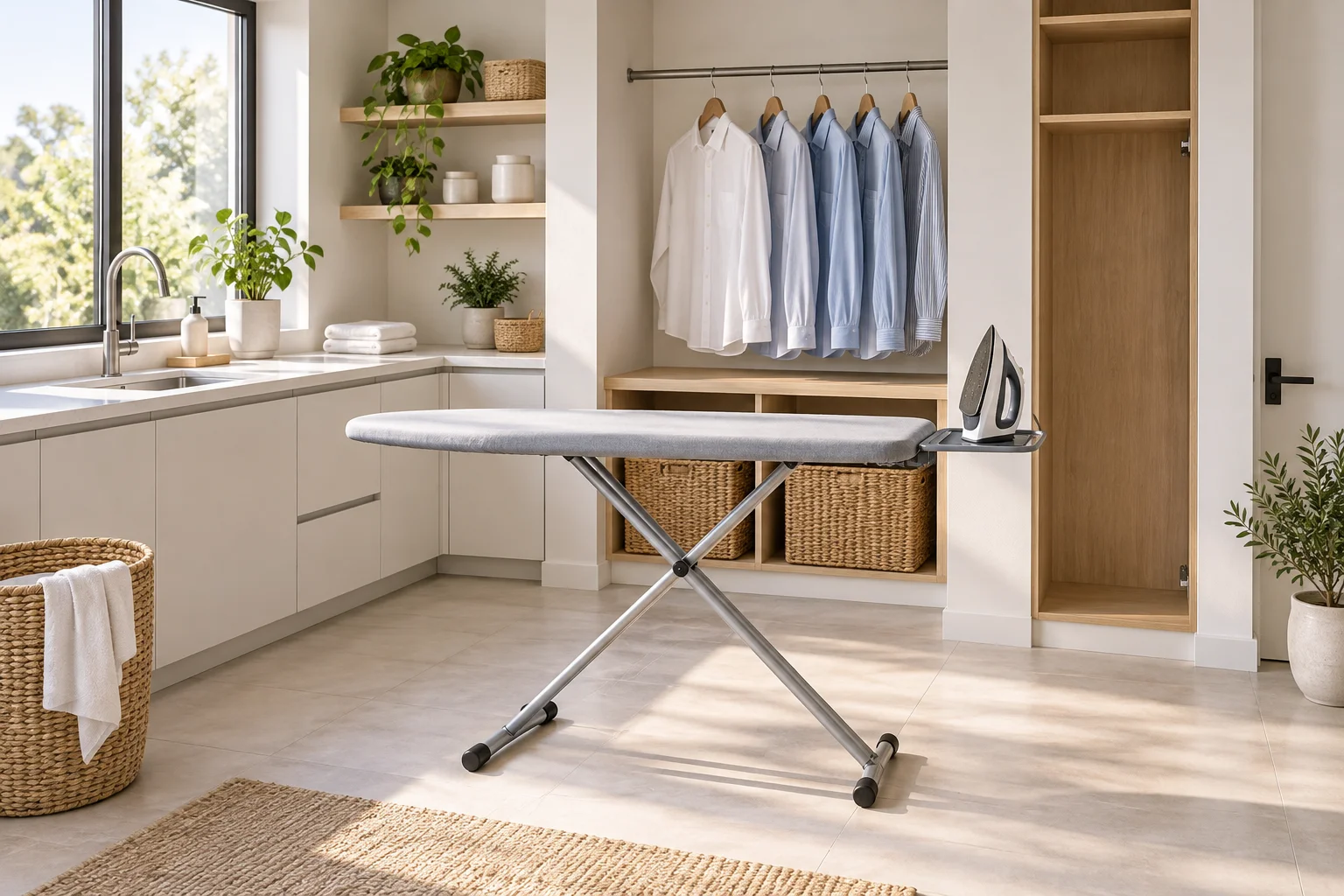
An ironing board has at least three sizes: folded, open, and in use. The folded size determines whether it fits inside a cupboard. The open size determines whether its legs can lock on the floor. The working size includes the person, hanging garments, iron rest, basket, and cable. Small-space layouts fail when they solve only the first of these.
Instead of searching for a gap to hide the board, plan the full sequence from taking it out to putting it away after the iron has cooled. This approach works for a laundry cupboard, bedroom dressing area, or living room used temporarily for household tasks. Follow the board and iron manufacturers' instructions for setup, loading, heat resistance, storage, and electrical use.
Measure the Folded and Open Equipment
Record the folded height, width, and thickness, including protruding feet and the iron rest. Then measure the opened board at the height the user actually finds comfortable. Leg footprints can change with adjustment, so the widest working setting may differ from the dimensions printed for the top.
An illustrative full-size board might have a 120 by 40 cm top, but the legs, iron rest, and hanging shirt can extend beyond it. Do not use those sample dimensions to buy a cabinet. Measure the chosen product, including handles, locking mechanisms, and any attached electrical holder. A steam generator needs its own stable, approved support area and may change the entire arrangement.
Check Retrieval, Not Just Storage Fit
A folded board standing vertically in a 150 cm high recess may fit on paper yet be impossible to tilt out beneath a shelf. Draw the movement from its stored position into the room. Include the cupboard door, nearby washing-machine door, and the person pulling the board free.
Use a suitable restraint or storage system compatible with the board and wall construction. A tall folded board should not be left balanced loosely where it can fall when another item is removed. Keep the storage location dry and follow the manufacturer's guidance about when and how the equipment can be put away.
Compare Three Storage Approaches
A Tall Utility Cupboard
A dedicated vertical bay can keep the board near laundry supplies. Separate it from loose cleaning tools that could catch the feet or release mechanism. A shallow bay is useful only if the complete folded thickness fits and the door closes without pressure. Check whether the board can be retrieved without first removing a vacuum cleaner.
A Wall-Mounted Holder
This can free cupboard space, but mounting needs to suit the wall and expected load. Confirm the holder supports the board shape and that any iron storage is permitted for the actual appliance. Do not assume every holder is designed for a hot iron. Position it where retrieval will not knock a light fitting, mirror, or adjacent shelf.
A Fold-Down or Cabinet Board
An integrated board reduces carrying but creates a fixed working position. Its hinge, support, load rating, and installation requirements must be respected. Check the fully deployed board against doors and routes before purchasing. A compact board that permanently blocks the only way out of a room is not a successful space-saving feature.
Lay Out the Working Area Around the User
Start with the person's usual hand, preferred board height, and typical garments. The iron rest should be usable without reaching across the hot soleplate or twisting around a basket. The cable should follow the intended equipment arrangement, remain clear of the hot surface, and stay out of the route through the room.
Place the unpressed clothing within a comfortable reach, with a separate location for finished items. A basket on the floor may require repeated bending; an appropriately stable raised surface can help if it does not crowd the board. For shirts and dresses, provide a nearby hanging point that does not require carrying the hot iron or stepping over a cable.
Do not arrange the task beside a door that another person may open into the board. If the household includes children or pets, choose a setup that prevents access to hot equipment and dangling cords. The working area needs protection throughout use and cooling, not merely while the user is standing there.
Test a Bedroom Example
Consider a 3.0 by 3.8 m bedroom with a 1.4 by 2.0 m bed and a 60 cm deep wardrobe. A board is stored in a wardrobe end bay and brought into the strip of floor near the foot of the bed. These are comparison dimensions, not ergonomic standards or required clearances.
First, open the wardrobe and retrieve the folded board. Next, unfold it without contacting the bed or trapping the cable under its legs. Add the person standing at the long edge, a basket of clothes, and a place for finished shirts. Finally, trace the route from the far side of the bed to the door.
If the route disappears, rotate the board or compare a different room. Do not solve the problem by leaving the legs partly folded or resting the board against furniture. A smaller approved board may be appropriate, but it still needs a stable setup and enough garment-handling space. The room planner can help compare the surrounding furniture, while a floor mock-up verifies the actual movement.
Reserve a Cooling Position
The end of ironing is not the end of the space requirement. Follow the iron's shutdown and cooling instructions and keep the appliance on the specified stable, heat-resistant support, away from contact and combustible materials. Do not return hot equipment to a cupboard simply because the board needs to be cleared for dinner.
Include cooling time in the household routine. If the same room becomes a play space immediately afterward, the layout needs a safe protected cooling arrangement before ironing begins. Do not leave hot equipment unattended. Store the cord only when permitted by the appliance guidance, and do not wrap it against a hot soleplate.
Check Light, Floor, and Nearby Storage
Place task lighting so the user's body does not cast a deep shadow over the garment. Daylight can be useful, but a window position must still respect curtains and appliance clearances. Avoid a cord route that crosses a doorway to reach the brightest spot.
Set up on a stable surface allowed by the board instructions and confirm the lock engages fully. Thick rugs or uneven flooring can undermine stability. Keep spray bottles and water containers where spills will not reach electrical connections. Coordinate laundry supplies with the interior layout guide so temporary ironing does not consume the household's only storage surface.
Full-Cycle Checklist
- Measure the folded board, open legs, iron rest, and service accessories.
- Confirm the board can be removed without moving heavy furniture.
- Check supports, mounting, locks, and load ratings for the chosen products.
- Provide space for the user, unpressed clothes, and finished garments.
- Keep doors, exit routes, cords, and hot equipment from conflicting.
- Plan safe shutdown, supervised cooling, and only then storage.
- Test the complete routine with the actual user and equipment.
Use the 3D demo to explore room proportions, then create an account if you want to develop the surrounding layout. The successful arrangement is the one that handles both a folded board on an ordinary day and a complete ironing session without improvisation.