Rice Cooker Steam Clearance: Plan a Safer Kitchen Shelf
Plan rice cooker placement with lid travel, steam release, stable shelves, reachable controls, and serving space using the exact appliance instructions.
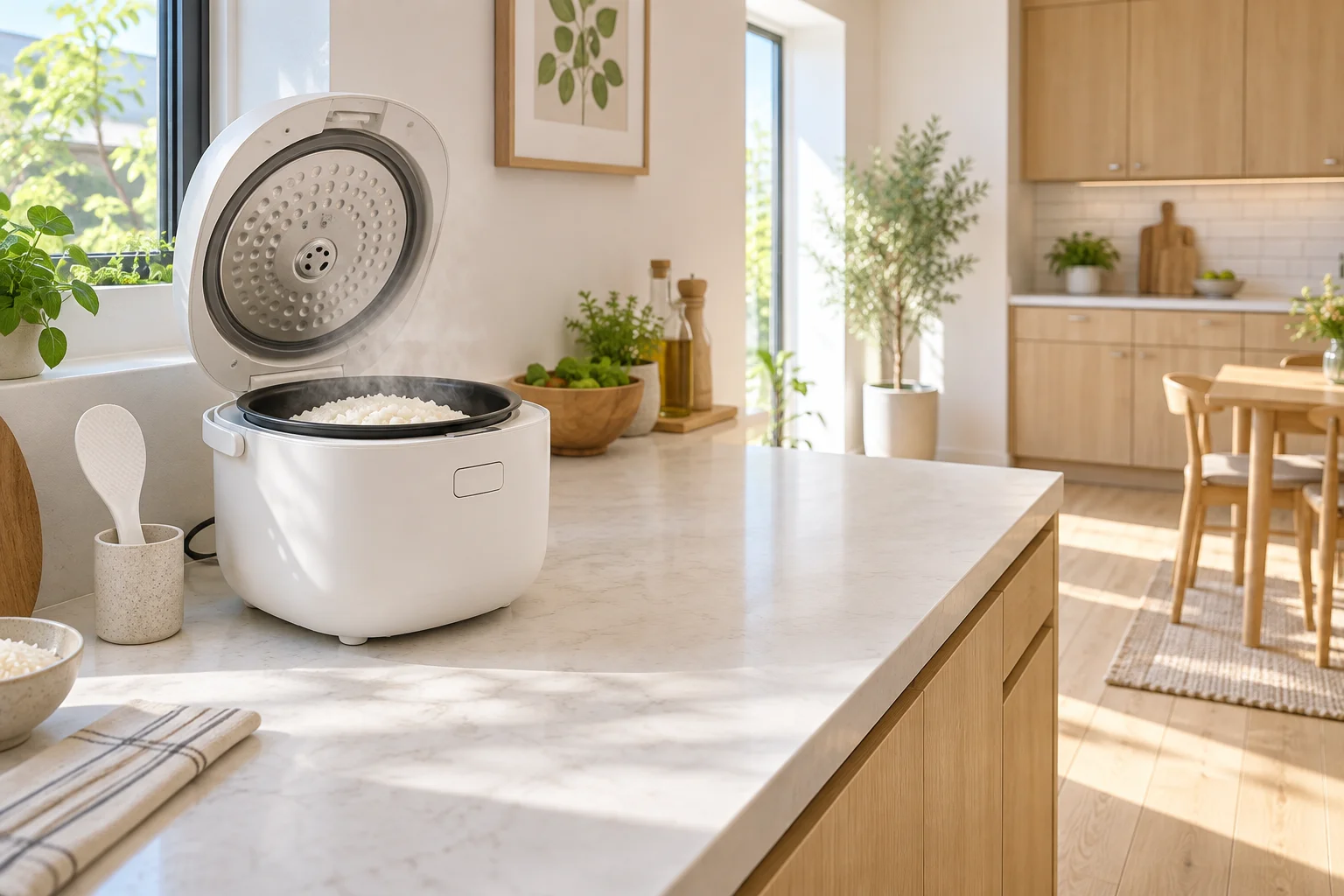
The rice cooker often receives the last available shelf in a kitchen plan. It looks compact with the lid closed, so a narrow niche seems sufficient. During use, however, the lid rises, steam exits, the inner pot travels to the sink, and someone needs room to serve hot food. A shelf that suits storage may not suit cooking. Treat the rice cooker as an active workstation, and use the appliance instructions to establish where it can operate.
Begin With the Exact Product Instructions
Different rice cookers release steam differently. Conventional, induction-heated, pressure, and steam-reducing models can have different installation restrictions. Do not copy a clearance from another brand or assume that a low-steam label allows installation inside any cabinet. Record the specified upper and side clearances, surface requirements, ventilation conditions, and restrictions on enclosed locations for your exact model.
Locate the steam outlet on a photograph or the actual appliance. It may be toward the back, near the lid center, or integrated into a removable cap. Mark that point in the plan. Include the power connector and any cable projection at the rear. If the instructions do not clearly address the proposed shelf arrangement, ask the manufacturer before committing to cabinetry rather than inventing a safe gap.
Measure the Lid in Its Fully Open Position
A closed appliance height is only a storage dimension. Measure from the supporting surface to the highest part of the fully opened lid, then include the space needed for the user to remove and replace the inner pot comfortably. The lid may sweep backward before reaching its final position, so inspect the whole movement. A rear wall or shelf lip can interfere even when the height appears adequate.
For example, a cooker 250 mm high when closed may reach roughly 450 mm with its lid open, depending on its hinge design. Those illustrative dimensions show why a 300 mm high niche could fail immediately; they are not product specifications. The steam clearance required during cooking is a separate condition and may be greater than the clearance needed merely to open the lid.
Understand Why a Pull-Out Shelf Is Not Automatic Protection
A pull-out shelf can place the steam outlet beyond an overhead cabinet, but only if the appliance and furniture instructions allow that arrangement. Check how far the outlet moves relative to every overhead surface. A partially extended shelf may leave the steam plume directly below the cabinet edge. Measure in the operating position and make that position unambiguous to everyone who uses the kitchen.
The shelf needs sufficient load capacity and stability for the appliance, water, food, and serving forces. Verify the hardware rating and the furniture manufacturer's intended use. A shelf that slides inward when someone presses a button is not a reliable workstation. Do not assume ordinary drawer slides lock or that a generic utility shelf is designed for a hot operating appliance.
Draw the Inner Pot's Journey
The inner pot usually travels from the cooker to the sink for washing or filling, then returns with water and rice. Test that route with the actual pot or an object of similar size and weight. The user should not lift it over another hot appliance or carry it across a narrow passage where someone may collide with them. A short route matters more than a perfectly aligned row of small appliances.
Reserve a stable landing area next to the cooker for the pot when appropriate under the product's handling instructions, using a suitable protective surface if needed. Place the rice scoop and bowl within easy reach. When serving, the user should be able to set down a bowl before closing the lid. Do not count the extended shelf itself as spare counter space unless it was designed and rated for that use.
Choose a Height for Actual Users
Worktop height is a reasonable starting point for comparing positions, but the correct operating height depends on the user, the appliance, and the action. Test whether a shorter adult can see the contents without lifting their shoulder, and whether a taller user can serve without sustained bending. High shelves may make the cooker look tidy while forcing a dangerous reach above hot steam.
Check the control panel, lid-release button, and unplugging access from the normal standing position. A front-facing panel can remain visible under a cabinet, but its visibility does not prove the steam path is acceptable. Keep the cooker out of children's immediate reach according to its instructions, while avoiding a height that makes adult handling unstable. Resolve these requirements together rather than solving one by creating another.
Protect Surfaces Without Concealing the Problem
Condensation can affect cabinet undersides, exposed edges, shelf hardware, and nearby stored ingredients. Look for surfaces above and beside the vent, including a projecting light fitting. A moisture-resistant finish may tolerate ordinary kitchen humidity but is not evidence that repeated direct steam exposure is acceptable. Cabinet and appliance instructions should both support the arrangement.
Avoid improvised steam deflectors, towels over vents, or covers placed on the appliance. These can interfere with operation and may direct hot moisture toward the user. An aftermarket accessory should only be considered when the manufacturer confirms compatibility and intended use. If the location depends on redirecting steam around unsuitable cabinetry, choose a better location or a product designed for the actual conditions.
Keep Cables and Neighboring Appliances in the Plan
Provide the electrical arrangement specified by the product and local requirements. A pull-out shelf changes cable position, so verify that movement cannot pinch, stretch, or trap the lead. Keep cords away from wet sink edges and hot cooking surfaces. Do not place a socket directly where escaping steam will repeatedly condense, and do not treat a loose extension cable as a permanent kitchen design solution.
If the cooker shares an appliance bank with a kettle, toaster, or microwave, model each operating envelope separately. Two appliances that fit side by side can still compete for lid space, landing space, or the user's hands. Decide which can realistically operate together and check electrical capacity with appropriate professional advice where needed. Do not infer capacity from the number of available outlets.
Build a Cooking and Serving Mockup
Tape the proposed supporting surface onto a counter and represent the overhead cabinet with cardboard at the measured height. Keep the mockup away from actual heat and use it only for cold movement tests. Open the real lid, lift an empty pot, reach the controls, and place two bowls beside the cooker. Then review the steam and electrical conditions separately against the instructions; a cold mockup cannot validate thermal performance.
In the room planner, create separate stored and operating views if using a permitted pull-out arrangement. Mark the vent position, lid arc, pot route, and serving zone. Use the interactive demo to inspect those relationships at eye level. Save the manufacturer requirements with the plan so they are not lost when cabinetry is ordered.
Final Placement Checklist
Confirm the exact cooker model, its allowed installation arrangement, clearances, stable support, cable movement, pot handling route, and serving area. Test every regular user rather than only the tallest person in the household. The right rice cooker location makes rinsing, cooking, and serving a short sequence of comfortable actions while keeping steam away from unsuitable surfaces. A neat storage niche is useful only when it also supports the real operating conditions.