Small Room Piano Layout: Space, Sound, and Comfort
Place an upright or digital piano in a small room using measured bench clearance, stable climate, neighbor-aware acoustics, lighting, power, and practice flow.
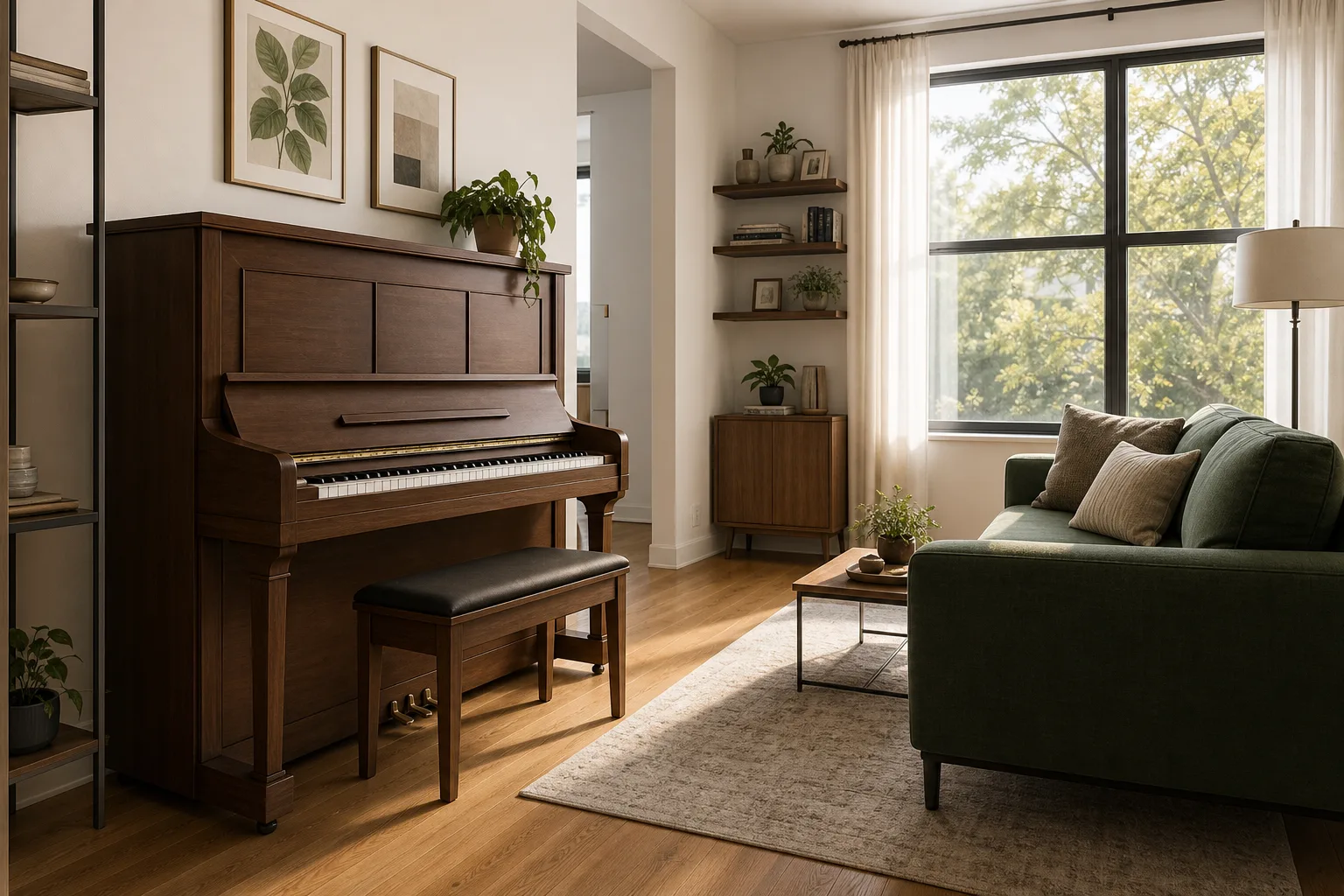
A piano occupies more than its case. The bench pulls out, elbows widen, sheet music needs light, a digital instrument needs cables and speakers, and an acoustic piano responds to temperature, humidity, sunlight, and wall construction. In a small room, the best position balances playing posture, circulation, instrument care, and sound transmitted to the household and neighbors.
Identify the Instrument Precisely
Record whether the instrument is an acoustic upright, baby grand, slab digital, console digital, or hybrid. Measure body width, depth, height, lid movement, pedals, power supply, headphone jack, speaker direction, music rest, bench, and technician access. Use manufacturer handling and environmental guidance.
An upright may be about 145–155 cm wide, but model depth and height vary. A digital keyboard can be shallower yet become equally deep after a stand, pedal unit, bench, and cable bend. A grand needs its full lid, keyboard, bench, and service envelope, not only the outline of the case.
Draw the Playing Envelope
Place the bench at the user’s comfortable distance, then add chair movement, knees, pedals, elbows, page turning, and someone walking behind. Roughly 75–90 cm behind a seated player can be a useful starting test when no one passes; regular passage requires more. Do not trap the player between an open door and the instrument.
Keep a clear route to the room exit. If the piano is in a living room, test people reaching the sofa, balcony, and kitchen while someone practices. A bench should have a defined parked position that does not become a trip hazard.
Prefer a Stable Interior Location
Acoustic pianos generally benefit from stable temperature and humidity and protection from direct sun, moisture, strong drafts, and heat sources, according to their maker or technician. Avoid pushing an instrument against a radiator, heating vent, frequently opened exterior door, damp wall, or sun-heated window.
An interior wall can be a practical candidate, but wall construction and neighboring rooms matter. Leave the manufacturer- or technician-recommended rear gap and access. Never block ventilation grilles on a digital or hybrid instrument.
Consider Who Is Behind the Wall and Floor
An acoustic piano transfers sound through air and structure. A shared wall beside a neighbor’s bedroom may be worse than a slightly less symmetrical wall beside a corridor. In an apartment, ask building management about rules, quiet hours, and structural or floor-protection requirements.
A dense, stable floor protector can prevent caster damage, but a soft pad that makes the instrument unstable is unsafe. Specialized isolation products should match the instrument and floor. Rugs, curtains, books, and upholstered furniture reduce harsh room reflections but do not make a room soundproof.
Control Reflections Without Killing the Room
Small hard rooms can sound painfully bright. Start with distribution: a rug, fabric window treatment, filled bookcase, upholstered seat, and irregular surfaces. Avoid covering every wall with thin decorative foam; it mainly affects high frequencies and may leave bass and structure-borne sound unchanged.
For serious isolation or acoustic treatment, consult a qualified acoustician. Soundproofing depends on mass, airtightness, decoupling, flanking paths, doors, and ventilation, not a few surface panels. The open-plan acoustic guide explains the distinction between absorption and isolation.
Set Bench and Keyboard Ergonomics
Adjust the bench so forearms are approximately level with the keys, shoulders remain relaxed, feet reach pedals securely, and the player can move without leaning toward the music. Children need a suitable foot support rather than dangling legs. The teacher or clinician should guide individual posture needs.
Choose a bench that remains stable and supports the session length. Storage benches are convenient but can encourage a height or depth compromise. Draw the lid open if music is stored inside.
Provide Useful Light and Power
Light the score and keys without shining into the player’s eyes or reflecting in glossy surfaces. A movable piano lamp can help, but its base and cable must not interfere with the music rest, lid, or page turns. Place general light so the player does not sit in a deep silhouette against a bright window.
Digital pianos need a correctly rated outlet, surge or power protection as the manufacturer recommends, cable strain relief, and ventilation. Keep adapters off walking paths and away from drinks. Headphone hooks and charging should be reachable without bending behind the instrument.
Store Music and Accessories Nearby
Put current scores within seated or one-step reach and archive music separately. A shallow vertical file often works better than deep horizontal piles. Store metronome, pencils, headphones, pedal accessories, and cleaning cloths near the instrument.
Do not stack plants, drinks, candles, frames, or heavy objects on an acoustic piano. They can spill, rattle, scratch, or obstruct service. Keep the top and back accessible for tuning and maintenance.
Compare Three Positions in 3D
Build the room in Aedifex with instrument, bench in use and parked, player elbows, open doors, windows, radiators, vents, neighboring-wall notes, score storage, lamps, and cables. Use the room planner to compare an interior wall, short return wall, and a position integrated with living-room seating.
Walk every route while the player is seated. Then test page turning, teacher seating, duet or parent supervision, cleaning, tuning access, headphones, and quiet-hour practice.
Small-Room Piano Checklist
- Measure the exact instrument, lid, pedals, music rest, cables, bench, and service access.
- Draw the full seated player and the route behind the bench.
- Choose a stable location away from direct sun, moisture, drafts, and heat.
- Review shared walls, floors, quiet hours, and building rules.
- Use furnishings to manage reflections without claiming sound isolation.
- Set bench height and foot support for the real player.
- Light the score and keys without glare or cable hazards.
- Provide safe, rated power and ventilation for digital instruments.
- Keep current music and accessories near the playing position.
- Test practice, teaching, cleaning, maintenance, and household circulation.
A good piano position makes starting practice easy while respecting the instrument and everyone around it. Once the envelope is proven, use the interior planner to balance storage and seating, then register to save the room.