Studio Apartment Layout Ideas — 5 Plans for 25-45 m² Spaces
Compare five studio apartment layouts for 25-45 m² spaces, including L-zone, Murphy bed office, loft bed, long studio, and minimalist open plans.
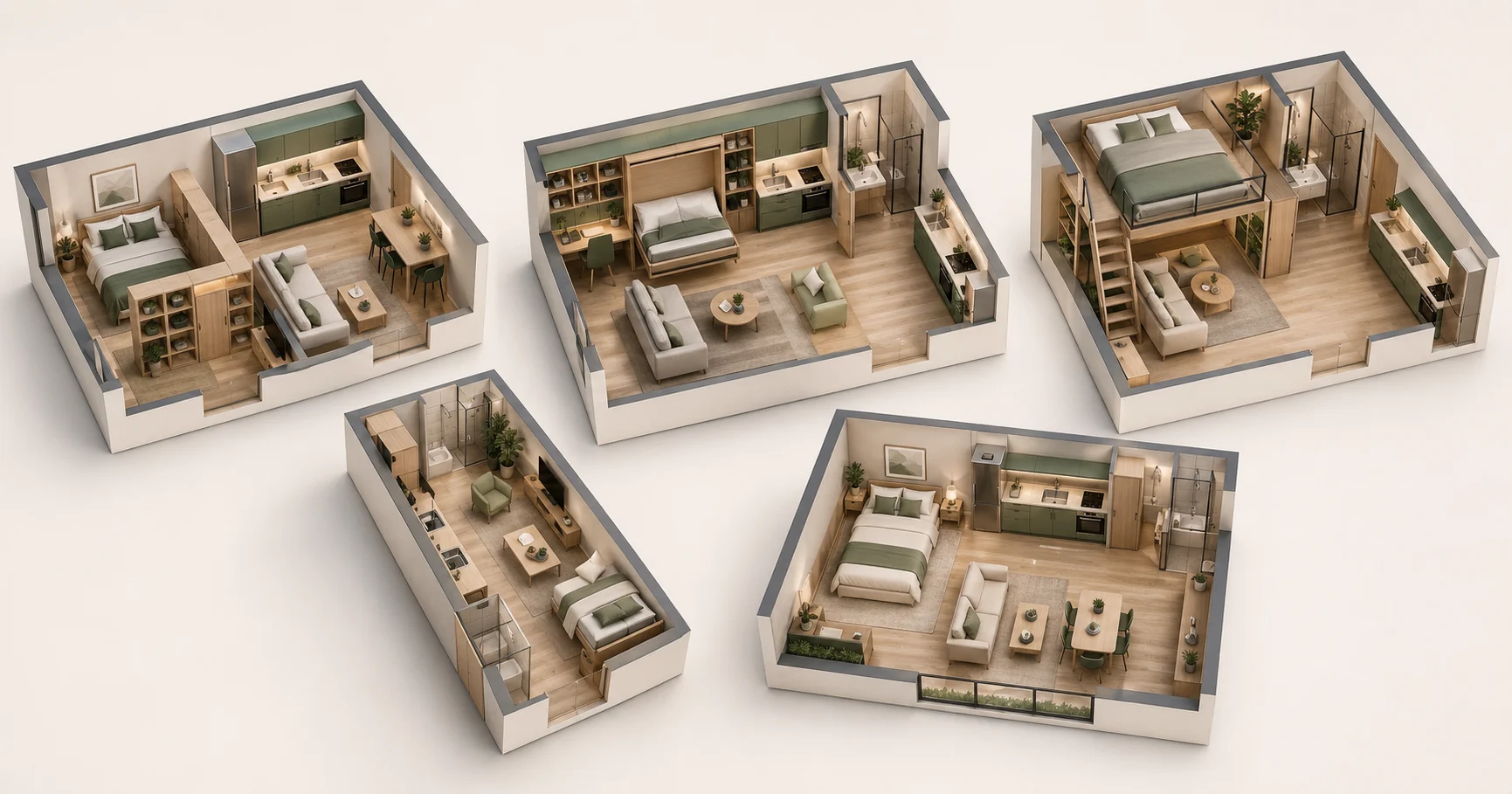
A studio apartment is one room carrying four routines: sleep, work, eat, and relax. The layout succeeds when those routines can overlap without colliding. The five plans below are organized by constraint, because a 25 m² studio with one window needs a different answer than a 45 m² long room.
Layout 1: The L-Zone (25-30 m², classic studio)
The constraint: One window, one entry door, kitchen along one wall.
The bed goes against the wall opposite the kitchen, perpendicular to the window. A bookshelf or low cabinet runs from the foot of the bed toward the entry, defining the "bedroom" zone visually. The other half of the L is the living/dining: small sofa parallel to the bookshelf, dining table doubles as desk.
What it solves: Zone separation without walls. The bookshelf is the divider and the storage.
Where it fails: If the bed needs to be queen-size, the divider has to shrink and the sleeping zone becomes more visible.
Layout 2: Murphy + Office (28-35 m², work-from-home priority)
The constraint: You work from home daily. The "bedroom" needs to disappear.
A wall-mounted Murphy bed folds away during the day. The bed wall is your desk wall when the bed is up — desk extends across the room. Living seating is a small two-seater sofa. No formal dining; you eat at the desk or at a wall-mounted drop-leaf table.
What it solves: Office floor space during the day. The room transforms morning and night.
Where it fails: Murphy beds are not cheap and usually require wall anchoring. Renters need landlord approval before assuming this works.
Layout 3: Loft Bed (high-ceiling studios, 30-40 m²)
The constraint: Ceiling is at least 2.7 m. You want maximum floor.
A loft bed up high (frame from the ground floor up to ~2 m). Underneath: a desk or a closet or a reading nook, your choice. The rest of the studio is normal-height living.
What it solves: Effectively gives you back ~3 m² of floor space for living.
Where it fails: Loft beds demand daily tolerance for ladders, heat near the ceiling, and lower headroom.
Layout 4: The Long Studio (linear, 30-45 m²)
The constraint: The room is 3-4 m wide and 8-10 m long. Long, narrow.
Bed at one short end, kitchen at the other short end. Living zone in the middle. Use a freestanding shelving unit perpendicular to the long walls to divide bed from living. The shelving is open both sides — looks like a partition, doesn't block light.
What it solves: Long rooms are awkward. The middle-zone partition makes them feel like two squarish spaces instead of one tube.
Where it fails: Lighting is a challenge — the middle of a long room often has the worst natural light.
Layout 5: Minimalist Open (35-45 m², adults who entertain)
The constraint: You host friends and want the studio to look like one beautiful space, not a "studio."
Bed against the most-windowed wall, framed with simple curtains that close at night. Daytime: bed is made, room reads as a lounge with a daybed. A real dining area gets a real table. Kitchen is tucked behind a half-wall or a galley.
What it solves: Looks like an apartment, not a dorm.
Where it fails: Requires daily bed-making. If the pile of laundry exists, the layout fails.
How to Try These
Open the demo, draw a rectangle for your studio's actual dimensions, and try Layout 1 first. Move things around, walk through with the camera. Use the AI assistant to ask: "Given a 30 sqm studio with one window on the south wall, suggest a layout for someone who works from home."
Want to read a deeper walkthrough of one specific studio? See Designing a 30 sqm Small Apartment.
The Truth About Studios
Studios are unforgiving because there is nowhere for a bad decision to hide. But a well-zoned studio in a great location can beat a larger apartment with wasted rooms. The layout is the whole game. Spend an evening in Aedifex testing options before you sign a lease or buy furniture.
How to Choose Between the Five Plans
Start with the routine that matters most. If work from home dominates the week, choose a layout that gives the desk daylight, storage, and a camera background. If sleep quality matters most, protect the bed from entry views, kitchen noise, and bright windows. If hosting matters, give the living and dining zone the best light.
Then check the fixed constraints: plumbing wall, entry door, window wall, radiator, closet, and outlets. A studio layout that ignores these will look clever on paper and fail in real life. The best plan is usually the one that works with the fixed wall, not the one that fights it.
Finally, decide how much bed visibility you can tolerate. Some people want the bed hidden. Others are comfortable treating it like a daybed. That preference changes the whole plan.
Storage Is the Real Divider
Studios rarely have enough separate rooms, so storage has to create boundaries. A wardrobe can shield the bed. A sideboard can define dining. A bookcase can separate work from living. A storage bench can mark the entry.
Use closed storage for visually messy categories: cleaning supplies, pantry overflow, clothes, cables, and paperwork. Use open storage for objects that still look good when seen from the sofa. If every shelf is open, the studio will feel busy even when it is technically organized.
Vertical storage helps, but do not block the only daylight source. A tall cabinet near the window can make the entire apartment feel smaller.
Studio Mistakes to Avoid
The first mistake is buying a normal living-room set. A full sofa, coffee table, TV console, dining table, desk, and bed may all fit individually, but together they leave no room to live.
The second is using too many dividers. Curtains, screens, shelving, and rugs can define zones, but too many boundaries chop a small apartment into awkward fragments.
The third is ignoring sound and smell. In a studio, cooking, laundry, work calls, and sleep share the same air. Good ventilation, soft materials, and clean storage matter more than in a larger apartment.