Bedroom Layout with a Queen Bed: Clearances, Closets, Windows
Plan a bedroom around a queen bed with walking clearances, nightstands, wardrobes, windows, desks, rugs, and lighting before buying furniture.
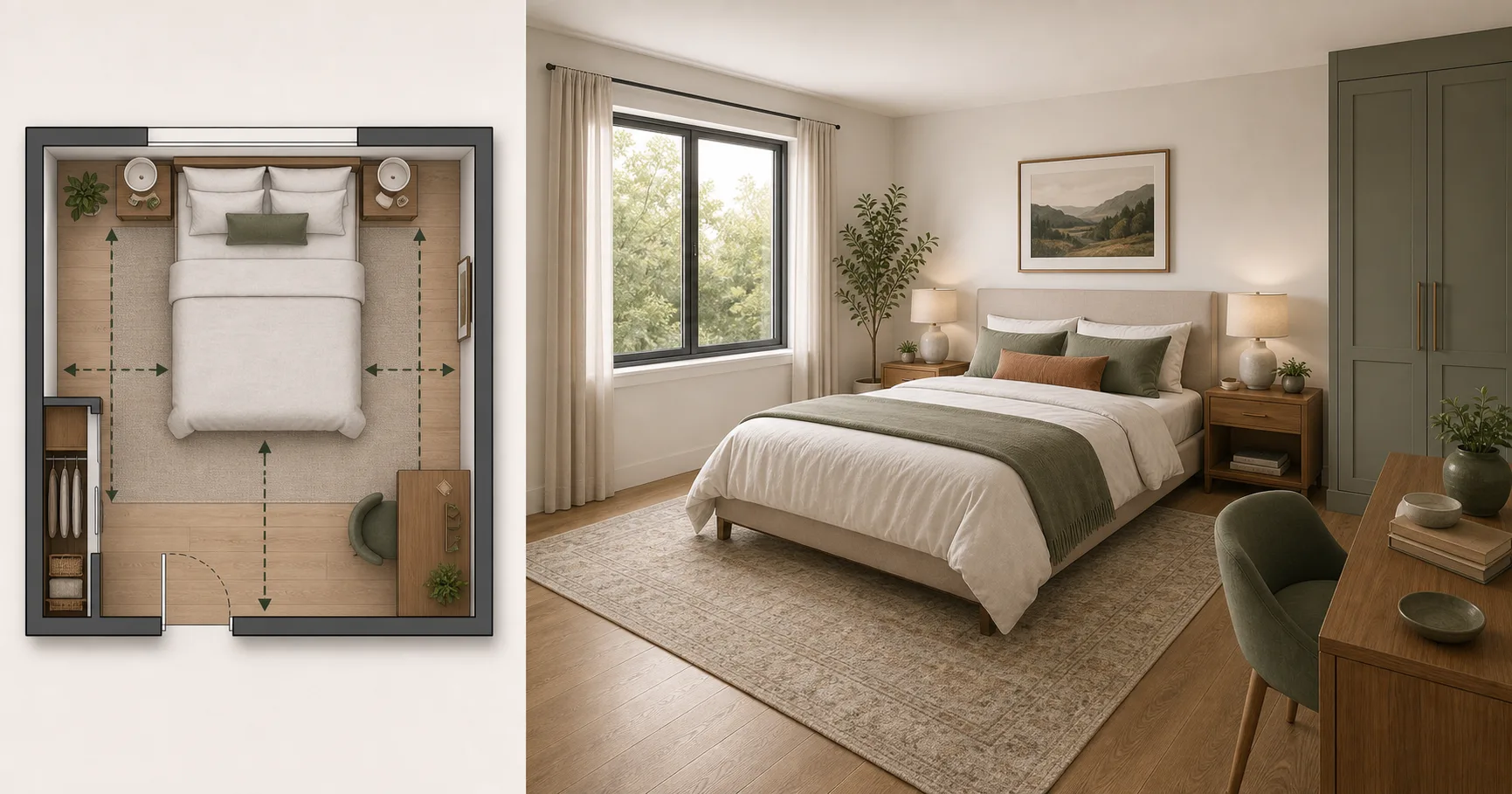
A queen bed can make a bedroom feel calm or completely blocked. The difference is not the bed size alone. It is the clearance around the bed, the wardrobe doors, the window position, and whether the room still has one simple path after the furniture arrives.
Use this guide before ordering a frame, dresser, or desk. Rebuild the room in Aedifex, place true-size furniture, and check the walkable space from eye level.
Start with the Bed
The bed is the anchor. In most bedrooms, place it before everything else. A queen mattress is about 1.5m by 2m, but the frame may add width and length. Upholstered frames, storage beds, and platform bases can be larger than expected.
Good bed positions usually have three traits:
- The headboard sits on a solid wall.
- Both sides have usable access if two people sleep there.
- The bed does not block a wardrobe, radiator, balcony door, or main window.
If the room is very small, one side of the bed may sit closer to a wall. That can work for one person, but it is inconvenient for two.
Clearances That Matter
For comfortable movement, leave about 600mm to 750mm beside the bed where possible. At the foot of the bed, leave enough room to walk, open drawers, or reach a wardrobe.
Check these conflicts:
- Bed frame versus closet doors
- Nightstand versus window curtain
- Dresser drawers versus bed corner
- Desk chair versus walking path
- Rug edge versus door swing
Clearance is not just empty space. It is the space needed when furniture is being used.
Nightstands and Lighting
Two matching nightstands are not always required. In a narrow bedroom, one full nightstand plus a wall shelf on the tight side may be better. Wall-mounted sconces or pendant lights free up surface space and make the room feel more intentional.
Keep switches reachable from the bed. If that is not possible, use smart bulbs or plug-in dimmers. Good bedroom lighting should support reading, dressing, and winding down, not only ceiling brightness.
Wardrobes and Dressers
Wardrobe access often decides whether a bedroom works. Hinged wardrobe doors need room to swing. Drawers need pull-out space. Sliding doors save clearance but show only one side of the wardrobe at a time.
If the room is tight:
- Use a taller wardrobe instead of a wider one.
- Replace a deep dresser with shallow drawers.
- Put seasonal storage under the bed.
- Avoid placing a desk where wardrobe doors open.
The same storage logic appears in our 30 sqm apartment design guide.
Windows and Bed Placement
Putting a bed under a window can work, but it depends on the sill height, curtain type, draft, and radiator location. A headboard can block airflow or make curtains hard to use. If the window is the room's main daylight source, placing the bed perpendicular to it usually keeps the room brighter.
Avoid placing a tall wardrobe beside the only window unless you want the room to feel narrower.
Add a Desk Only If It Has a Real Zone
Many bedrooms now double as workspaces. A desk can fit, but it needs chair movement, cable access, task lighting, and a video-call background. If the desk chair hits the bed every time it moves, the room will feel unfinished.
For a dedicated workspace, compare this with the Home Office Layout Guide.
Quick 3D Check
In Aedifex, draw the room and place the bed first. Then add nightstands, wardrobe, dresser, desk, rug, and door swings. Test:
- Can you enter without walking into the bed corner?
- Can both sides of the bed be used?
- Can every drawer and wardrobe door open?
- Can curtains move freely?
- Is there one calm wall for art, mirror, or lighting?
If the answers are yes, the room is ready for style decisions. If not, solve the plan before choosing bedding or paint. For a guided tool, start with Bedroom Design.
Room Sizes That Usually Work
A queen bed can fit in a surprisingly small room, but "fit" and "work" are different. In a room around 3m by 3m, the bed will dominate. Use a slim frame, wall lights, and shallow storage. A dresser may need to move into the closet or hallway.
Around 3.3m by 3.6m, the room becomes more forgiving. You can usually keep two nightstands, a narrow dresser, and a rug that extends beyond the bed. The main risk is the wardrobe wall, especially if hinged doors open toward the bed.
At 3.6m by 4m or larger, the question changes from clearance to zoning. You may be able to add a reading chair, desk, bench, or larger wardrobe, but each new zone needs its own space to be used. A chair squeezed into a corner becomes laundry storage. A desk without task light becomes a shelf.
Rug, Art, and Bench Placement
Rugs are often too small in queen bedrooms. A useful rug should extend beyond the sides and foot of the bed enough that bare feet land on it. If a large rug is too expensive, use two runners beside the bed rather than one small rug floating under the lower third.
Art should relate to the headboard width. One large piece, a pair of prints, or a calm textile works better than many small frames scattered across the wall. Leave breathing room above the headboard so the bed does not feel boxed in.
A bench at the foot of the bed is useful only when the room has depth. If the bench blocks the path to the wardrobe or makes the bed feel longer than the room, skip it. Use wall hooks, a slim valet stand, or a storage ottoman elsewhere.
Mistakes to Avoid
Do not buy the bed frame before measuring the full outside dimensions. Storage beds, rounded frames, and upholstered rails can add enough bulk to ruin a tight clearance plan.
Do not place the bed only for symmetry. A centered bed looks good in photos, but if it blocks the best wardrobe access or leaves no path to the window, the room will be frustrating every day.
Do not treat lighting as decoration. A bedroom needs at least three levels: soft ambient light, focused reading light, and practical dressing light. When all light comes from one ceiling fixture, the room feels flat and the bed becomes the only usable zone.