Closet Office Layout Guide: Desk Nook, Lighting, Storage
Turn a closet into a practical office nook with the right desk depth, chair clearance, lighting, outlets, ventilation, and closed storage.
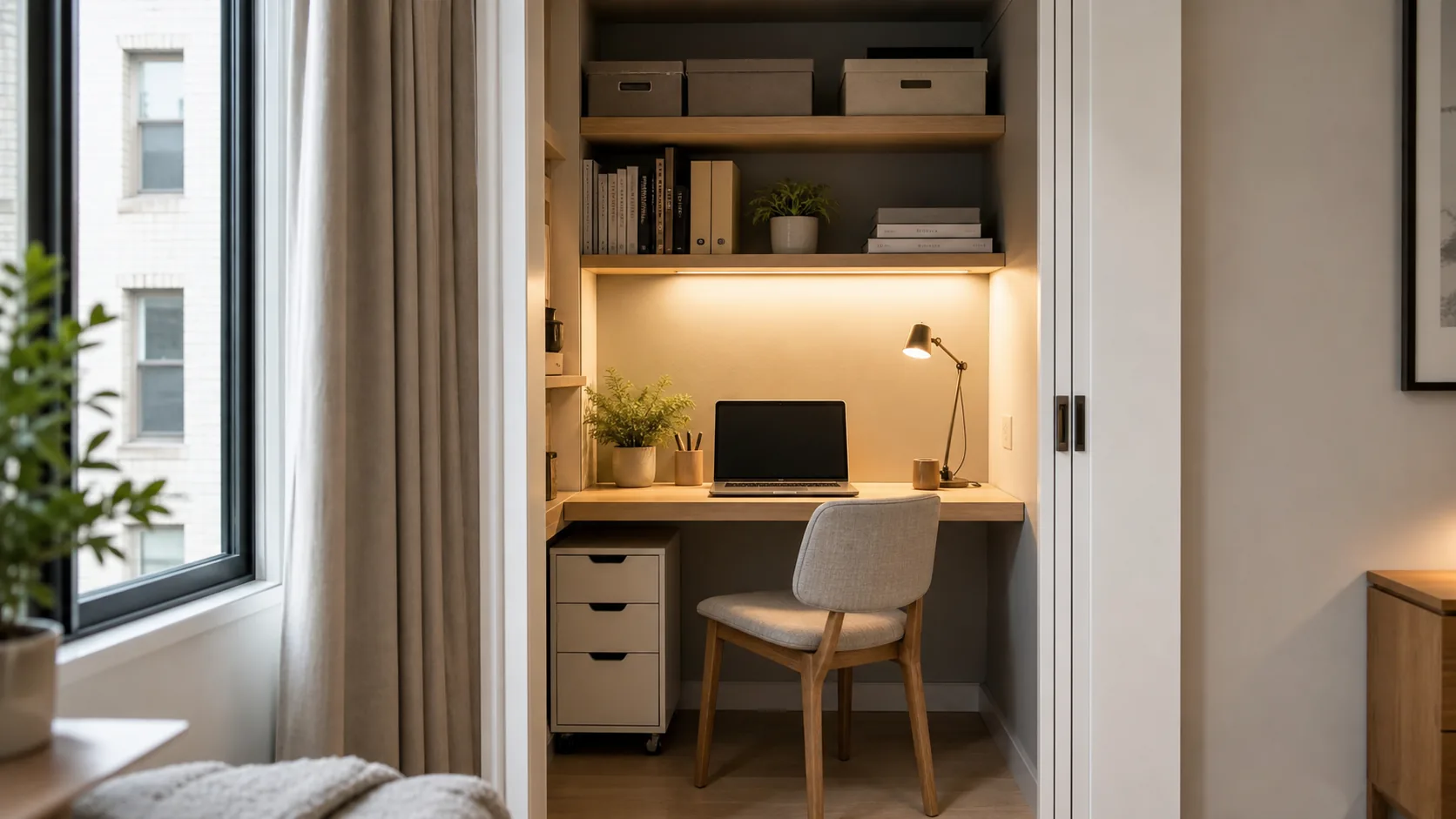
A closet office, often called a cloffice, can be an efficient way to add a workspace without giving up a full room. But a closet is not automatically a good office. It needs desk depth, lighting, outlets, ventilation, storage, and enough chair space to work without feeling wedged into furniture.
Plan the closet as a tiny room. Draw the wall opening, desk, chair, shelves, and door swing in Aedifex before cutting shelves or ordering a built-in.
Check the Closet Depth
Depth is the first constraint. A laptop-only desk can be shallower than a monitor setup, but you still need room for forearms, cables, and a comfortable viewing distance.
If the closet is too shallow, consider:
- A wall-mounted drop desk
- A pull-out keyboard tray
- A monitor arm
- A laptop stand with external keyboard
- A nearby cabinet for printer or files
Do not make the desktop so shallow that every work session becomes uncomfortable.
Chair Clearance Is the Real Test
The desk may fit inside the closet, but the chair usually sits outside the opening. Check whether the chair blocks a hallway, bedroom path, wardrobe door, or bed.
If space is tight, choose a slim task chair, stool, or chair that can tuck under the desktop. Avoid oversized office chairs unless the surrounding room has enough clearance.
Lighting Cannot Be an Afterthought
Closets are often dark. A ceiling light behind you will cast a shadow on the work surface. Add focused task lighting under a shelf or on the wall, and avoid glare if you use a monitor.
Warm ambient light can make the nook feel integrated with the room. Bright task light helps during work. Both matter.
Plan Outlets and Cable Routing
A closet office needs power for laptop, monitor, lamp, phone, and possibly a router or printer. If outlets are not inside the closet, plan a safe cable route that does not cross a walking path.
Use cable trays, wall raceways, or grommets to keep the work surface clear. A closet office becomes stressful fast when every shelf has visible cords.
Use Vertical Storage Carefully
Shelves above the desk are useful, but they can crowd your head and make the nook feel heavy. Keep the lowest shelf high enough to sit comfortably. Store daily items at arm's reach and rarely used items higher.
Closed boxes help visual calm, especially if the closet is visible from a bedroom or living room.
Doors, Curtains, or Open Nook?
Closet doors can hide the office at the end of the day, but they may interfere with the chair. Sliding doors save swing space, while curtains are softer and easier to move. Removing doors can make the nook feel larger, but it also means the desk must stay visually tidy.
Choose based on your work habits. If you need psychological separation, keep a way to close the office.
Ventilation and Comfort
A small closet can become warm if it contains a monitor, laptop, and lamp. Do not block airflow completely. If the nook has doors, leave gaps, use breathable curtains, or open the closet between work sessions.
Comfort also includes sound. A closet office in a bedroom may need a rug, curtains, or soft materials nearby to reduce echo during calls.
Test a Workday
In Aedifex, model the closet office and walk through:
- Sitting down and standing up.
- Opening laptop and monitor.
- Reaching shelves.
- Joining a video call.
- Closing the office at night.
If the chair blocks the whole room or the desk cannot close cleanly, revise before building.
Common Mistakes
The first mistake is treating any closet as suitable. Some closets are better kept for storage.
The second is forgetting light and power until after the desk is installed.
The third is overfilling shelves. A closet office should feel like a compact workspace, not a desk hidden inside clutter.