Dining Room Table Size Guide: Seats, Clearance, Rugs, Lighting
Choose the right dining table size with chair clearance, rug dimensions, sideboard space, pendant placement, and a 3D layout test.
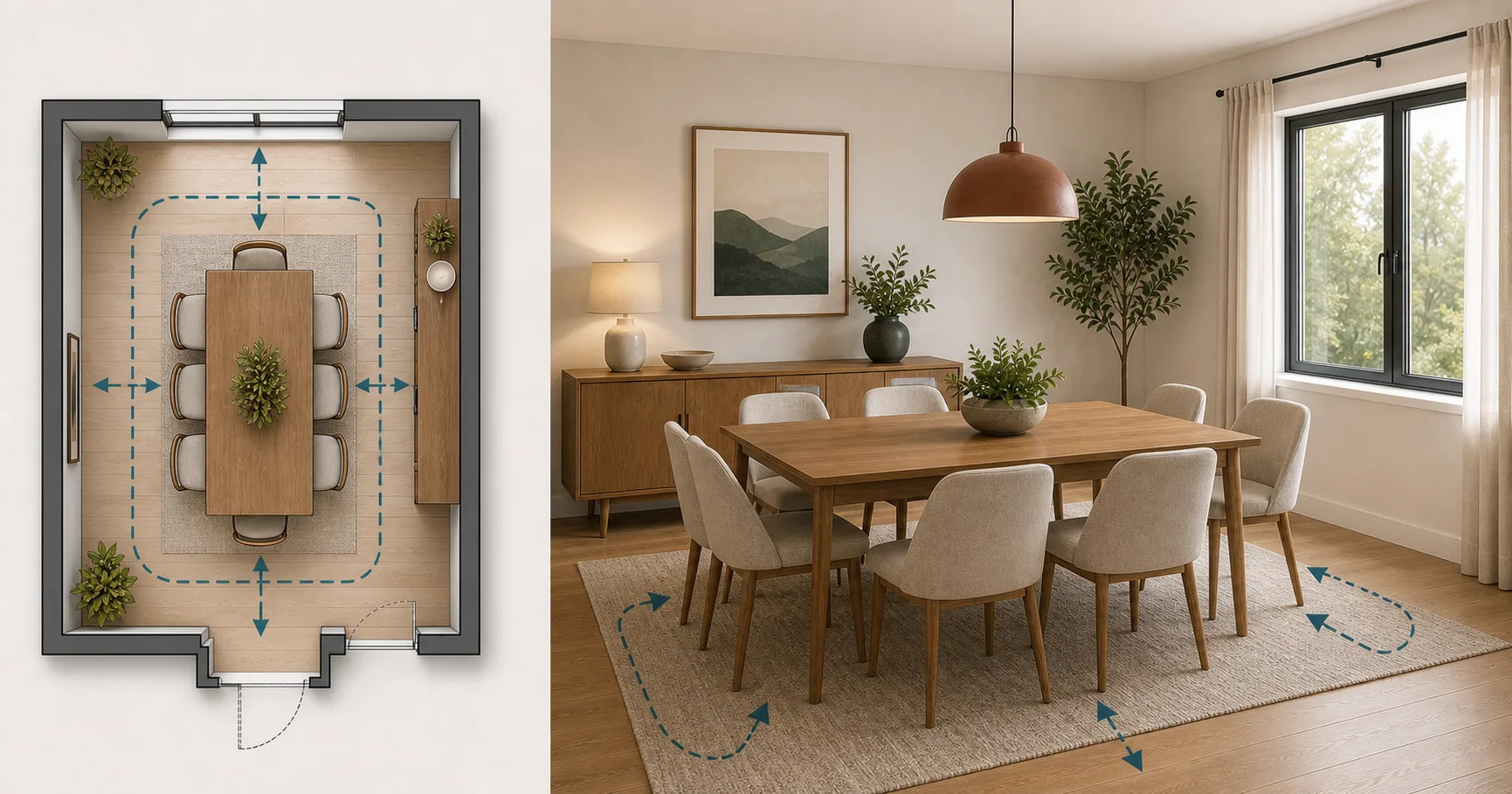
Dining rooms fail when the table is chosen in isolation. A six-person table may fit the floor plan, but it is not useful if chairs cannot pull out, the sideboard blocks serving, or guests have to squeeze behind one another to reach the kitchen.
Use this guide before buying a table. Rebuild the room in Aedifex, place the table and chairs at real size, then test the room with the chairs pulled out.
Start with the Room, Not the Table
Measure the usable dining zone first. In open-plan homes, this may be part of a larger living room. In a closed dining room, subtract door swings, radiators, windows, and sideboard depth before choosing the table.
The table should sit in the center of the usable zone, not necessarily the geometric center of the room. A pendant light can move visually, but circulation cannot.
Chair Clearance
A dining chair needs more space when someone is sitting down, standing up, or passing behind it. As a practical starting point:
- Leave about 900mm around the table where people need to pull out chairs.
- Leave 1,100-1,200mm where people need to walk behind seated guests.
- Avoid placing a sideboard where chairs already need clearance.
- Check balcony doors, kitchen entries, and hallway paths.
The common mistake is measuring only the tabletop. Measure the active dining setup.
Table Shape
Rectangular tables work well in long rooms and open-plan dining zones. Round tables are better for conversation and tight corners, but they become inefficient at larger sizes. Oval tables soften circulation in narrow rooms while still seating more people than many round tables.
Choose shape by movement:
- Narrow room: rectangular or oval
- Square room: round or square
- Open-plan room: rectangular table aligned with kitchen or sofa zone
- Small apartment: round table or extendable table
Rug Size
A dining rug should remain under chairs when they pull back. If chair legs catch the rug edge, the rug is too small. When in doubt, choose a larger simple rug or skip the rug entirely.
In small dining areas, flooring continuity may feel cleaner than a rug. For broader material planning, see Wood Flooring Types Compared.
Lighting
Pendant lights should relate to the table, not the room center. If the table moves, the light may need to move too. The fixture should give enough light for eating while avoiding glare at eye level.
Layer lighting with a sideboard lamp or wall light if the room also works as a homework, board game, or laptop space.
3D Test
In Aedifex, draw the dining area, then place the table, chairs, sideboard, rug, and nearby door swings. Test:
- Can every chair pull out?
- Can someone walk behind a seated guest?
- Can food move from kitchen to table?
- Can the sideboard open while the table is in use?
- Does the pendant align with the actual table?
If the layout works with chairs pulled out, it will probably work in daily life. For more general movement rules, see Furniture Arrangement Rules.
Table Sizes by Seating Count
Use these as a starting point before checking the actual chair width:
- Two people: 70-80 cm round, or 70 x 90 cm rectangle.
- Four people: 90-110 cm round, or 80 x 120 cm rectangle.
- Six people: 90 x 180 cm rectangle, or 120-140 cm round if the room is wide enough.
- Eight people: 95 x 220 cm rectangle, or an extendable table that normally stays smaller.
Round tables are good for conversation and tight corners, but they need more diameter as seating grows. Rectangular tables work better in long rooms and beside kitchen runs. Oval tables soften circulation because there are no hard corners near the walking path.
Chair Choice Changes Everything
Many table guides ignore the chair. A slim dining chair may need about 45 cm of width; an upholstered armchair can need 60 cm or more. Arms also change how far the chair tucks under the table. If you plan to use armchairs at the ends, model them separately.
Seat height matters too. A thick tabletop or apron can make a normal chair feel cramped. Before buying, check knee clearance and whether the chair slides fully under the table. In small dining rooms, a chair that tucks in cleanly is often more valuable than a dramatic silhouette.
Benches save visual space but are not always more comfortable. They work well against a wall or for children, but guests may dislike climbing over each other. If the dining area is used for work, homework, or long meals, individual chairs are usually better.
Storage and Serving Space
A sideboard is useful only if it does not steal chair clearance. Leave enough space to open drawers while someone is seated nearby. In a small room, a shallow wall cabinet, bar cart, or built-in niche may be better than a deep freestanding piece.
Think about the route from kitchen to table. If every serving dish crosses behind a seated person, the table is probably too close to a wall or sofa. The best dining layouts keep one clear service side, even if the other side is tighter.
Common Mistakes
The first mistake is sizing the table for rare holidays instead of daily life. Buy for the normal week, then use leaves, folding tables, or a second surface for occasional guests.
The second is choosing a rug that catches chair legs. Dining rugs need to extend far enough that chairs remain on the rug when pulled out. If that size makes the room feel smaller, skip the rug and use lighting to define the zone.
The third is centering the table under an existing ceiling light when the room layout says otherwise. Move the pendant or use a swag hook. A centered fixture is not worth a bad table position.