Kitchen Work Triangle Layout Guide: Clearances, Islands, Zones
Plan a kitchen work triangle with sink, stove, fridge, island clearances, storage zones, and a browser 3D test before renovation.
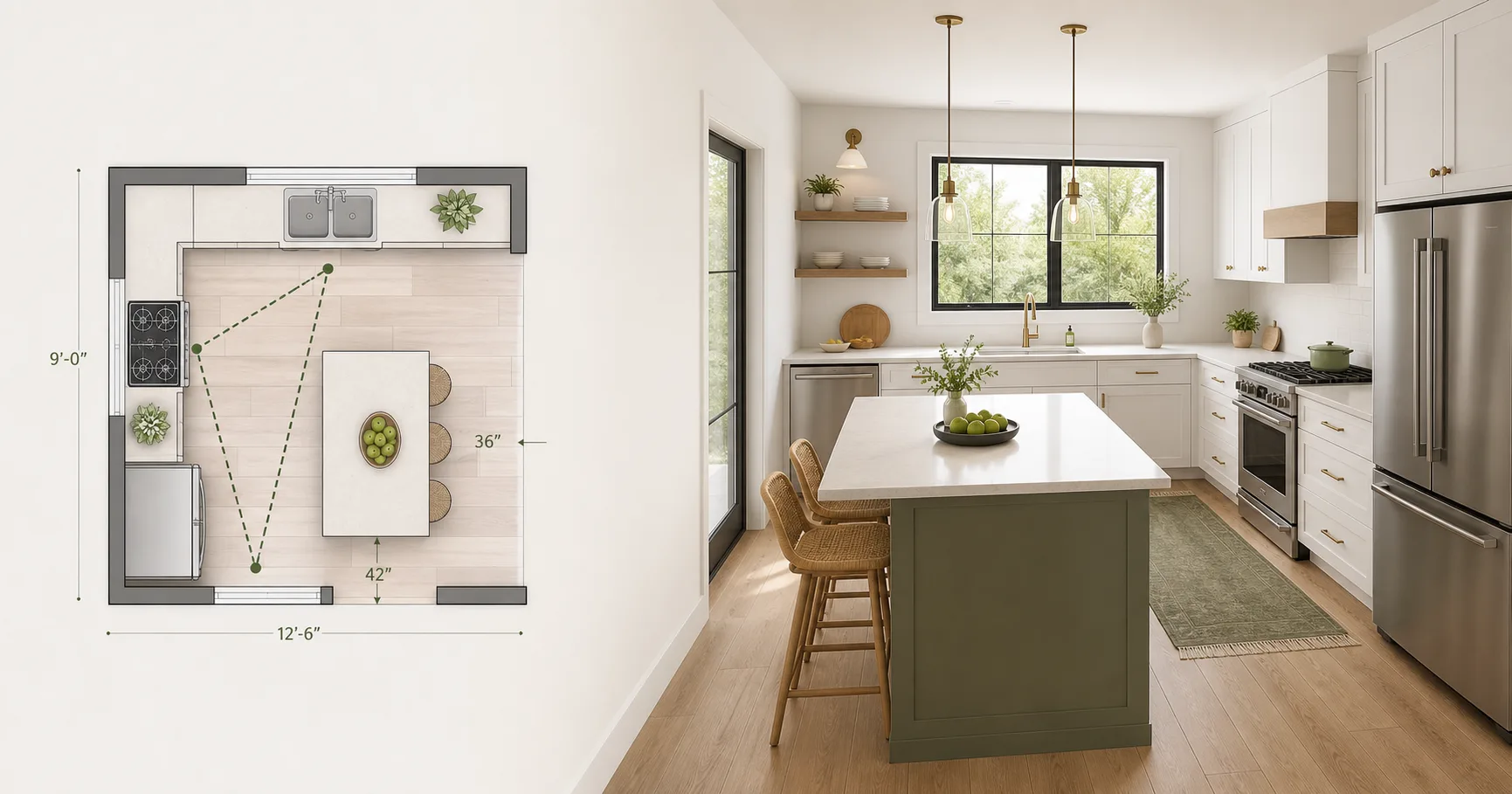
The kitchen work triangle is still useful, but only if you treat it as a starting point instead of a rule carved into stone. Older kitchen advice assumes one cook, three fixed appliances, and a closed room. Modern kitchens often include an island, a coffee station, a second cook, open-plan dining, and a phone on the counter showing the recipe. The triangle matters because it forces you to ask a simple question: can the person cooking move between the sink, stove, and refrigerator without crossing chaos?
This guide turns that question into a practical layout checklist you can test in Aedifex before you commit to cabinets, plumbing, or an island.
What the Work Triangle Measures
The triangle connects the three busiest points in most kitchens:
- Sink: washing, prep, cleanup, dishwasher loading.
- Stove or cooktop: heat, pans, ventilation, hot landing space.
- Refrigerator: cold storage, meal prep, snack traffic.
Classic guidance says each side should be roughly 1.2m to 2.7m, with the total triangle around 4m to 8m. Those numbers are helpful, but they do not solve the whole room. A triangle can be technically correct and still feel awful if the dishwasher opens into the main path, the island blocks the fridge, or there is no counter beside the stove.
Start with the Fixed Constraints
Before sketching cabinets, mark what is expensive to move:
- Plumbing wall and drain location
- Existing exhaust route or exterior wall
- Door swings and hallway connections
- Window height and sill depth
- Structural columns, beams, or load-bearing walls
If plumbing and exhaust sit on the same wall, a single-wall or L-shaped kitchen may be more sensible than forcing a U shape. If the room opens into a dining area, the refrigerator may belong near the entry so family traffic does not cut through the cooking zone.
Choose the Right Layout Type
Most kitchens fall into one of five patterns.
Single-wall kitchen works for studios and narrow apartments. Put the refrigerator at one end, the sink near the center, and the cooktop away from the fridge. Add a mobile island only if you still have a clear 900mm path.
Galley kitchen is efficient when two parallel runs are 1m to 1.2m apart. Less than that feels tight when drawers open; much more than that makes cooking feel like pacing.
L-shaped kitchen is the safest default for open-plan rooms. It keeps one corner active and leaves space for dining or an island.
U-shaped kitchen gives excellent storage but can trap people. It works best when the opening is wide enough for two people to pass.
Island kitchen is not a layout by itself. It is an addition to another layout. The island must earn its floor area with prep space, seating, storage, or a sink.
For a broader tool comparison before planning, see free 3D architecture tools in 2026.
Clearances That Decide Whether It Works
A good kitchen is mostly invisible measurements.
- Leave 900mm minimum for a one-person walkway.
- Leave 1,000-1,200mm between counters when drawers and appliances open opposite each other.
- Leave 1,200mm or more behind island seating if people need to walk behind stools.
- Keep a 300-450mm landing zone beside the refrigerator handle side.
- Keep 450-600mm landing zones beside the cooktop where possible.
- Do not let an oven, dishwasher, or fridge door block the only path.
These are not luxury dimensions. They are the difference between a kitchen that photographs well and a kitchen that works at 7 p.m. when someone is unloading groceries while another person is cooking.
Zones Beat Triangles in Larger Kitchens
If your kitchen is larger or used by more than one person, think in zones:
- Prep zone: sink, trash, knives, cutting boards, mixing bowls.
- Cooking zone: cooktop, oven, pans, oil, spices, heat-safe landing.
- Storage zone: fridge, pantry, dry goods, small appliances.
- Cleanup zone: sink, dishwasher, dish storage, trash.
- Serving zone: island, dining edge, coffee or drinks.
The work triangle should not fight these zones. For example, placing the dishwasher between sink and stove may shorten the triangle, but it can block prep when the door opens. A slightly longer triangle with a clear prep counter is usually better.
Test the Island Before You Fall in Love with It
Kitchen islands cause more layout mistakes than almost any other element. They look useful in plan view because they fill empty space. In real life they can block the refrigerator, pinch the walkway, or turn one cook into a traffic controller.
An island is worth keeping when it gives you at least one of these:
- A true prep surface near sink and stove
- Seating that does not block cabinet access
- Storage you cannot fit on the perimeter
- A visual boundary between kitchen and living room
If the island only holds decorative bowls, remove it. In a narrow kitchen, a peninsula or mobile prep table may work better.
Common Mistakes to Avoid
The first mistake is placing the refrigerator too deep inside the cooking zone. Everyone uses the fridge, not just the cook. Put it where people can grab drinks without stepping through the hot zone.
The second mistake is designing around cabinet symmetry instead of tasks. A centered sink under a window may look tidy, but if it leaves no prep counter between sink and stove, the kitchen will feel broken.
The third mistake is forgetting vertical storage. Tall pantry cabinets, wall rails, and full-height doors often solve more than another base cabinet.
The fourth mistake is treating lighting as decoration. Put strong task lighting over prep counters, not only over the island. For small rooms, the same logic appears in our small-room lighting guide.
A Quick 3D Test
Open the Aedifex demo and draw the kitchen footprint. Place the sink, stove, refrigerator, and island as simple blocks first. Then walk through three scenarios:
- Someone enters to get water while another person cooks.
- The dishwasher door is open while plates are put away.
- Groceries move from entry to fridge to counter.
If any scenario blocks the only clear path, revise the layout before choosing finishes. If the core path works, then cabinets, materials, and lighting become much easier decisions.
For a focused workflow, try the Kitchen Design page or save your plan with a free account.