Lighting Design for Small Rooms — Layers, Bulbs, and Placement
Make a small room feel larger with layered lighting, warm bulb temperatures, wall washing, dimmers, and a 20 m² studio lighting plan.
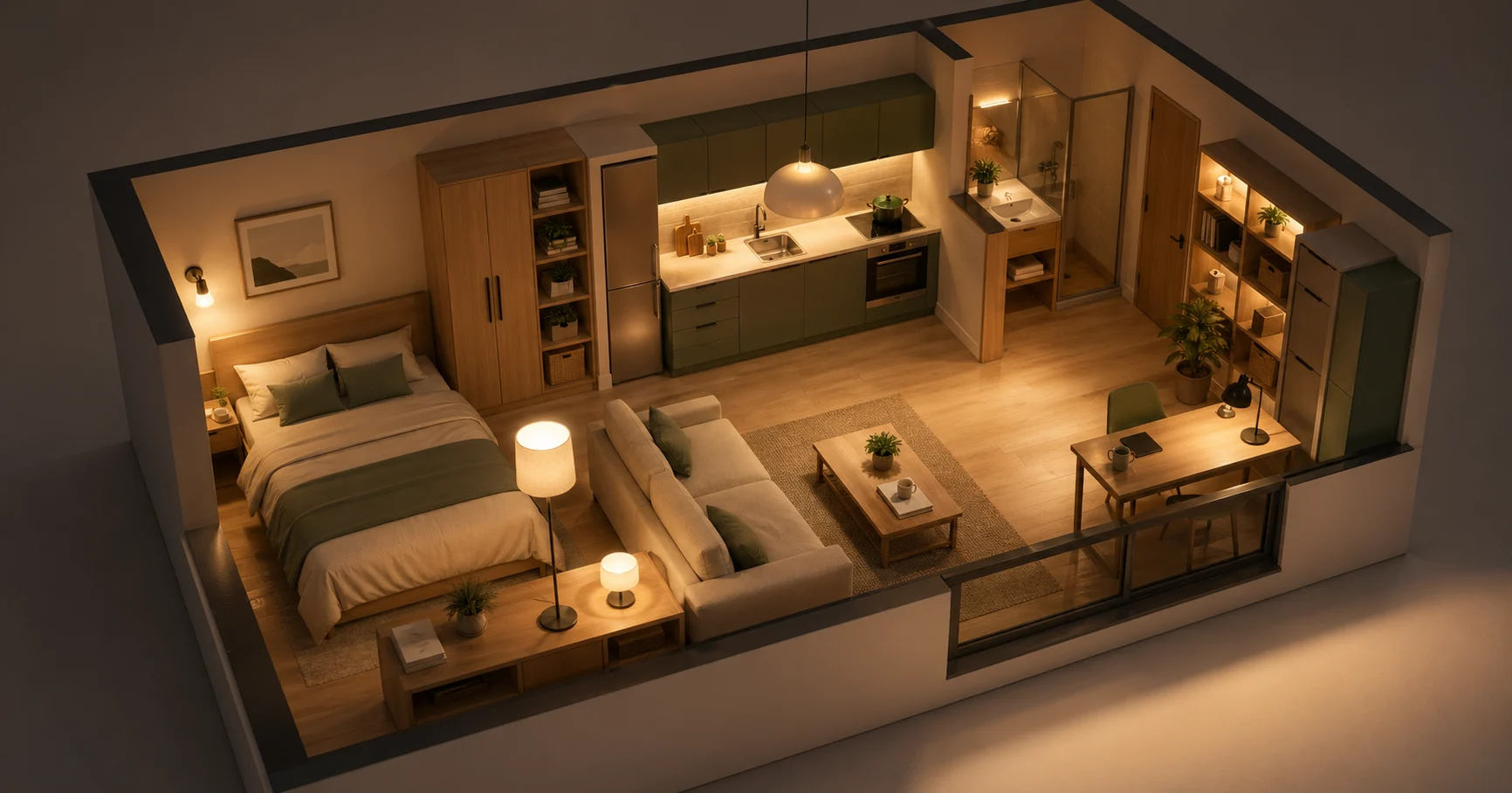
A small room with one ceiling pendant usually reads flat: bright center, dim corners, no depth. Add lower lights, wall glow, and a dimmable task lamp, and the same room starts to show layers. This guide explains where to place those lights, what bulb temperature to choose, and how to test the effect before buying fixtures.
The Three Layers Every Room Needs
Lighting designers split light into three categories. A small room that combines all three feels planned. A small room with only one usually feels like a hallway or a rental bedroom.
1. Ambient
The base layer. Fills the room with overall brightness so you can navigate without bumping into anything. Common sources: ceiling pendants, recessed cans, floor lamps with diffuse shades.
In small rooms, ambient should be softer than you think. A 60W-equivalent LED in the middle of a 4×5 m room is plenty. Bigger and it flattens the space.
2. Task
Focused light where you do specific things: reading, cooking, working. Common sources: desk lamps, undercabinet LEDs, swing-arm wall sconces, pendants over a kitchen island.
Task lighting is the layer most people forget. A small room without it feels gloomy at the dining table even when ambient is generous.
3. Accent
Light that draws the eye to specific objects: art, plants, an architectural detail. Common sources: picture lights, uplighters, LED strip on a shelf, a candle.
Accent is what makes a room feel intentional rather than merely bright. In a small room, one or two accents are usually enough.
Five Rules That Make Small Rooms Feel Bigger
Rule 1: Multiple low-watt sources beat one high-watt source
Three 40W-equivalent bulbs around the room create more depth than one 100W bulb in the middle. Each light has its own falloff, layering shadows that signal three-dimensional space to the eye.
In Aedifex you can place lamps and switch between time-of-day modes to see the effect before buying anything.
Rule 2: Mix heights
Floor lamp (140 cm), table lamp (40 cm above the table), wall sconce (160 cm). The ceiling light becomes one of multiple sources, not the only one. Eyes see height variation as space.
Rule 3: Light walls, don't shadow them
Uplighters or wall-mounted fixtures bounce light off the walls. Bright walls visually push out, expanding the room. Dark unlit walls visually contract.
This is why hotel rooms and good Airbnbs almost always have a wall-mounted lamp.
Rule 4: Warm bulbs (2700-3000K) for living areas
Cool white (4000K+) is for offices, kitchens, and bathrooms. Warm white is for the rest. A small living room with cool bulbs feels clinical; the same room with warm bulbs feels intimate.
For the kitchen-living combo studios, mix: warm in the living zone, neutral white in the kitchen. The transition itself helps zone-define.
Rule 5: Dimmers, always
Every light source in a small living room should be dimmable. Daytime brightness is different from movie-night brightness is different from dinner-party brightness. The same fixture can support three moods: cleaning, dinner, and late-night low light.
A Worked Example
A 20 m² living-bedroom combo studio.
Ambient: 1 ceiling pendant, 60W-equivalent warm LED, on a dimmer.
Task: Reading lamp by the bed (small swing-arm wall sconce). Floor lamp behind the sofa. Pendant over the dining table.
Accent: One picture light over a piece of wall art. One LED strip behind a floating shelf.
That's six light sources in a 20 m² room. Each one is small. Together, they make the room feel layered, intentional, and bigger than its physical footprint.
Test It Before You Buy
Open Aedifex on a sample studio scene, place lamps where the plan above suggests, and switch to evening lighting mode. Compare one central pendant against three smaller sources before you order fixtures.
For more on small-space layouts, see Studio Apartment Layout Ideas or the 30 sqm walkthrough.
Fixture Placement by Room Type
In a small bedroom, avoid relying on a single ceiling light. Use bedside sconces or narrow lamps, a soft general light, and a wardrobe or mirror light if the room is used for dressing. Put switches where they can be reached from the bed, or use smart bulbs with dimmed evening scenes.
In a small living room, place light near the corners instead of only in the center. A floor lamp behind a chair, a table lamp near the sofa, and a wall wash behind art can make the room feel wider because the edges are visible.
In a small kitchen, under-cabinet lighting matters more than decorative pendants. The counter needs task light without casting your body shadow over the prep surface. If the kitchen opens to a living area, use warmer, lower light outside the work zone.
In a hallway or entry, use even light that avoids dark pockets. A narrow space with one harsh fixture at the center can feel longer and tighter. Two or three lower-output fixtures may feel better than one bright ceiling dome.
Bulb Specs That Matter
Look at color temperature, brightness, beam spread, and color rendering. For living areas, 2700K to 3000K is usually comfortable. For kitchens, laundry rooms, and focused work, 3000K to 4000K can be useful. Avoid mixing very warm and very cool bulbs in the same small room unless you are deliberately zoning.
Brightness should be layered. A 20 m² room rarely needs one extremely bright fixture. It needs several moderate sources that can be switched separately. This lets the room support cleaning, working, relaxing, and hosting without feeling overlit.
Color rendering matters for materials. Low-quality bulbs can make wood, paint, and fabric look dull or strange. Choose high-CRI bulbs for areas where color and texture matter, especially near artwork, closets, vanities, and dining tables.
Common Mistakes
The first mistake is hanging a pendant too low in a small room with a low ceiling. If people duck or sight lines are blocked, use a flush mount, wall lights, or table lamps.
The second is lighting only the floor. Small rooms feel larger when vertical surfaces are visible. Wash a wall, light a shelf, or add a lamp near a corner.
The third is buying fixtures before planning switches. A beautiful lamp that must be unplugged every night will not get used. Convenience is part of lighting design.