Open Floor Plan Pros and Cons — When to Remove Walls
Decide whether an open floor plan fits your home by weighing light, noise, privacy, smells, HVAC, hosting, and a 3D wall-removal test.
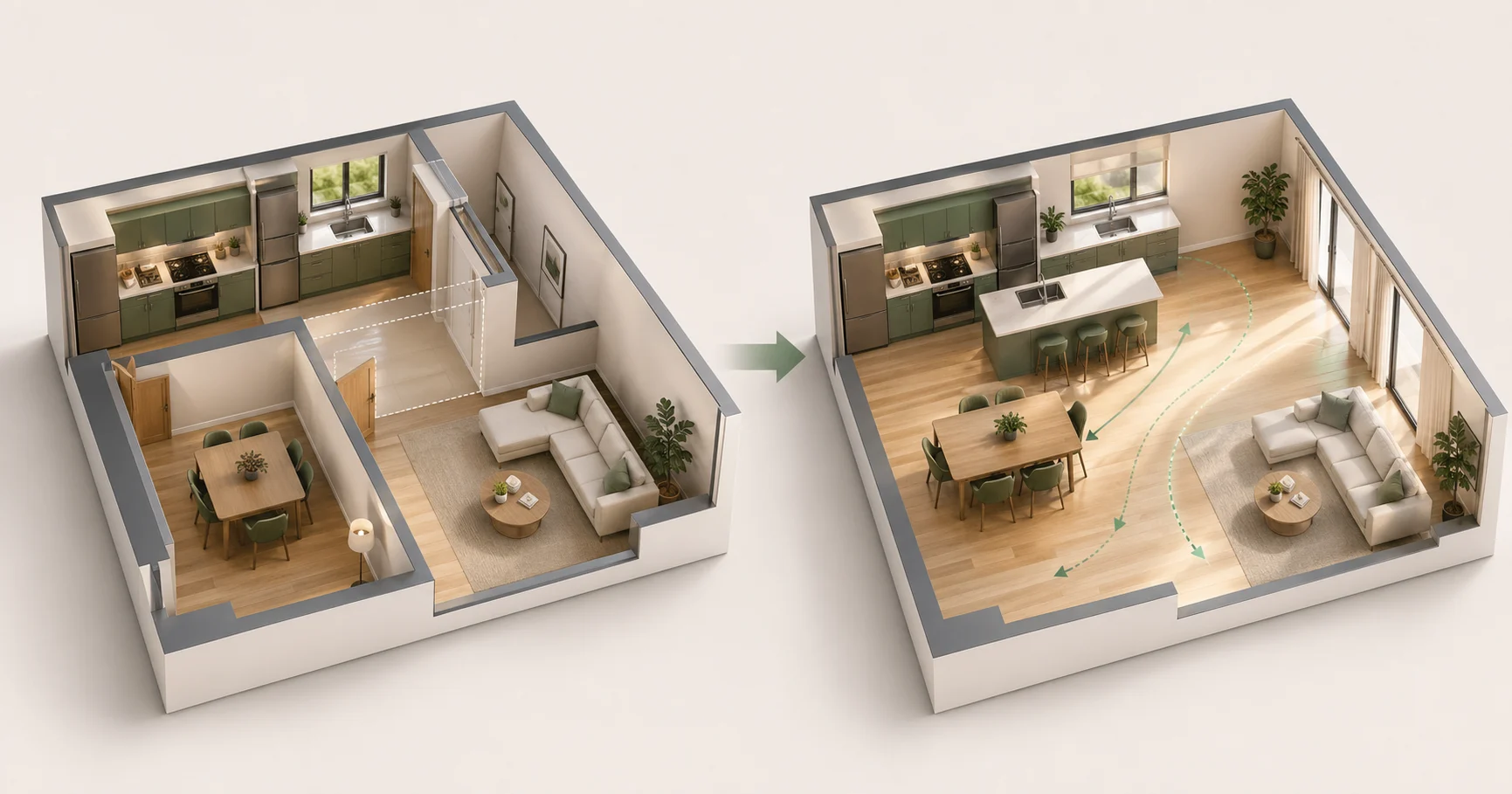
"Open floor plan" still reads like an upgrade in many listings, but removing walls is not automatically better. It can move light through a small home and make hosting easier. It can also turn cooking noise, dishes, and privacy conflicts into daily problems. Use this guide before you pay to demolish a wall.
What an Open Floor Plan Actually Is
The term gets used loosely. A true open plan removes interior walls between three or more functions, typically kitchen, dining, and living, so the spaces flow into each other without doors. A "great room" is the related term.
Note: a kitchen-with-an-island that opens to a dining room is not an open plan. It's an open kitchen, which is fine, but it doesn't carry the same tradeoffs.
What Open Plans Solve
1. Family Visibility
The original case for open plans, in the postwar era: parents could cook while watching kids in the living area. This is genuinely a quality-of-life improvement for a family with young children.
2. Light Distribution
Removing walls lets sunlight from the brightest side of the house reach further. A north-facing kitchen that gets light through the south-facing living room becomes usable for breakfast.
3. Apparent Size
A 60 m² open plan reads larger than three 20 m² rooms separated by walls. This works in apartments where the actual size is fixed but the perception matters.
4. Entertaining
Hosting works better when the cook isn't isolated. Guests cluster wherever drinks are; if drinks are in the kitchen, the kitchen needs to be visible.
What Open Plans Break
1. Acoustic Hell
This is the biggest underpriced cost. Hard surfaces, kitchen counters, hardwood floors, large windows, reflect sound. With no walls to absorb it, kitchen activity reverberates into the living area. A dishwasher running while someone watches a movie is much louder in an open plan than in walled rooms.
Solutions are expensive: heavy curtains, large area rugs, acoustic ceiling treatments, soft furniture. None of them as effective as a wall.
2. Cooking Smells Spread
If you cook fish on Tuesday, your living room smells like fish on Friday. High-CFM range hoods help but don't eliminate this. Some cuisines cook with strong smells deliberately and become less enjoyable in open plans.
3. Visual Clutter
In a closed-room layout, the kitchen mess stays in the kitchen. In an open plan, dirty dishes are visible from the couch. Households with one tidy person and one untidy person experience this as a chronic friction point.
4. Less Privacy
Anyone in any of the three rooms is visible from the others. Phone calls have no quiet space. Reading and watching TV can't happen simultaneously without conflict.
5. Heating and Cooling Are Less Efficient
Closed rooms can be heated or cooled selectively. An open plan demands one HVAC strategy for the whole space. Old houses converted to open plans frequently see energy bills increase.
When Open Plans Work
- Small homes (under ~80 m²) where partition walls would make rooms too small to function
- Households with shared schedules (everyone works together, eats together, watches TV together)
- Frequent hosting of large groups
- Light-starved homes where moving light around the floor is a real win
- Climates where you spend most of the year with windows open anyway
When Open Plans Don't Work
- Households on different schedules (one person works night shifts, one cooks at 6 AM)
- Music or piano practice, in any household
- Strong-smelling cuisine as everyday cooking
- Anyone working from home in calls (unless you have a separate office)
- Multi-generational households where privacy is culturally important
How to Test Before You Demolish a Wall
Removing a load-bearing wall costs $5,000-$15,000 plus structural engineer fees, plus the redesign of HVAC, electrical, and possibly plumbing. Worth being sure.
Open Aedifex. Draw your current floor plan with all the walls. Save it. Then duplicate the project and remove the wall(s) you're considering. Walk both versions in 3D, side-by-side.
Things to evaluate in the open version:
- Standing in the kitchen, can you see the TV in the living area? Is that what you want?
- Standing at the front door, what's the first thing you see? Often the kitchen mess area.
- Sitting on the couch, how visible is the kitchen counter clutter?
- Where would the dining table go, given that one wall it could anchor against is now gone?
Many renovation regrets come from skipping this exercise. The wall comes down, the new arrangement is worse than the old one, and now the wall has to be rebuilt or the compromised layout has to be lived with.
A Middle Path
Half-walls. Pony walls. Pass-through windows. Wide cased openings instead of full demolition. These let you keep some acoustic separation, some visual interest, and some structural mass while opening up the space. They're often what people actually want when they say "open plan."
Try one in Aedifex before you commit. Half-walls are easy to draw and immediately show the difference in 3D.
Summary
Open plans work well for some households. For others, they trade one problem for three new ones. Test the sightlines, noise, and furniture layout before treating demolition as the default.
For more layout-testing workflows: AI-Assisted Room Layout Walkthrough. For tool selection: Free 3D Architecture Tools 2026.