Under-Bed Storage Access and Bedroom Layout Planning
Plan under-bed storage around drawer travel, lifting lids, cleaning, and daily access. Compare bed positions before choosing bins or a storage frame.
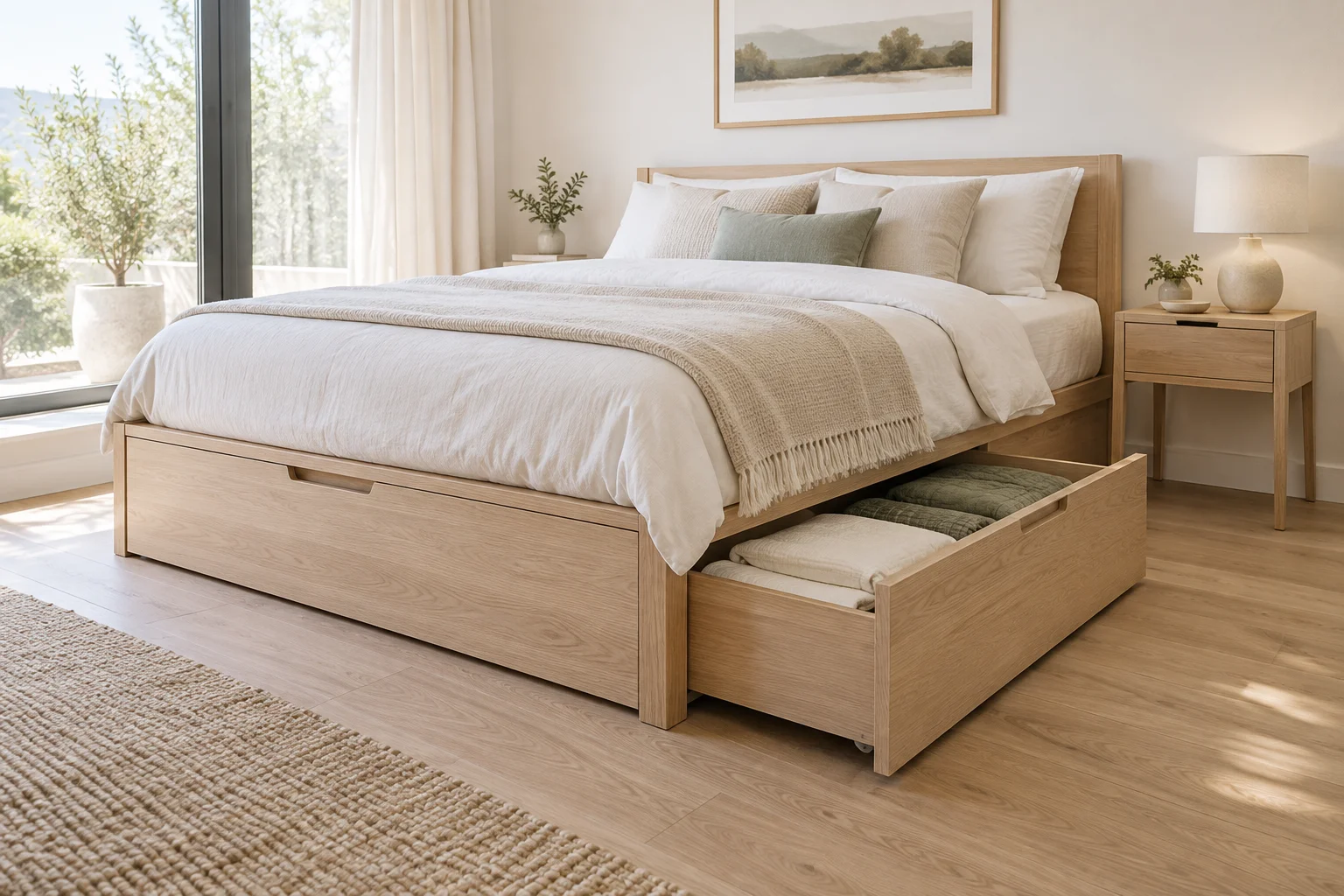
Under-bed storage looks like free space until a box cannot slide past the bedside table or a lifting base hits a pendant light. The volume beneath a mattress is only useful when you can reach it without dismantling the room. Before choosing a storage bed or buying a set of bins, decide what will go there, which direction it will move, and where your body will be during access.
Start With the Frequency of Use
Separate everyday items from seasonal items. Spare bedding needed every week deserves easier access than holiday decorations retrieved twice a year. If the only usable storage opening requires moving a heavy bed, it is poorly suited to a frequent task. Write down the retrieval routine for each category rather than treating every liter of storage as equally valuable.
Also consider weight and handling. A large container filled with books can be difficult to pull across a rug and awkward to lift from floor level. Several smaller containers may be more manageable, but their handles and dividers use space. Use the actual contents to choose the container instead of buying maximum-size bins and deciding what to put inside later.
Measure the Space Below the Whole Bed
Measure the lowest clear opening under the frame, including rails, support beams, center legs, and any mechanism. The visible gap at the edge may be taller than the usable interior space. A container can enter beneath the side rail and still stop against a support halfway through. Record a simple map of supports, not just one height and one width.
Include the container lid, wheels, handle, and any raised corners in its outside dimensions. Allow a small practical tolerance for uneven floors and manufacturing variation rather than selecting a bin with exactly the same height as the opening. A cardboard template can help check passage around legs before ordering multiple matching containers. Do not modify structural bed parts to make a container fit.
Compare Three Access Systems
Loose containers that pull sideways
These work best when the route beside the bed allows the entire container to come out. They can suit an existing raised bed without changing the frame, provided the supports permit access. Check whether the handle is usable from your standing or crouching position. Wheels can help on suitable flooring, but rug edges and transitions may still obstruct movement.
Integrated drawers
Built-in drawers offer a defined opening direction and often a more orderly appearance. Their travel is fixed by the product, so obtain the full extension dimensions before committing to a bed position. Some beds have drawers only near the foot; others have several along both sides. A bedside table can block the head-end drawer even when the rest of the room seems spacious.
A lifting mattress platform
A lifting base can provide access from the foot or side without rolling containers into an aisle. It still requires room for the person operating it and clearance above the moving mattress. Confirm the direction of opening, maximum height, permitted mattress weight, and operating instructions for the exact model. Do not assume that every gas-assisted mechanism works with every mattress.
Calculate Side Access as an Activity Zone
Suppose a storage drawer extends 55 cm beyond the bed frame. In a 95 cm gap between bed and wall, the fully open drawer leaves 40 cm beyond its front. The drawer can open, but crouching or removing a bulky duvet may be uncomfortable. Compare a larger gap, a shorter-travel storage option, or a different access direction rather than concluding that the visible fit is sufficient.
For an early mock-up, try adding roughly 45–60 cm of personal working space beyond a fully extracted drawer or bin, then adjust to the actual person and task. This is a planning test, not a universal minimum, and it does not include a separate passing lane. Mobility equipment and applicable accessibility requirements can need a different arrangement and more space.
Loose bins may need extra room because they must clear the frame before their lids open. Measure the whole sequence: pull, turn if necessary, remove the lid, lift out the contents, and return the bin. A container that can slide halfway out may still be useful for small items near its handle, but it does not provide reliable access to the entire storage volume.
Check the Foot of the Bed Separately
Foot-end drawers can work when one long side of the bed is against a wall. However, a dresser, bench, or bedroom door may occupy the extraction zone. Measure from the actual footboard rather than the mattress length. If a bench must be moved for every access, decide whether that is acceptable for the items stored there.
A lifting base also needs an operating position at the specified end or side. Try standing there with the bedroom door in its usual position. Confirm that the raised platform cannot contact a sloped ceiling, shelf, wall light, or pendant. The three-dimensional opening envelope matters as much as the floor footprint, especially in attic rooms and compact bedrooms.
Keep Storage Compatible With the Bed
Follow the manufacturer's ventilation guidance for the mattress and base. Filling every void with tightly packed bags can alter airflow, and some systems require particular clear areas. Store textiles clean and dry, and choose containers appropriate to the room conditions. A sealed box does not solve a damp bedroom or make wet bedding suitable for storage.
Respect the load limits of drawers, containers, and lifting mechanisms. Do not use a storage drawer as a step or allow children to play inside a lifting base. Keep hands clear of moving mechanisms and follow the product's opening and closing procedure. If a system is difficult to operate with its specified mattress, address that with the supplier rather than improvising supports or changing the mechanism.
Include Cleaning in the Layout
Under-bed storage can make dust removal harder when every container occupies a narrow slot. Leave a realistic way to remove bins and reach the floor. Check whether the vacuum head fits beneath the rail and around support legs. A robot vacuum may need a different clear height from a low-profile manual attachment, so use the dimensions of the actual cleaning equipment.
Plan where containers will temporarily sit during cleaning. If they block the only door when removed, work through a safer sequence or reduce the quantity. Labeling the outward-facing end helps avoid pulling every bin out to find one item. Use simple categories such as spare sheets, winter layers, and guest bedding instead of overlapping categories that become confusing after several months.
Test the Complete Routine Before Buying
Mark the bed frame and extraction zone on the floor, then use an existing box to rehearse access. Include the bedside table, hanging bedding, door swing, and rug. Repeat with the largest item you expect to store. This small trial is more informative than comparing storage capacity figures without knowing how the contents will move.
Use the room planner to compare side-access and foot-access layouts, and review overall bedroom proportions in the demo. Keep opening envelopes explicit in your measurements and check product instructions independently. The best under-bed storage is the space you can use, clean, and close comfortably without turning a simple retrieval task into a furniture-moving project.