Apartment Kitchen Layout Ideas: Galley, L-Shape, Peninsula
Plan an apartment kitchen around storage, appliance zones, aisle clearance, lighting, and everyday cooking flow before ordering cabinets.
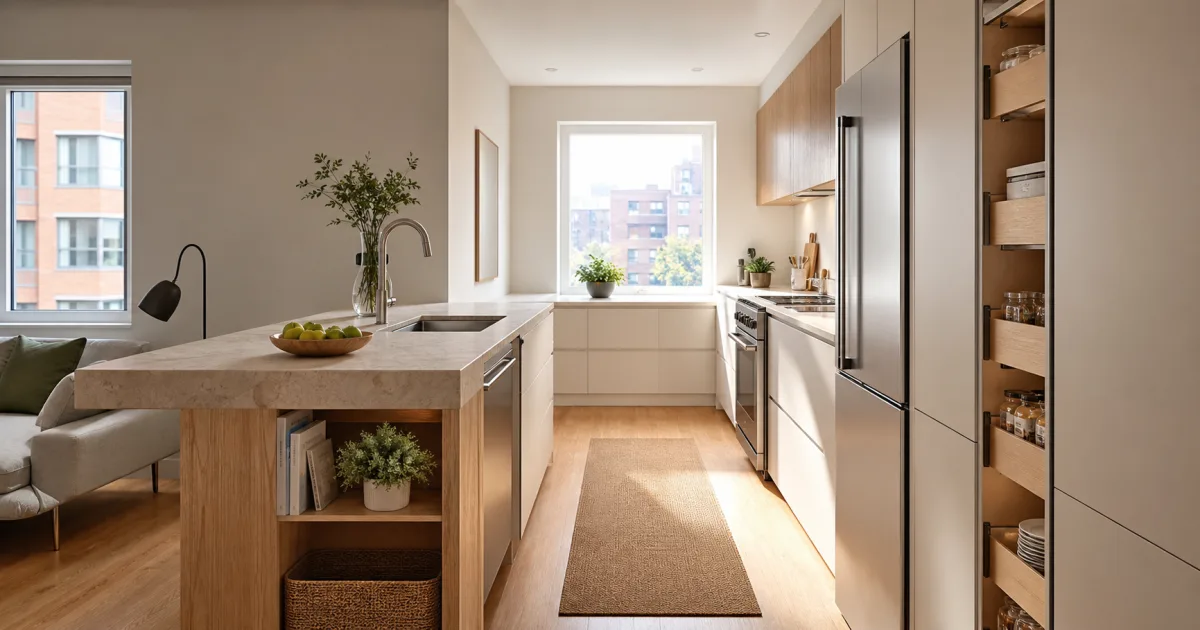
Apartment kitchens succeed when every step has a purpose. The room is usually small, but the problem is rarely size alone. A poor plan makes the sink, cooktop, refrigerator, trash, and storage fight for the same corner.
Before buying cabinets, draw the room in Aedifex and place the largest fixed pieces first. Test doors, drawers, appliance swings, and the path from groceries to prep to cooking.
Start with the Work Zones
Think in zones instead of single objects:
- Landing space near the refrigerator.
- Prep space between sink and cooktop.
- Cooking tools near the range.
- Dishes near the dishwasher or drying rack.
- Trash and recycling near the prep zone.
If two people cook often, protect the aisle. A wider counter is not useful if every drawer blocks the other person.
Galley Kitchen
A galley kitchen is efficient when the two runs have a clear job. Put sink and prep on one side, cooking and tall storage on the other. Keep upper cabinets lighter near the window so the room does not feel like a tunnel.
This layout works well for renters and narrow apartments because plumbing can stay on one wall. Add under-cabinet lighting and a few open shelves only where they will not collect grease.
L-Shaped Kitchen
An L-shaped kitchen opens one side of the room for dining or living. It is forgiving in studios and small apartments because the corner can hold storage while the open leg keeps traffic moving.
The corner is the risk. Do not let a blind cabinet become a place where appliances disappear. Use drawers, pull-outs, or a clear rule: only seasonal items go there.
Peninsula Kitchen
A peninsula can add counter space, seating, and a visual boundary without building a full wall. It works best when the open end does not cut across the main route from entry to living room.
Check stool depth, cabinet doors, and appliance handles before committing. If the peninsula makes people turn sideways to pass, shorten it or use a mobile island instead.
Lighting and Storage
Small kitchens need layered light. Use ceiling light for general brightness, task light under cabinets, and a pendant only if it does not block sight lines.
For storage, prioritize deep drawers, vertical tray slots, and one tall pantry cabinet. Extra shelves look good at first, but closed storage usually keeps an apartment kitchen calmer.
Test the Layout
In Aedifex, walk these routes: refrigerator to sink, sink to cooktop, cooktop to table, dishwasher to cabinet, and entry to living room. If a route crosses an open oven door or a stool, the plan needs another pass. For appliance spacing, pair this guide with the Kitchen Work Triangle Layout Guide or start from the Kitchen Design page.
Apartment Constraints That Change the Plan
Apartment kitchens often have constraints that detached-house kitchen advice ignores. The plumbing stack may be shared with neighbors. The exhaust route may be fixed. The electrical panel may limit appliance upgrades. The floor may not allow heavy stone counters or a thick new build-up at the threshold. Before planning finishes, confirm which parts of the room can actually move.
Ventilation is a common compromise. If the range hood recirculates instead of venting outside, avoid placing the cooktop where odors move directly into a sofa or bed zone. In studios, even a small peninsula can help by turning the cooking area away from the sleeping area.
Noise matters too. Dishwashers, refrigerators, and extractor fans are more noticeable in open apartments. If the kitchen shares a wall with the sleeping zone, choose quieter appliances and add closed storage so the room does not look like a utility wall from the bed.
Clearance Numbers Worth Modeling
These are preliminary comparisons only, not universal minima. Use the actual users, finished projections, appliance manuals and applicable local requirements before choosing a layout.
Use these as planning checks, then verify local codes and appliance manuals:
- Aim for 900-1100 mm between opposite counters in a galley.
- Leave about 1000 mm behind stools when people need to pass.
- Keep at least 300 mm of landing space beside the refrigerator.
- Preserve 450-600 mm of prep space near the sink.
- Check the full oven, dishwasher, and refrigerator door swing together.
The important part is testing them at the same time. A peninsula may leave enough walking room until a dishwasher door opens. A refrigerator may fit the wall but block the entry route when someone stands in front of it.
Storage Priorities for Small Kitchens
Store daily tools where the work happens. Knives, boards, and mixing bowls belong near prep. Pans belong near the cooktop. Mugs and plates belong near the dishwasher or drying rack. If every task requires crossing the kitchen, the layout will feel larger and more annoying than it is.
Use vertical space carefully. Tall cabinets are efficient, but a full wall of tall storage can make a small apartment kitchen feel heavy. Break it with one open niche, a lighter finish, or a counter zone. If the room has only one window, keep bulky storage away from that side.
Common Mistakes
The first mistake is choosing a peninsula because it looks premium. In many apartments, a slim movable island gives the same prep benefit without permanently narrowing the room.
The second is underestimating trash, recycling, and cleaning storage. These are not decorative, but they decide whether the kitchen stays usable. Give them a real cabinet or pull-out instead of leaving them as afterthoughts.
The third is designing for guests before designing for weekdays. A four-seat counter is not useful if the main cook loses prep space every night. Daily cooking flow should win first; entertaining comes second.
Apartment Kitchen Layout Ideas: Galley, L-Shape, Peninsula
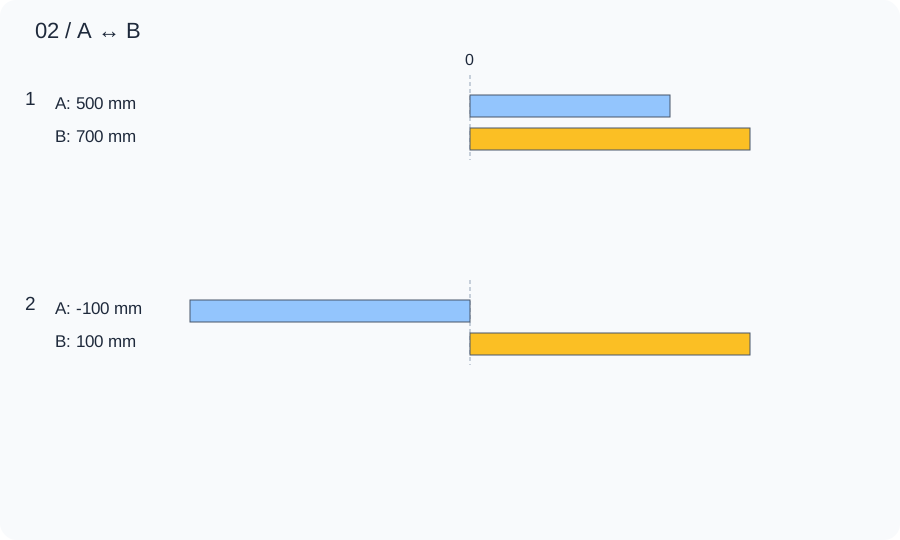
Independent teaching assumptions follow. An apartment-kitchen study assumes 2300 mm between finished walls and two 600 mm cabinet runs. Add a hypothetical 600 mm open appliance projection and a 600 mm operator comparison zone.
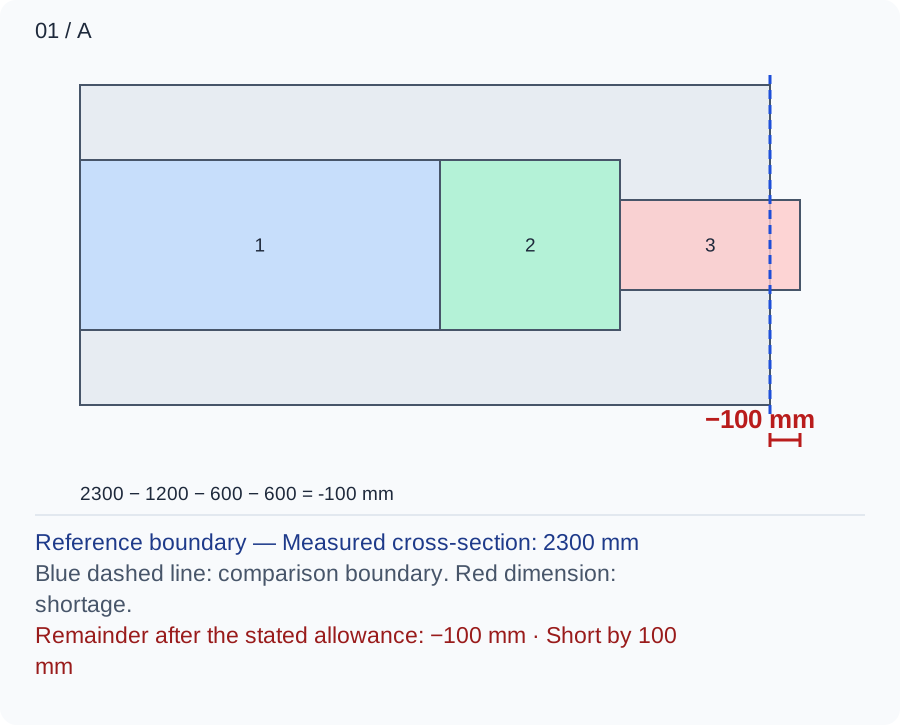
The closed aisle is 1100 mm, but an open appliance leaves 500 mm. The operator allocation makes the balance −100 mm, explaining why a closed-plan aisle can fail during cleanup.
Numbers and marks identify the items described here; use the stated dimensions rather than measuring the screen.
1: fixed occupation; 2: operating extension; 3: chosen user or route allocation. These are sequential allocations, not exact furniture positions.
| Input | A | B |
|---|---|---|
| Measured cross-section (mm) | 2300 | 2300 |
| Combined fixed occupation (mm) | 1200 | 1000 |
| Operating projection (mm) | 600 | 600 |
| Chosen user or route allowance (mm) | 600 | 600 |
Changed conditions and evidence
A shallow non-appliance run reduces combined fixed depth to 1000 mm and leaves a 100 mm balance. It loses storage depth and does not authorize reducing the selected appliance’s required cabinet or hose space.
| Calculated relationship | A | B |
|---|---|---|
| 1. Unoccupied cross-section | 500 mm | 700 mm |
| 2. Remainder after the stated allowance | -100 mm | 100 mm |
Tape the cabinet faces and open appliance edge before reenacting a meal cleanup. Confirm plumbing, exhaust and electrical constraints with responsible parties; recovering 200 mm does not validate those services.
TRY THE EXAMPLE
Apartment Kitchen Layout Ideas: Galley, L-Shape, Peninsula
Independent teaching assumptions follow. An apartment-kitchen study assumes 2300 mm between finished walls and two 600 mm cabinet runs. Add a hypothetical 600 mm open appliance projection and a 600 mm operator comparison zone.
Allowed range: 1–12000 · Step: 1
Allowed range: 0–12000 · Step: 1
Allowed range: 0–12000 · Step: 1
Allowed range: 0–12000 · Step: 1
A negative remainder means the selected allocations overlap. Change the inputs or the proposal.
- Unoccupied cross-section
- 500 mm
- Remainder after the stated allowance
- -100 mm
Reference boundary — Measured cross-section: 2300 mm
Blue dashed line: comparison boundary. Red dimension: shortage.
Remainder after the stated allowance: −100 mm · Short by 100 mm
2300 − 1200 − 600 − 600 = -100 mm
Tape the cabinet faces and open appliance edge before reenacting a meal cleanup. Confirm plumbing, exhaust and electrical constraints with responsible parties; recovering 200 mm does not validate those services.
Teaching assumptions, not a surveyed home or a construction check. Results describe this simplified geometry or budget only. Changes stay on this page and reset on reload.