Bedside Lamp Switch Placement: Test Your Actual Reach
Choose a bedside lamp position by testing the switch from your usual sleeping position, while leaving room for the table, cable and nighttime route.

A bedside lamp can look well balanced in a photograph yet be awkward to switch off once you are lying down. The decision is not just left or right: switch location, mattress position, table clutter and cable route all affect the nightly routine. Test the whole sequence before buying a lamp or fixing anything to the wall.
What goes wrong at lights-out?
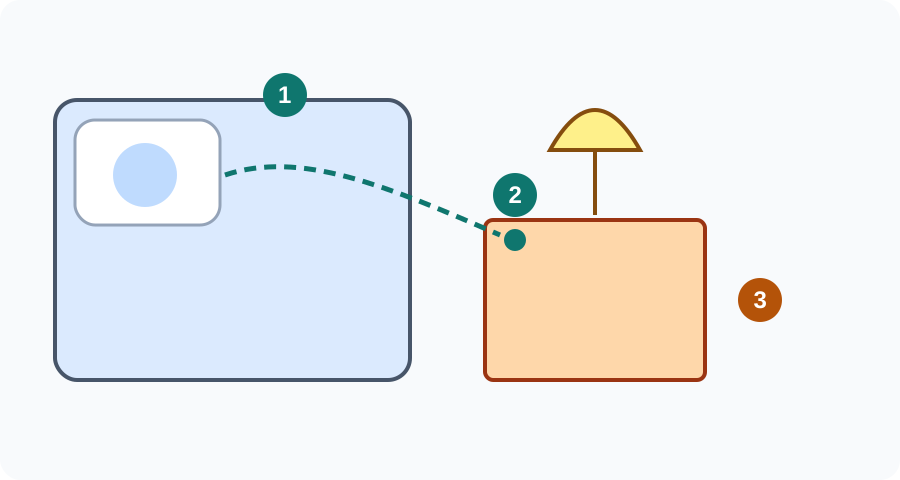
Open the bedtime reach diagram
The conceptual side view marks 1 the usual sleeping position, 2 the switch and 3 the table edge. The dotted line suggests a reach to test, not a measured reach or a safety boundary.
- You cannot find the switch: test turning the lamp so the control faces the bed, then check where the cable moves.
- You can reach it only by stretching: compare moving the table or choosing another control location; test in your usual sleeping position.
- Your hand hits a glass on the way back: move the glass or the switch and repeat the whole movement.
Choose a symptom in the diagnostic exercise, then record observations in the worksheet. The suggestion is not a safety verdict.
Start with the switch, not the shade
Identify whether the switch is on the base, the cord, the socket or a separate controller. Check the actual product rather than assuming every lamp uses the same mechanism. Note the movement needed to find and operate it, including the direction of a rocker or cord switch. If there are two sleepers, test each person's own position and whether the light disturbs the other person. A reach that works while sitting may fail when lying under bedding.
In this teaching scenario, a person sleeps on the left side of a bed and has a small table there. Option A puts a base switch toward the far edge of the table, behind a water glass; option B turns the same lamp so the switch faces the bed, with the cable routed clear of the edge. The second option may be easier to find, but only a real trial can establish that. It may also make the shade or cable occupy a less convenient position. No assumed arm length or geometric distance certifies the person's reach.
Test the nighttime sequence
- With the lamp unplugged while arranging it, place a stable mock-up in the proposed position. Mark the switch and the table edge; include ordinary items such as a glass and phone.
- Lie in the usual position with normal bedding. Without stretching into an uncomfortable posture, locate and operate the actual switch. Repeat on the other side if both people use it.
- Check the return path: after switching it off, can the person put their hand back without knocking the glass or dragging the cable? Repeat after changes to the pillow, mattress or table position.
If reaching is uncomfortable, move the switch or compare a product with a different switch location. A separate controller may need batteries, compatibility or its own place; check its specifications rather than assuming it works with the lamp. A different side of the bed can solve one person's reach while making the other person's route or drawer harder to use.
Check the lamp and cable together
The lamp must stand securely on a level surface with its base fully supported. Keep cables out of walking routes and away from bedding, water and areas where they could be pinched, following the manufacturer's instructions. Do not route a cable under a rug or improvise electrical modifications to make a layout work. The switch test is not an electrical inspection.
Check whether the shade blocks access to a drawer or interferes with the headboard, and whether its light is comfortable for the intended task. Trial the lamp in the evening if possible, but avoid claiming a particular brightness is universally suitable. For room-level planning, the small-room lighting guide covers how different light sources work together.
Record a result you can use
Write down the mattress and table positions, switch type and the action that failed or succeeded. If no available position is comfortable, choose a different switch arrangement rather than relying on a longer reach. Recheck when bedding or furniture changes. The interactive diagnosis suggests what to try for each symptom; it does not verify the result.
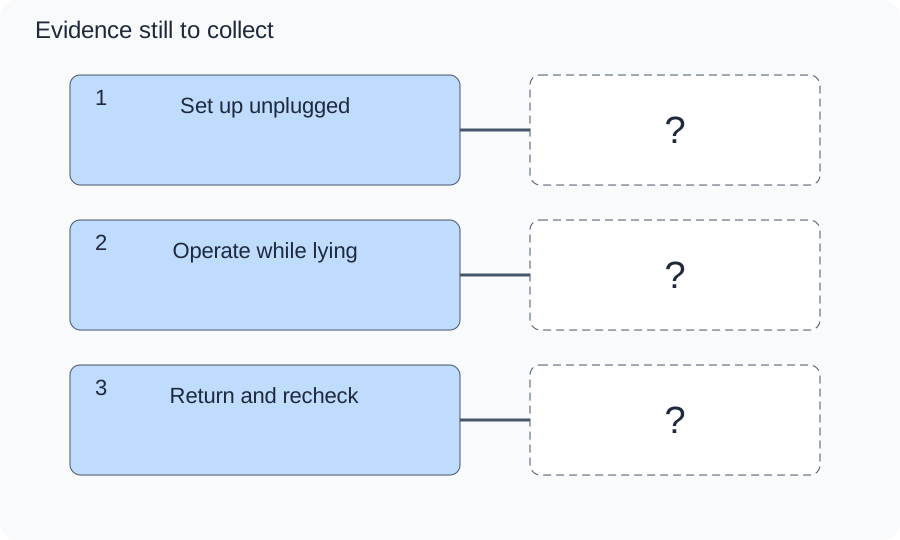
Follow the numbered sequence from setup through operation and return. The boxes mark separate actions; none indicates that the test has passed.
Download the measurement and evidence record (CSV). Keep unknown values blank. The example uses the stated inputs. Record your own measurements and the source of each observation.
TRY THE EXAMPLE
Find the problem at lights-out
Select the difficulty you observe to see one possible adjustment, then test it in the actual sleeping position.
Turn the lamp so the control faces the bed, then check the cable is not pulled.
Evidence still needed: a stable unplugged setup, the actual user’s comfortable operation, and a return movement without moving the glass or cable. Electrical safety requires its own checks. Conceptual illustration, not to scale. Check the actual product, full movement and surroundings; this is not a safety or installation approval.
Teaching assumptions, not a surveyed home or a construction check. Results describe this simplified geometry or budget only. Changes stay on this page and reset on reload.