Cat Tree by a Window: Plan Curtain and Access Space
Compare a cat tree beside the window with a side-wall position. Measure the base, curtain travel, window access and the cat's actual route.
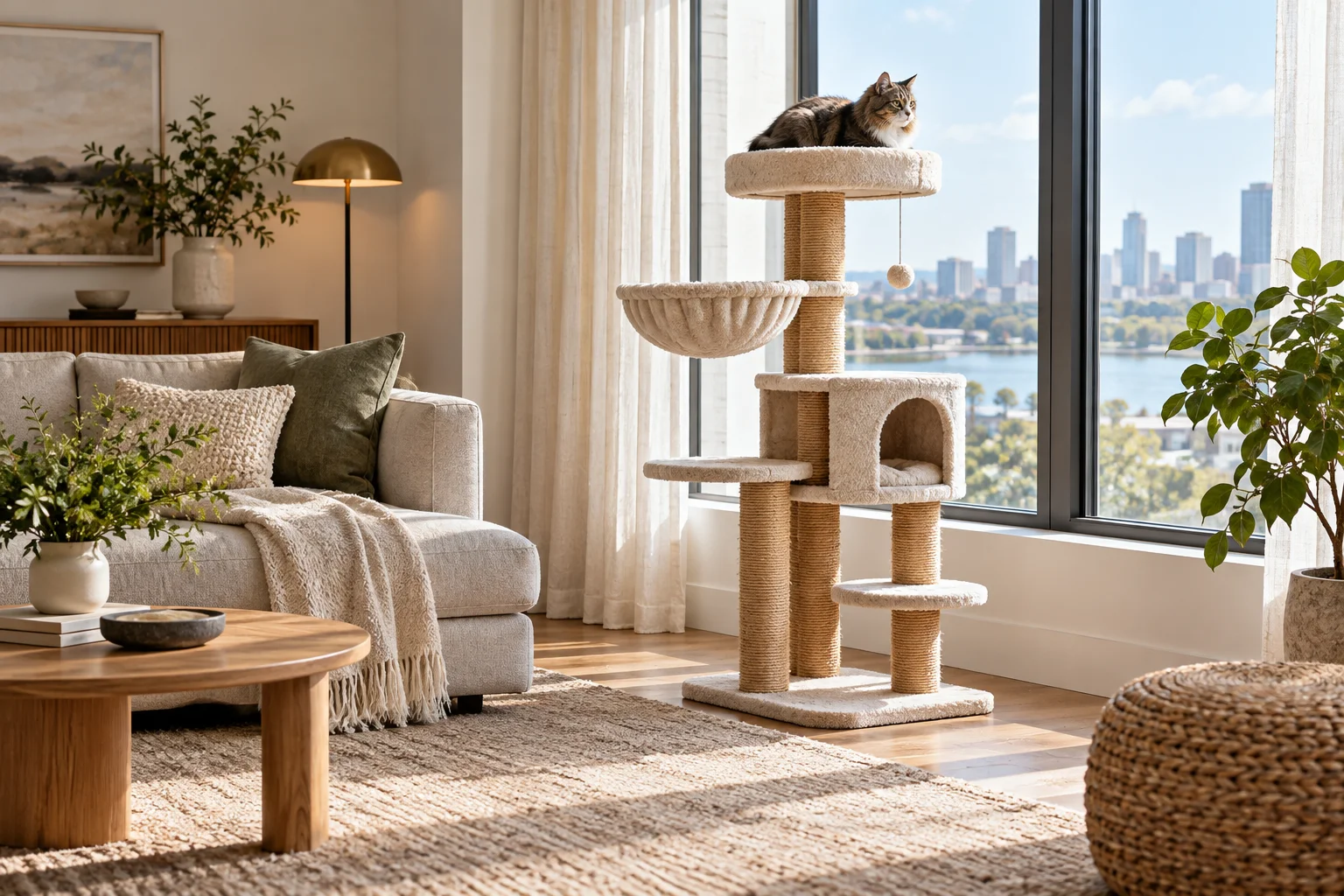
A window can give a cat a view, but a tower placed directly against the curtain may stop the fabric, block a window handle or leave no practical way to clean. Compare the window position with a side wall using the complete tree, the moving curtain and the routes used by both the cat and the household.
Two places, two different compromises
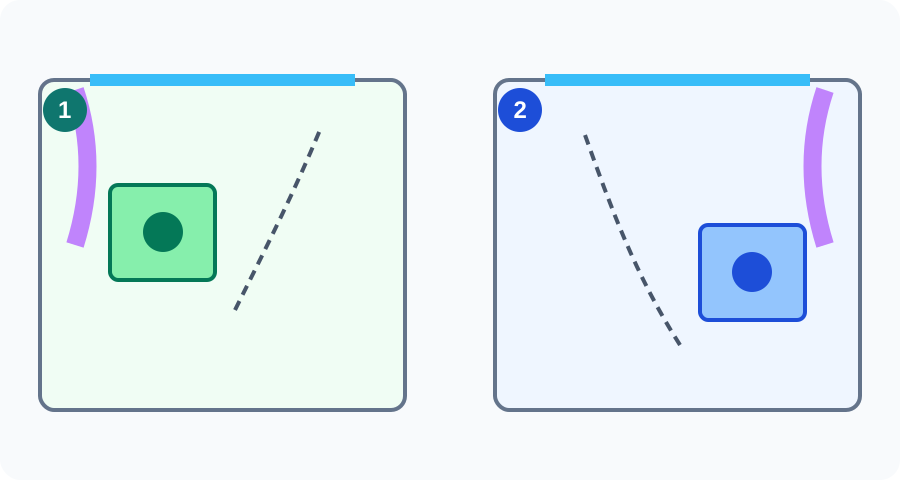
In this conceptual plan, 1 puts the tree nearer the window; 2 moves it to the side wall. Purple marks the curtain, blue marks the window and dotted lines indicate the approach to check. The shapes are not to scale. In the first position, test curtain travel and window access; in the second, check whether the cat uses the perch and whether another route is squeezed. A view alone does not establish that either location is safe.
Try this before choosing: mark both footprints, move the curtain with the window secured, then observe the cat approaching the stable tree. Use the comparison exercise only for the stated one-dimensional section; keep the window and climbing checks separate.
Measure the tree above the base
The base is only one outline. Measure platforms, hammocks, toys and any projecting posts at their widest points and note their heights. If the tree is not assembled yet, use product dimensions as provisional data and confirm the assembled shape before positioning it. The chosen location also needs a firm, level surface and must follow the product's assembly and anchoring instructions; clearance calculations do not establish stability.
Consider how your cat reaches each platform and comes back down. The space for a moving animal is not an extension that can be assigned a universal dimension. Observe the individual cat and avoid using a tall tree as a substitute for a safely secured window or screen. Check the window and its fittings independently; do not rely on the cat tree or curtain to prevent falls.
Compare the curtain position with a side wall
The following is a hypothetical one-dimensional comparison at one selected height. A 1400 mm strip must contain a 600 mm projection from the tree and a 250 mm curtain stack from the opposite side. It leaves 550 mm. If a household chooses an independent 400 mm trial allocation for reaching the curtain, the arithmetic balance is 150 mm. It does not prove that the curtain can be operated or that the cat can move safely.
Moving the tree so its projection into this same strip becomes 500 mm increases the gap to 650 mm and the balance after the same trial to 250 mm. The tradeoff may be a less direct view or less room alongside another item. Check the new position separately: a smaller number in one strip can introduce a different conflict near the wall or a door.
Test all window and curtain states
With the window secured according to its own instructions, check access to the handle and the actual opening path. Draw or mark the curtain when open, closed and gathered; account for the tieback if used. Avoid positioning cords or loops within reach of pets, and follow the window-covering manufacturer's safety guidance. A static curtain stack in a plan is not evidence that the fabric can move freely.
Mark the tree's widest platform and the base with removable tape suitable for the floor. Have another person steady a temporary mock-up while you move the curtain and reach the handle. Never stand on the mock-up. Note whether the fabric catches on platforms, whether the cleaning tool reaches the window, and whether the cat's approach shares a route with a frequently used door.
Decide what must change
If the curtain catches, first test a lateral move or a different curtain arrangement rather than compressing the fabric into an assumed width. If a side-wall position gives up the window view, observe whether the cat actually uses that perch before choosing a taller tower. If the base rocks, stop and follow the maker's instructions; adding weight or drilling into an unknown wall is not a substitute for a suitable product and fixing surface.
Keep the window-side and wall-side measurements with your plan and revisit them when the tree, curtain or furniture changes. For a broader room-level comparison, see the pet-friendly apartment layout guide.
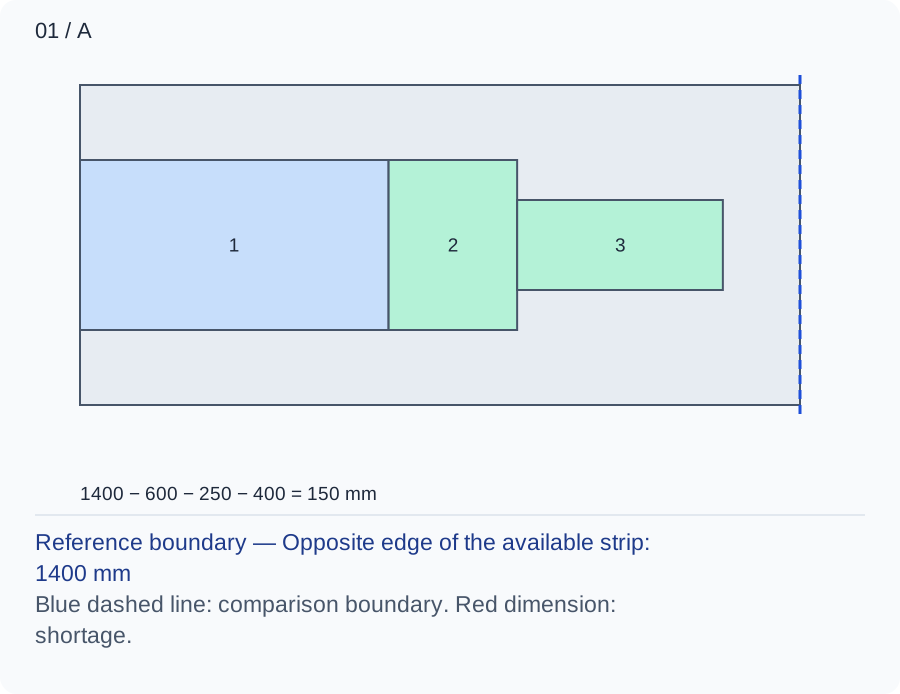
The tree and curtain bands leave 550 mm; subtracting the independently chosen 400 mm trial leaves 150 mm. The drawing omits other heights and actual fabric motion. 1: tree projection; 2: gathered curtain; 3: chosen hand-access trial. Bands are arithmetic allocations, not exact positions; the door, window swing and other heights are omitted.
Download the measurement and evidence record (CSV). Keep unknown values blank. The example uses the stated inputs. Record your own measurements and the source of each observation.
TRY THE EXAMPLE
Compare window and side-wall positions
Compare two hypothetical positions and change the curtain state. The numerical section assumes the curtain is gathered.
Near the window: check curtain travel and access to the window.
Gap before the trial allocation: 550 mm
Balance after the trial allocation: 150 mm
Gathered: check the actual stacked fabric and window handle; the drawing is conceptual.
With a stable mock-up, move the curtain and reach the window handle. Check the entire tree, its anchoring instructions, the secured window and your cat’s actual route. Conceptual illustration, not to scale. Check the actual product, full movement and surroundings; this is not a safety or installation approval.
Teaching assumptions, not a surveyed home or a construction check. Results describe this simplified geometry or budget only. Changes stay on this page and reset on reload.