Curtain Stack-Back: Keep the Window Opening Clear
Plan curtain stack-back with a measured width budget. Compare two rail spans, check each side of the window, and avoid confusing clear glass with ventilation.

Decide what “fully open” should expose
A curtain can reach the end of its rail while still covering the glass. The fabric has a compressed width, often called stack-back, and that width needs somewhere to park. The useful question before ordering is not simply whether the rail is wider than the window, but whether each parked curtain clears the part of the window you want exposed.
Here the target is the full 1600 mm width of a hypothetical window opening. It is a visual-width target, not a calculation of ventilation, daylight performance, escape clearance, or legal opening area. Handles, opening leaves, reveals, and the depth of the fabric remain separate checks. For a patio doorway, usable passage needs its own test.
Work from a sample of the actual heading and fabric
Obtain a stack-back dimension for the intended fabric, lining, heading, rail, and number of panels. If a supplier cannot confirm it, record it as unknown and test an appropriate sample before treating the layout as settled. Do not use a fixed percentage of window width as if it applied to every curtain. A sheer layer and a lined curtain may occupy different tracks and depths; their stack widths cannot automatically be added or assumed identical.
Measure the usable parking span between the relevant end limits. Decorative finials, motors, stops, and returns can make the usable span differ from the overall product length. The rail’s support and mounting requirements must be checked separately; this width exercise does not specify hardware or fixings.
Compare two symmetrical rail positions
This original teaching example uses millimetres. Both panels have a hypothetical measured stack width of 340. The initial effective span is 2160 and the 1600 window is centred within it, leaving (2160 − 1600) ÷ 2 = 280 outside the opening at each end.
| Condition | A: initial span | B: wider span |
|---|---|---|
| Effective rail span | 2160 | 2300 |
| Left stack | 340 | 340 |
| Right stack | 340 | 340 |
| Width left between stacks | 1480 | 1620 |
| Target exposed opening | 1600 | 1600 |
| Total margin | −120 | 20 |
In A, 2160 − 340 − 340 = 1480. Each 340 stack exceeds its 280 parking strip by 60, so the pair covers 120 of the target opening. Moving to B gives 350 outside the opening on each side. The same stacks leave 10 per side, or 20 in total, because 2300 − 340 − 340 − 1600 = 20.
That is a narrow geometric margin, not a robust allowance for fabric variation or an instruction to order a 2300 mm product. Confirm actual stack measurements and installation limits before choosing the order length.
Total width can pass while one side still fails
Suppose the available parking space outside the same opening is 420 on the left and 280 on the right. The total span remains 420 + 1600 + 280 = 2300, so the width budget still reports 20 spare. Yet the right stack overlaps the opening by 340 − 280 = 60, while the left side has 420 − 340 = 80 spare. Width cannot be transferred through the window merely because a sum is positive.
This is why the interactive strip is a width allocation diagram, not a literal elevation: its numbered bands are rearranged to show subtraction. Check each real stack against its actual reveal coordinate. If widening the rail is blocked by a return wall, consider a different heading or fabric with confirmed smaller stacks, or deliberately accept partial glass coverage. A one-way draw changes the parking location and stack specification; do not assume it is simply twice one of the existing stacks.
Test depth and operation before ordering
A clear front view can conceal fabric rubbing the handle, a leaf catching the hem, or a sofa trapping the closed curtain. Mark the parked stack and the closed-fabric plane in both plan and elevation. Operate the window, including normal handle movement and cleaning access. Keep heating equipment and curtain operation within their actual instructions. No mounting, fire, or child-safety compliance is certified by the width sum.
Download the curtain parking record. It has separate entries for left and right parking, stack evidence, and the target opening; unknown measurements stay blank. Write the fabric and heading specification beside each measurement so that a later product change triggers a new check.
In the interactive width budget, change the effective span from 2160 to 2300 while leaving both stacks at 340 and the target at 1600. Then change the right stack to 380: the 2300 span leaves 1580 between stacks and a −20 target margin. The diagram and results update together; reset restores A. After any positive result, do the side-by-side position check above. The apartment window-treatment guide can help compare privacy options once this parking problem is resolved.
Geometry and assumptions
Original width budget, all mm: effective rail span 2160, left stack 340, right stack 340, target opening 1600. Bands 1 and 2 represent the two stacks and band 3 the target. This is a rearranged width budget, not a literal window elevation; actual stacks sit at opposite ends.
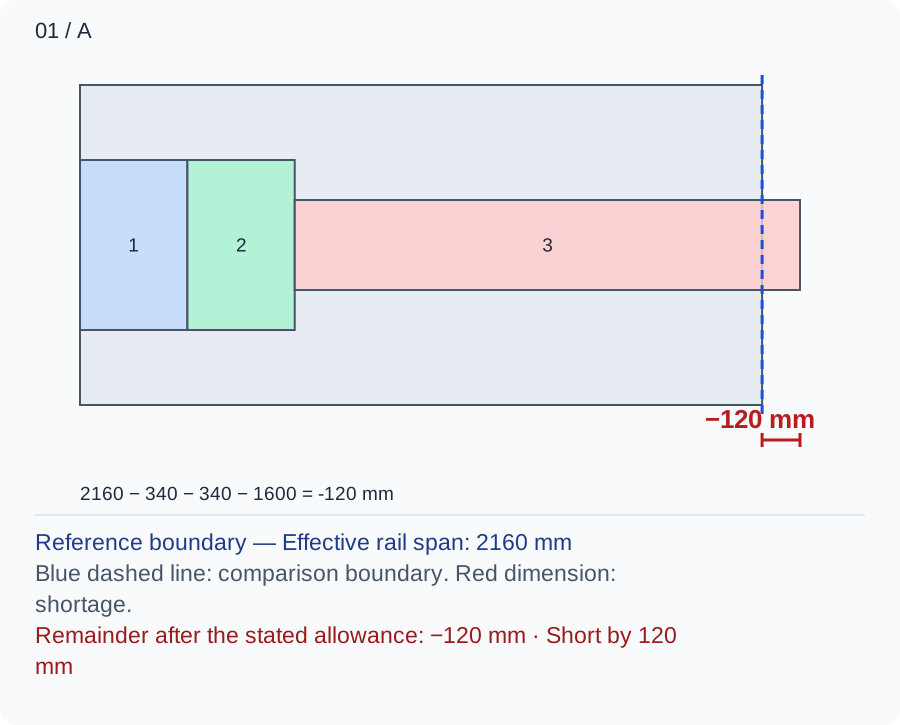
The width between stacks is 1480, leaving −120 against the 1600 target. In this symmetric example each stack exceeds the 280 outside strip by 60. Inspect the reveal position as well as the sum.
Numbers and marks identify the items described here; use the stated dimensions rather than measuring the screen.
1: Left stack width; 2: Right stack width; 3: Target visible opening. Sequential width allocations, not exact furniture positions.
| Input | A | B |
|---|---|---|
| Effective rail span (mm) | 2160 | 2300 |
| Left stack width (mm) | 340 | 340 |
| Right stack width (mm) | 340 | 340 |
| Target visible opening (mm) | 1600 | 1600 |
Changed conditions and evidence
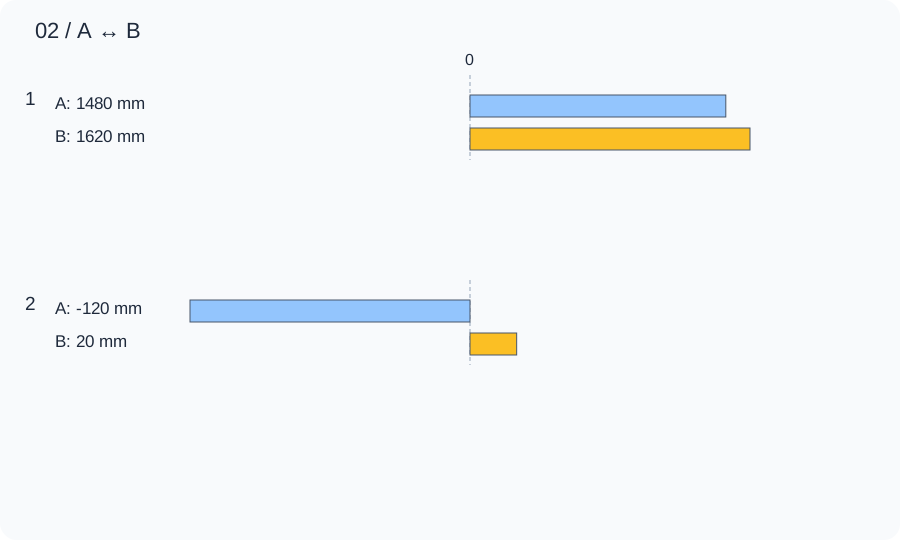
B widens the effective span to 2300 while keeping both 340 stacks. The remaining 1620 yields 20 total spare, or 10 per side only when centred. An asymmetric 420/280 parking split still blocks 60 on the right despite that same total.
| Calculated relationship | A | B |
|---|---|---|
| 1. Unoccupied cross-section | 1480 mm | 1620 mm |
| 2. Remainder after the stated allowance | -120 mm | 20 mm |
Measure each side separately with the intended heading and fabric. Open the window and operate its handle, then check the closed curtain depth. A positive width result does not verify daylight, ventilation, mounting, or safety compliance.
TRY THE EXAMPLE
Curtain Stack-Back: Keep the Window Opening Clear
Original width budget, all mm: effective rail span 2160, left stack 340, right stack 340, target opening 1600. Bands 1 and 2 represent the two stacks and band 3 the target. This is a rearranged width budget, not a literal window elevation; actual stacks sit at opposite ends.
Allowed range: 1–10000 · Step: 1
Allowed range: 0–3000 · Step: 1
Allowed range: 0–3000 · Step: 1
Allowed range: 0–8000 · Step: 1
A negative remainder means the selected allocations overlap. Change the inputs or the proposal.
- Unoccupied cross-section
- 1,480 mm
- Remainder after the stated allowance
- -120 mm
2160 − 340 − 340 − 1600 = -120 mm
Measure each side separately with the intended heading and fabric. Open the window and operate its handle, then check the closed curtain depth. A positive width result does not verify daylight, ventilation, mounting, or safety compliance.
Teaching assumptions, not a surveyed home or a construction check. Results describe this simplified geometry or budget only. Changes stay on this page and reset on reload.