Window Treatment Ideas for Apartments: Light, Privacy, Curtains
Choose apartment window treatments that balance daylight, privacy, blackout needs, furniture clearance, rental rules, and room style.
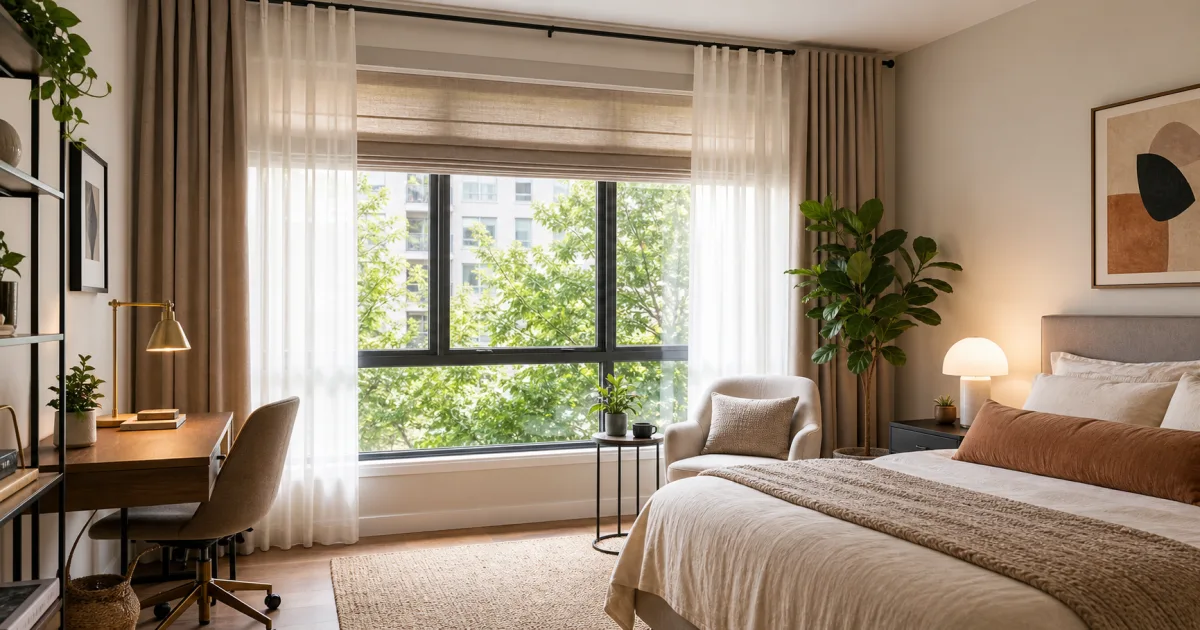
Windows decide how an apartment feels throughout the day. They control daylight, privacy, heat, glare, sleep, and the relationship between furniture and the view. Treat them as part of the layout, not as a final decoration.
The right window treatment depends on what the room needs most.
Decide the Main Problem
Choose the priority before choosing fabric:
- Privacy from neighbors or street level.
- Blackout for sleep.
- Glare control near a desk or TV.
- Heat control in strong sun.
- Softness for a room that feels hard or echoing.
One product rarely solves everything. Layering is usually better.
Layer Sheer and Blackout
Sheer curtains keep daylight while softening the view from outside. Blackout curtains or shades help bedrooms and nurseries. Together, they let the room change from bright daytime to private evening without feeling sealed off.
Mount curtains high and wide when possible. This makes the window look larger and keeps fabric from covering too much glass.
Watch Furniture Clearance
Curtains need space to hang and move. Desks, beds, radiators, sofas, and balcony doors can interfere. In Aedifex, place the main furniture near the window and check whether curtains still open cleanly.
For balcony doors, panels that slide or stack to one side often work better than heavy fabric that blocks the handle.
Renter-Friendly Options
Renters should confirm drilling rules before installing rods. Tension rods, no-drill brackets, adhesive shades, or existing track systems may be safer. Test adhesive products in an inconspicuous spot and avoid overloading them.
If the existing blinds are unattractive but functional, add curtain panels in front rather than removing them.
Match the Room Mood
Linen and cotton feel relaxed. Roman shades look tidy. Roller shades are simple and modern. Wood or woven shades add texture but may need a privacy liner.
For small rooms, choose fabric close to the wall color to reduce visual breaks. Pair this with Lighting Design for Small Rooms and test the full room in the Interior Design workflow.
Choose by Room Function
Bedrooms need sleep control first. Use blackout curtains, blackout roller shades, or layered sheer plus blackout panels. If street light leaks around the edges, mount wider than the window and consider side returns where possible.
Living rooms need flexible daylight. Sheers, linen curtains, woven shades, or light-filtering rollers usually work better than full blackout. The room should feel private in the evening without becoming dark during the day.
Home offices need glare control. A beautiful sheer may not be enough if the sun hits the monitor. Use adjustable shades, top-down bottom-up options, or curtains that can block the exact angle of light.
Kitchens and bathrooms need moisture-aware materials. Avoid heavy fabric near sinks, cooking steam, or poor ventilation. Roller shades, washable curtains, or moisture-resistant blinds are usually easier to maintain.
Mounting and Proportion
High and wide curtain mounting usually makes windows look larger, but only if there is enough wall space. Extend the rod beyond the window so curtains stack beside the glass instead of covering it. This preserves daylight and makes the room feel wider.
For low ceilings, avoid heavy headers and bulky rods. A simple track close to the ceiling can feel cleaner. In modern apartments, ceiling tracks often look more intentional than short rods mounted just above the frame.
Curtain length should look deliberate. Floor-length panels feel finished in living rooms and bedrooms. Sill-length treatments can work in kitchens, bathrooms, and windows above radiators or desks.
Privacy and View
Privacy is not the same at every hour. A sheer that works during the day may become transparent at night when the lights are on. Test from outside if possible, or assume that evening privacy needs a second layer.
If the apartment has a good view, do not hide it with heavy fabric during the day. Use side-stacking panels, solar shades, or woven shades that soften glare while preserving some view.
Common Mistakes
The first mistake is buying curtains before measuring stack space. Fabric needs somewhere to go when open.
The second is choosing a pattern without checking the whole room. Window treatments are large vertical surfaces; a busy pattern can dominate a small apartment.
The third is ignoring cleaning. Dust, cooking residue, and pet hair collect on fabric. Choose washable or easy-care materials for high-use rooms.
Before You Order
Measure the window, wall space above it, stack space on both sides, sill depth, radiator position, furniture clearance, and door or balcony movement. Then decide whether the treatment needs to filter light, block light, add privacy, reduce heat, soften sound, or simply finish the room. The right product follows the job, not the other way around.
For awkward windows, start with the least permanent solution. A good tension shade, no-drill bracket, or layered curtain on an existing track can solve the problem without creating move-out repair work.
Window Treatment Ideas for Apartments: Light, Privacy, Curtains
Assume an apartment bedroom needs daytime light and nighttime privacy from the same window. Compare sheer-only and layered treatments with the existing bed, heater and handle positions held fixed.
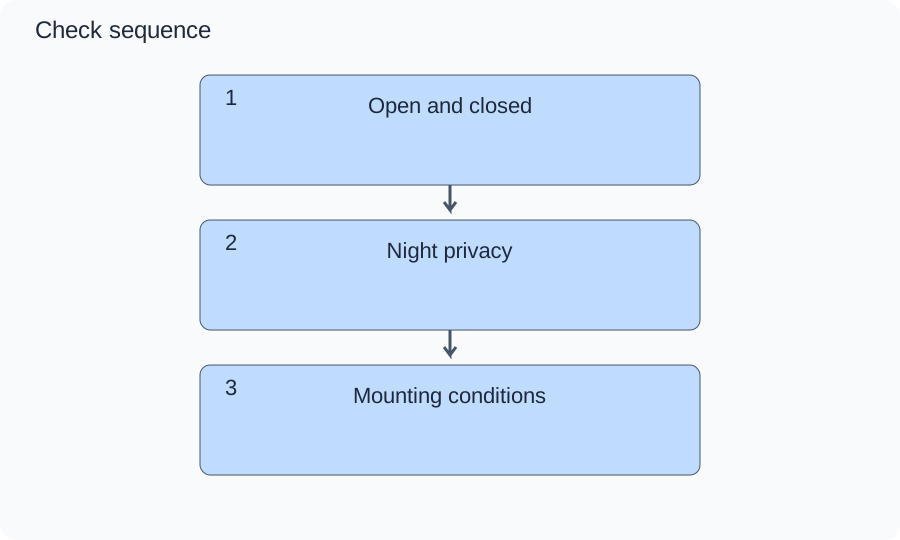
The workflow compares open and closed treatment states, nighttime privacy and mounting conditions. Its evidence boxes request actual fabric movement and a permitted nighttime observation before accepting the window solution.
Numbers and marks identify the items described here; use the stated dimensions rather than measuring the screen.
1–3 refer to the evidence steps below. A highlighted step is selected, not automatically verified.
| Step / option | What to check |
|---|---|
| 1. Open and closed | Measure both the closed fabric and fully gathered stack at the actual window. Note the handle and furniture they must pass without catching. |
| 2. Night privacy | With permission, inspect the lit room from the relevant outside viewpoint. Record visible silhouettes before choosing sheer-only or layered treatment. |
| 3. Mounting conditions | Check the frame substrate, fastening instructions and any cord-control requirements. Do not install a removable system unless that exact mounting condition is supported. |
Changed conditions and evidence
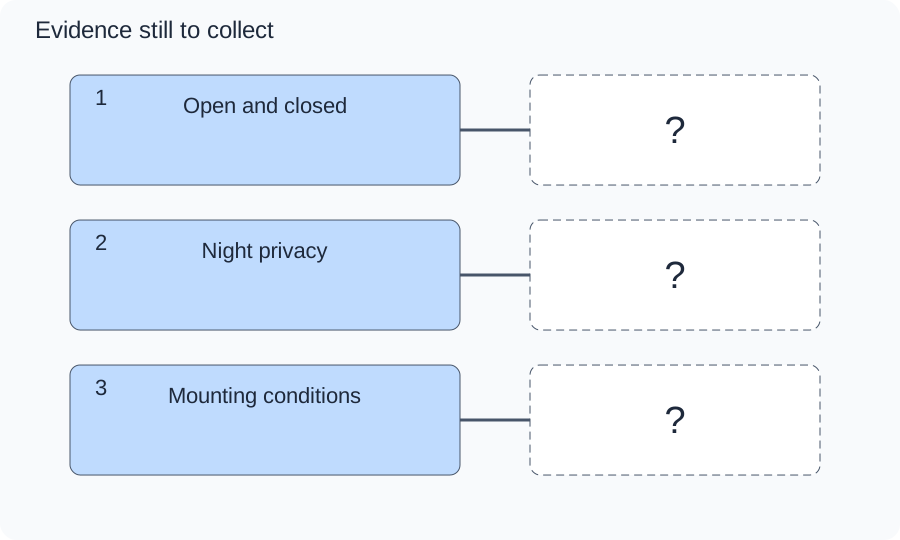
If the blackout layer catches a radiator or blocks window operation, compare a suitable different treatment with moving nearby furniture. The solution may reduce drape volume or change the room’s appearance, but cannot ignore heat and mounting instructions.
The question marks are evidence still to obtain, not a completed check.
Operate the selected sample or mock-up through its full travel and check the normal nighttime lighting condition. Confirm permission, substrate and product-specific cord safety before installation; removable mounting is not automatically suitable for every frame.
TRY THE EXAMPLE
Window Treatment Ideas for Apartments: Light, Privacy, Curtains
Assume an apartment bedroom needs daytime light and nighttime privacy from the same window. Compare sheer-only and layered treatments with the existing bed, heater and handle positions held fixed.
Measure both the closed fabric and fully gathered stack at the actual window. Note the handle and furniture they must pass without catching.
Operate the selected sample or mock-up through its full travel and check the normal nighttime lighting condition. Confirm permission, substrate and product-specific cord safety before installation; removable mounting is not automatically suitable for every frame.
Teaching assumptions, not a surveyed home or a construction check. Results describe this simplified geometry or budget only. Changes stay on this page and reset on reload.