Will Your Dining Chair Arms Fit Under the Table Apron?
Compare the lowest apron edge with the highest chair arm, then check the leg opening and insertion depth using a worked example before choosing a pair.
A table's advertised height is the wrong clearance
If the chair arms stop at the table edge, the chair stays farther into the room even though its seat fits comfortably. The purchase question here is whether an unoccupied chair can slide level into its intended parked position. Seat comfort and the aisle behind someone eating are separate checks; see the dining table layout guide for the room-level decision.
Use the finished floor beneath the actual table and chair as one vertical datum. Measure the highest point of both arms, including caps and upholstery, without relying on someone's weight to compress the chair. Under the table, follow the insertion route and identify the lowest apron, bracket, or extension mechanism. A tabletop height minus tabletop thickness can miss a much lower apron.
A 10 mm collision hidden by a 750 mm tabletop
This is an original hypothetical example, not a measured product pair. All lengths are millimetres. Tabletop top is 750 above the floor. The lowest obstruction extends 85 down from that top, including tabletop thickness, so the available underside height is 750 − 85 = 665. Do not subtract the tabletop thickness again.
| Check | Chair A | Alternative B |
|---|---|---|
| Highest unloaded arm | 675 | 650 |
| Apron underside | 665 | 665 |
| Physical vertical gap | −10 | 15 |
| Gap after a chosen 10 mm trial allowance | −20 | 5 |
A fails before the allowance is considered: the arm reaches 10 above the apron underside. B lowers only the arm height by 25 and gives 15 of geometric separation. The 10 allowance is a teaching input for a mock-up, not a universal tolerance. It leaves 5 in B but does not certify the chair's insertion path.
Change these four dimensions in the fit exercise. Its downward band is the whole 85 obstruction measured from the tabletop top; the lower block represents the height up to the arm, not a solid chair shape. Compare physical gap and allowance margin separately. An arm height of 660 gives a physical gap of 5 but a margin of −5 after the chosen 10 allowance: there is no physical collision in this section, only an unmet allowance. At an arm height of 665 the arm physically touches the apron, and the allowance margin is −10; the overall feedback therefore still warns of unmet allocations rather than showing a contact-only state. The dashed arm-top boundary uses a downward coordinate from the tabletop: 750 − 675 = 75 for A. That 75 is not the arm height above the floor, which is 675. Refreshing the page resets the exercise; save your own evidence outside it.
Check the mouth of the table, not just the height
Suppose the opening between the legs at arm level is 600 and the chair's maximum arm-to-arm width is 570. Centering gives (600 − 570) / 2 = 15 each side. If the chair approaches 20 off centre, one side has 15 − 20 = −5: there is a collision despite positive total width. Tapered legs can make the opening smaller farther in, so repeat the width check at the final parking depth.
For depth, mark the first arm point that would cross the apron. In this example the desired insertion from that point is 240, but a cross brace stops the chair after 210. The 30 shortfall remains even with B's lower arms. Record how far the back of the parked chair then projects into the route; do not assume all of the seat disappears under the table.
A low-risk trial before choosing the pair
- Record the floor surface, glides, arm maximum, and underside profile at the intended seat position. Save a photo with the measurement endpoints visible.
- Ask for the actual leg and brace drawing when shopping remotely. A missing underside drawing is an unresolved question, not permission to infer a clear rectangle.
- Mark the 600 opening and the desired 240 insertion with removable tape or a full-size outline. A template can reject a collision but cannot prove upholstery compression or structural compatibility.
- With an available sample, slide the empty chair straight and level through its intended path without forcing it. Stop at contact. Check both arms and legs, including the return trip.
- Recheck on the actual rug or floor. Changing glides or adding a rug under only the chair changes the relative height; tilting the chair to get under is a different, less convenient parking action.
What to change when it fails
A lower-arm chair preserves the table but may change arm support and comfort, which needs a seated trial. An armless chair removes this arm collision while changing the way the seat feels. Keeping A partly out avoids a product change but consumes room behind it. A table with a higher clear underside can work only after checking its legs and mechanisms. Do not cut an apron, remove a brace, or add improvised table risers on the strength of this calculation.
Download the chair/apron measurement record (CSV). The example column preserves the assumptions above; enter your own readings separately, attach the product drawing or photo reference, and leave unknowns visible. Its depth and width rows prevent a positive vertical result from becoming an unsupported “fits” decision. Use the room measurement guide if the floor and endpoint references are unclear.
Geometry and assumptions
Original side-section height budget, mm: tabletop top 750 above the floor, total downward obstruction 85 including the top, unloaded arm maximum 675, chosen trial allowance 10. The apron underside is 665. The net-height result is the physical gap between the apron underside and arm top; the margin subtracts the chosen teaching allowance as well. With the arm at 660, the gap is 5 and the margin −5: the arm does not collide in this section, but the 10 allowance is unmet. At 665 the arm physically touches the apron, while the margin is −10, so the overall feedback still warns of unmet allocations. The dashed arm-top boundary is located downward from the tabletop by tabletop height minus arm height; this is not its height above the floor.
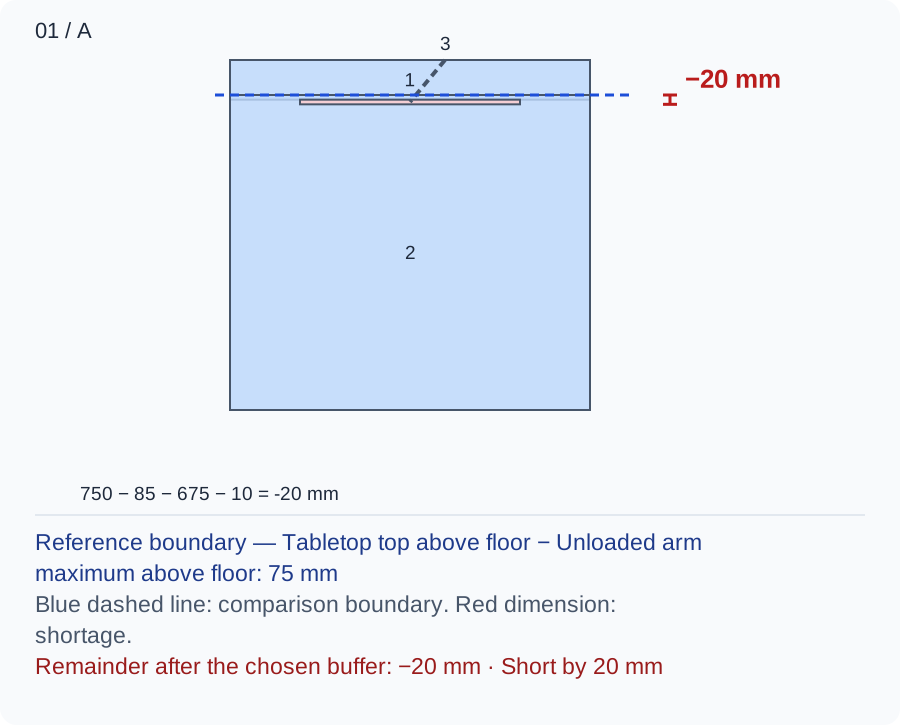
Band 1 hangs down from the tabletop; block 2 reaches up from the floor. They overlap by 10 before band 3 is considered. The physical gap is −10 and the allowance margin −20; this is a collision, not merely a missed preference.
Numbers and marks identify the items described here; use the stated dimensions rather than measuring the screen.
1: total downward obstruction including tabletop; 2: floor-to-arm height envelope; 3: chosen gap below the obstruction. Widths are schematic; legs and insertion depth are omitted. The blue boundary is the arm top. Its displayed coordinate is measured down from the tabletop, not up from the floor: A is 750 − 675 = 75; B is 750 − 650 = 100.
| Input | A | B |
|---|---|---|
| Tabletop top above floor (mm) | 750 | 750 |
| Total downward obstruction (mm) | 85 | 85 |
| Unloaded arm maximum above floor (mm) | 675 | 650 |
| Chosen trial gap (mm) | 10 | 10 |
Changed conditions and evidence
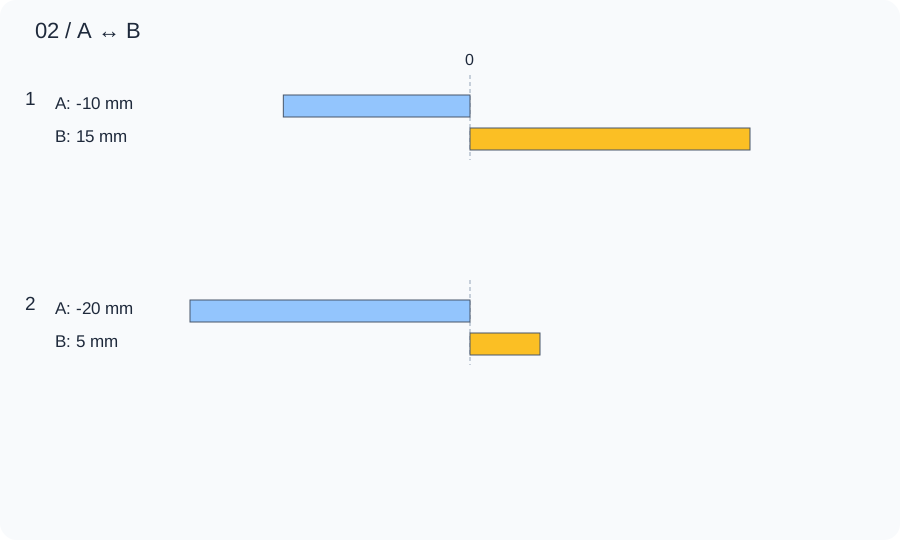
B lowers the arm from 675 to 650 without changing the table. Gap becomes 15 and the 10 trial leaves 5. Compare support comfort and check the leg opening; the lower arm does not solve a depth obstruction.
| Calculated relationship | A | B |
|---|---|---|
| 1. Actual apron-to-armrest gap | -10 mm | 15 mm |
| 2. Remainder after the chosen buffer | -20 mm | 5 mm |
Measure both arms and the lowest point along the entire insertion path on the actual floor. Test the empty chair level; stop at contact. Confirm width, depth and product instructions separately. A positive result is not installation approval.
TRY THE EXAMPLE
Will Your Dining Chair Arms Fit Under the Table Apron?
Original side-section height budget, mm: tabletop top 750 above the floor, total downward obstruction 85 including the top, unloaded arm maximum 675, chosen trial allowance 10. The apron underside is 665. The net-height result is the physical gap between the apron underside and arm top; the margin subtracts the chosen teaching allowance as well. With the arm at 660, the gap is 5 and the margin −5: the arm does not collide in this section, but the 10 allowance is unmet. At 665 the arm physically touches the apron, while the margin is −10, so the overall feedback still warns of unmet allocations. The dashed arm-top boundary is located downward from the tabletop by tabletop height minus arm height; this is not its height above the floor.
Allowed range: 1–3000 · Step: 1
Allowed range: 0–3000 · Step: 1
Allowed range: 0–3000 · Step: 1
Allowed range: 0–200 · Step: 1
A negative remainder means the selected allocations overlap. Change the inputs or the proposal.
- Actual apron-to-armrest gap
- -10 mm
- Remainder after the chosen buffer
- -20 mm
Reference boundary — Tabletop top above floor − Unloaded arm maximum above floor: 75 mm
Blue dashed line: comparison boundary. Red dimension: shortage.
Remainder after the chosen buffer: −20 mm · Short by 20 mm
750 − 85 − 675 − 10 = -20 mm
Measure both arms and the lowest point along the entire insertion path on the actual floor. Test the empty chair level; stop at contact. Confirm width, depth and product instructions separately. A positive result is not installation approval.
Teaching assumptions, not a surveyed home or a construction check. Results describe this simplified geometry or budget only. Changes stay on this page and reset on reload.