Dining Table Mat Storage: Check Flat and Rolled Size
Choose where to store a dining table protector by comparing its flat size, rolled length and the space needed to handle it.
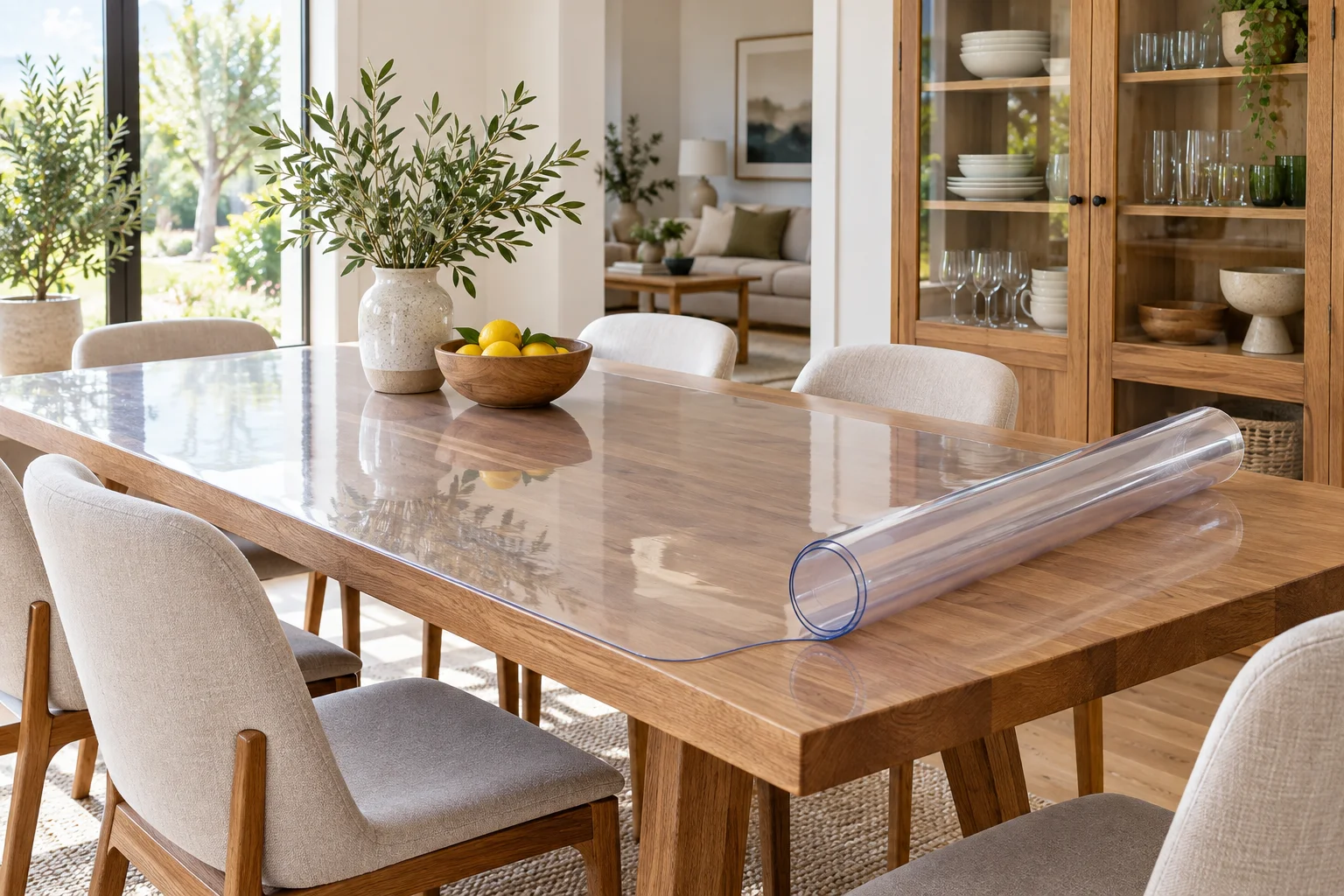
A protective mat may cover the table neatly yet have nowhere convenient to go when the table is extended or used without it. Before buying or cutting a mat, compare the flat dimensions, the maker's storage instructions and the actual path to the proposed storage position.
Start with the tabletop and the mat's intended use
Measure the tabletop at its usable outer edges, including rounded corners and any extension leaves. Decide whether the mat should remain on the extended table, cover only the closed top or be removed for particular activities. A protector that fits the closed table does not automatically fit the extended one. Check the manufacturer's advice for the table finish, heat, cleaning and storage; a layout diagram cannot establish material compatibility.
In this example, a rectangular mat is 1200 mm long and 700 mm wide. The household compares storing it flat in a 1250 mm long opening with rolling it so that the roll length is 700 mm. The flat option has 50 mm arithmetic length difference before any handling allowance; the roll has 550 mm. These numbers do not prove either fits: width, roll diameter, door opening and the material's permitted bend are separate unknowns. Do not roll a mat unless the maker permits it.
Compare flat and rolled handling
A flat mat needs a clean supporting surface large enough for its entire outline and a route that avoids folding it unintentionally. A rolled mat needs the measured roll diameter and length, room to grip it, and a way to keep it from unrolling that follows the product instructions. The roll length depends on which edge is rolled; do not assume the shorter dimension is always an acceptable roll axis.
Mark the storage opening and the mat outline using floor-safe removable tape, or use a lightweight paper template. Without blocking a door or carrying an unstable object overhead, trace the movement between table and storage. Ask for help with a large flexible mat. Stop if the route requires bending beyond the manufacturer's instructions or if the material catches on a sharp edge.
Check the table in both states
For an extendable table, operate the leaves using the table maker's instructions. Check where the mat goes while the table changes shape and whether it obstructs the mechanism. Record the closed and extended dimensions separately. A mat that hangs over an edge may be pulled unintentionally; assess the actual household and product rather than assuming overhang is safe.
If neither storage position works, compare a smaller permitted protector, a different material, or leaving the table unprotected for the chosen activity. A smaller mat exposes more surface, while a different material may behave differently with the finish. Record unknown compatibility rather than guessing. The extendable dining table guide helps check the furniture's own operating space.
Keep a practical record
Write down the flat length and width, allowed storage method, actual rolled dimensions if applicable, storage opening and observations from the handling trial. Recheck if the mat or table changes. The interactive sequence below identifies evidence to collect; selecting a step does not certify material compatibility or handling safety.
Download the measurement and evidence record (CSV). Keep unknown values blank. The example uses the stated inputs. Record your own measurements and the source of each observation.
Geometry and assumptions
Hypothetical 1200 × 700 mm mat and 1250 mm opening. Flat length differs by 50 mm; if rolling in the stated direction is allowed, roll length is 700 mm and differs by 550 mm. These length differences do not establish fit.
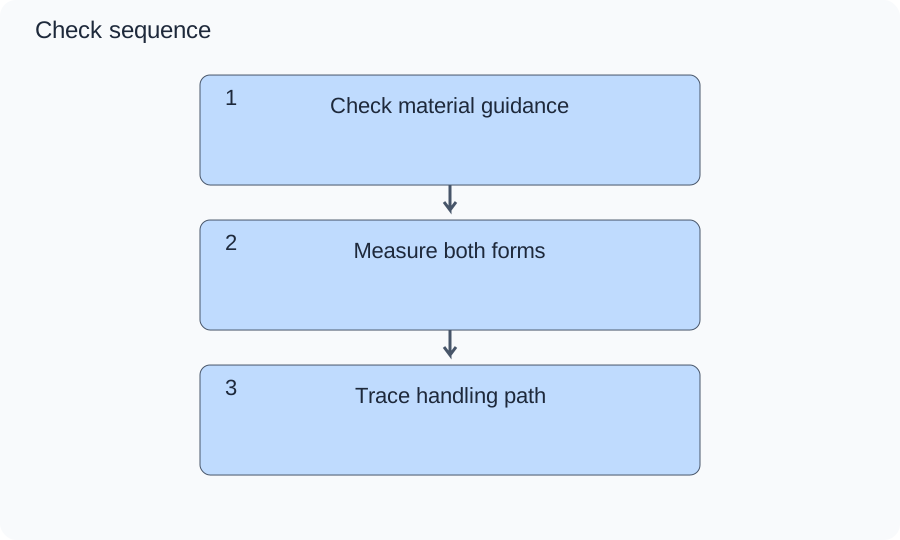
Follow the sequence from material instructions to flat and rolled handling. Question marks mean evidence remains to be gathered.
Numbers and marks identify the items described here; use the stated dimensions rather than measuring the screen.
1–3 refer to the evidence steps below. A highlighted step is selected, not automatically verified.
| Step / option | What to check |
|---|---|
| 1. Check material guidance | Find the table finish and mat maker’s compatibility, heat and permitted storage guidance; record unknowns. |
| 2. Measure both forms | Measure flat length and width and, only if permitted, the actual roll length and diameter; measure the entire storage opening. |
| 3. Trace handling path | Use a light template or assisted handling to trace table-to-storage movement without an unsupported bend or blocked door. |
Changed conditions and evidence
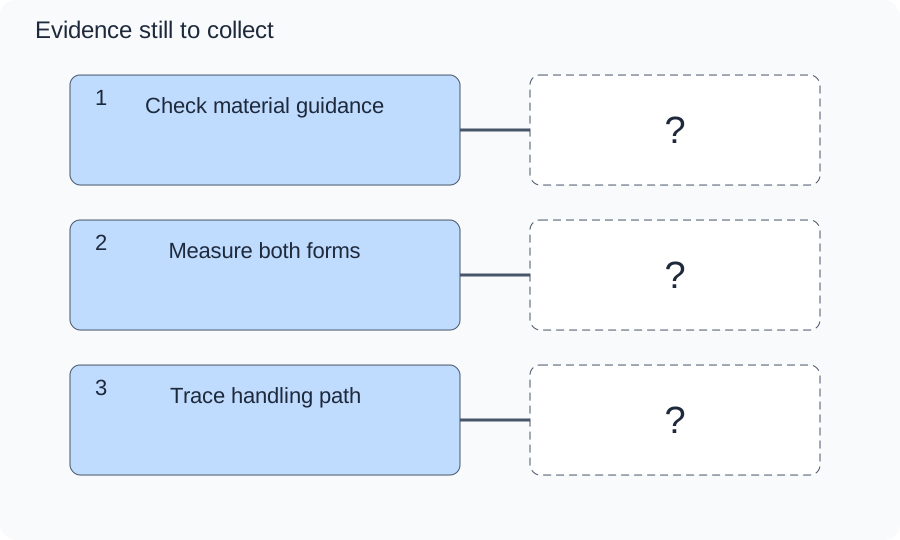
If rolling is not permitted or the roll diameter is unknown, compare a flat support or a different permitted protector. A smaller length alone does not establish compatibility.
The question marks are evidence still to obtain, not a completed check.
Obtain the maker’s storage and finish instructions, measure the full opening and allowed roll, then trace the actual handling path. Do not treat selection of a step as a completed check.
TRY THE EXAMPLE
Compare mat storage evidence
Hypothetical 1200 × 700 mm mat and 1250 mm opening. Flat length differs by 50 mm; if rolling in the stated direction is allowed, roll length is 700 mm and differs by 550 mm. These length differences do not establish fit.
Find the table finish and mat maker’s compatibility, heat and permitted storage guidance; record unknowns.
Obtain the maker’s storage and finish instructions, measure the full opening and allowed roll, then trace the actual handling path. Do not treat selection of a step as a completed check.
Teaching assumptions, not a surveyed home or a construction check. Results describe this simplified geometry or budget only. Changes stay on this page and reset on reload.