Dish-Drying Mat: Size for Counter and Folded Storage
Compare a dish-drying mat's flat counter footprint with one folded storage slot, then check drying, seams and actual access before choosing.
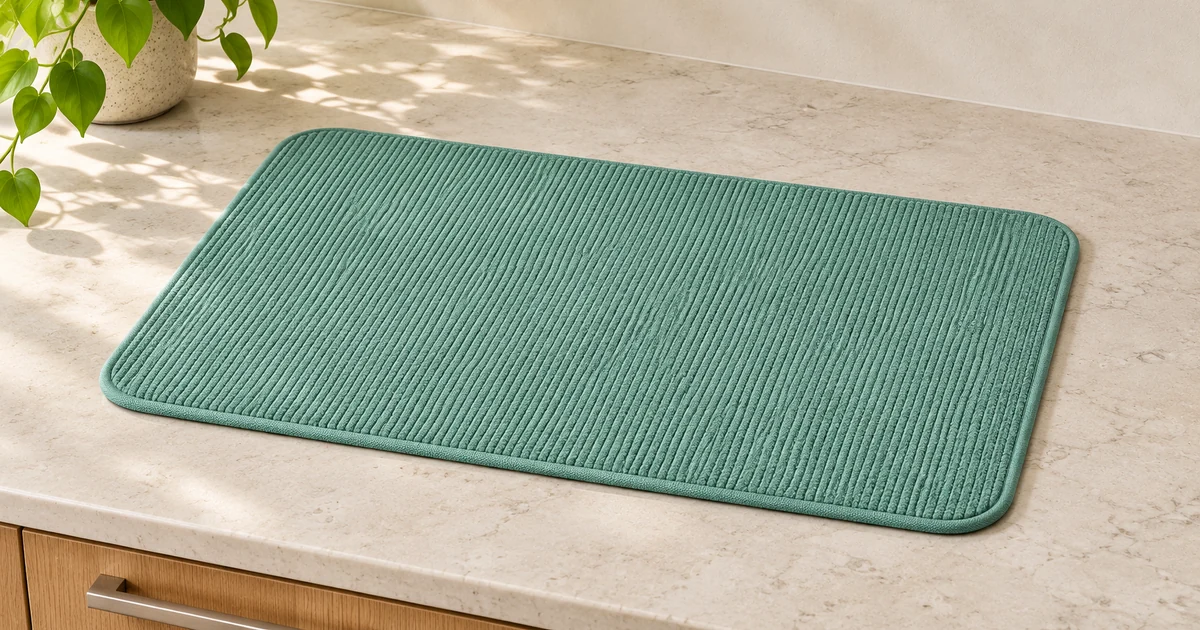
Drying mat flat and folded
The 500 × 400 × 6 mm mat leaves 100 mm of total width and 50 mm of depth on the worktop. The ideal 250 × 400 × 12 mm folded mat fits the 300 × 450 × 20 mm opening with 8 mm of height to spare.
A dish-drying mat needs a useful position when spread out and a separate place after use. A large mat may cover the preferred washing-up area but occupy too much counter; folding can make it easier to store while introducing thickness and a care question. Choose using the mat's actual size, the dishes you dry and the manufacturer's drying and storage instructions. If the folded thickness or its drying location is unknown, measure or test it before buying a narrow slot.
The numbers here are hypothetical teaching assumptions in millimetres. One ideal fold halves the mat's width and doubles its thickness; real seams, stiffness, compression and trapped air can change the result. A geometric fit does not prove that a damp mat is dry, clean or suitable for enclosed storage.
Check the spread-out footprint
Assume a clear counter area 600 mm wide × 450 mm deep beside the sink, after fixed objects are excluded. A mat 500 × 400 mm leaves total differences of 600 − 500 = 100 mm in width and 450 − 400 = 50 mm in depth. Those differences are split between edges according to where the mat is placed; they are not automatically usable hand space.
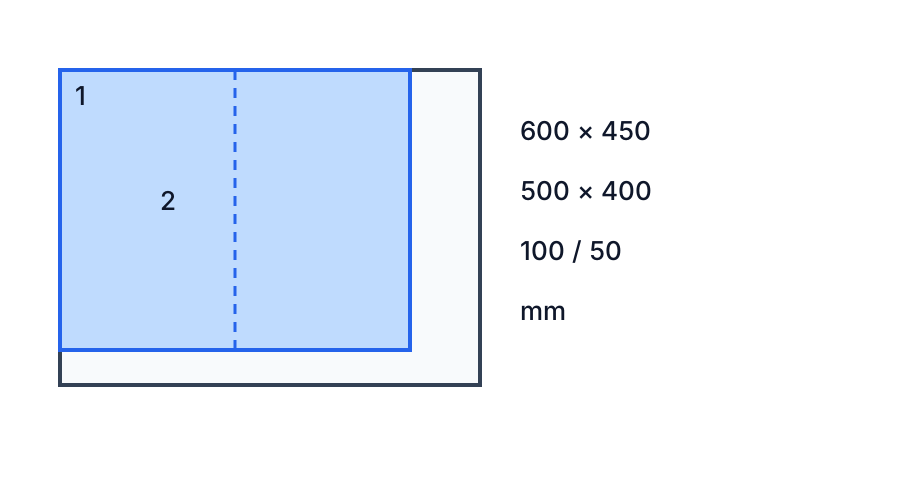
Open the full-size counter plan
The outline is 1, the mat is 2, and the dashed line indicates the assumed fold direction. Look at the narrow depth difference before deciding where to put the mat: the sink edge, taps and dish handles can occupy space not represented here. Place actual clean dishes as you normally would and check the counter route and manufacturer guidance; the plan alone does not show whether dishes are stable or how water drains.
Compare the folded envelope with the slot
Imagine a mat 6 mm thick, folded once across its 500 mm width. An ideal fold creates an envelope 250 × 400 mm and 12 mm thick. In a slot 300 mm wide × 450 mm deep × 20 mm high, the calculated differences are 50 mm wide, 50 mm deep and 8 mm high. The slot's mouth, dividers and protrusions must be measured independently.
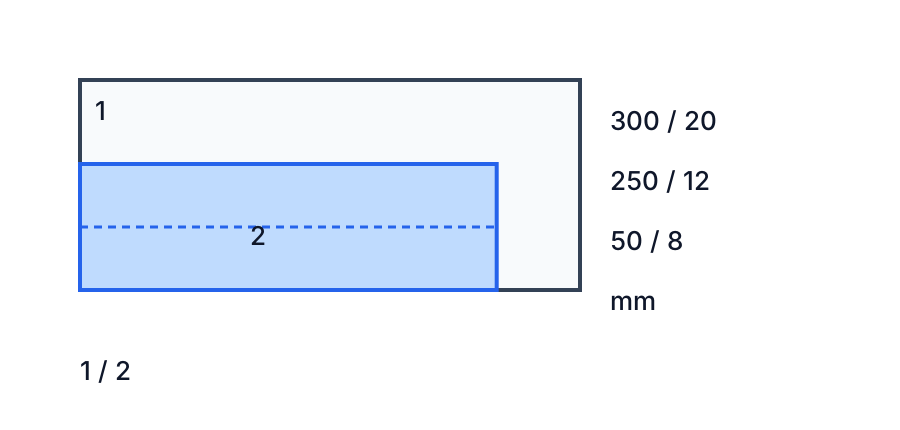
Open the full-size folded-slot section
The section is schematic and not to scale: 1 is the slot and 2 the two-layer mat. It shows width and thickness, while the depth comparison is separate. In a 10 mm high slot the ideal folded thickness exceeds the opening by 2 mm; do not force the mat in or compress an unknown material to make the arithmetic pass. A rolled, hung or unfolded storage method may be more appropriate for a particular product, but each requires its own dimensions and care check.
In the flat and folded comparison, switch states and enter the actual mat, counter and slot dimensions. A blank input stays unknown. The folded state reports all three differences; a positive value only fits the assumed envelope. Follow the care label to decide how the mat is cleaned, dried and stored. Folding an item that fits does not establish that it has dried or that a closed space has enough airflow.
Shortlist a mat only after you know where it spends the day
The mat has three jobs in three places. While dishes drain it needs worktop area and a way for you to keep using the sink. After the dishes are gone it needs the drying arrangement specified for that product. Once it is ready to store, the mat needs to go through the narrowest point of a slot or sit in a separate open position. A label that says the mat is a certain width addresses just one of these conditions. Start with the condition that is hardest to change in your kitchen. If the only available storage is a very low slot, a comfortable countertop footprint is not enough reason to keep that candidate on the list.
Use the illustrations above before shopping. The plan compares the area occupied when the mat is spread out with what is left on the worktop. The section compares the folded article with the opening it has to pass through. Between those two measurements is an unmeasured state in the example. You need to find an actual drying place in your kitchen and confirm it with the care instructions. For a particular mat it might be a flat surface or a supported hanging position. An instruction to dry it a different way has to change the layout you are evaluating.
| Decide this first | A useful measurement or observation | Candidate to remove from the list |
|---|---|---|
| Dish load | Footprint of the plates and bowls in your ordinary wash | A mat that needs a second round you are unwilling to do |
| Working surface | Space left for the actual sink route while dishes sit on the mat | A mat that overlaps the tap or working area at the time you need it |
| Drying position | Place and orientation permitted by the real care instructions | A product that cannot be dried as directed in the available place |
| Stored envelope | Thickness at the folded seam or full dimensions unfolded, with smallest opening | An arrangement that depends on squeezing an unverified fold through a narrow mouth |
Notice that the table asks you to cross out arrangements, rather than hunt for one universal size. A larger mat that handles a weekly pan could still crowd the place used every morning. A mat that looks thin when open might become awkward at its folded edge. A mat that can be stored flat might be more convenient than either of those options if you have a full-width drawer and an uncomplicated drying position. The best candidates are the ones whose compromises match the way dishes really move.
Use an ordinary load and a separate large load
Pick the closest thing to a regular wash. It might be two breakfast bowls and a glass, or several plates and a cutting board that is washed according to its instructions. Use clean, empty items for a layout exercise. Lay them out where you normally expect them to go and mark the rectangle on a piece of paper. Large handles and stems matter. Keep the items stable according to their care and the mat's instructions. The aim is to see the actual footprint and the space where a hand puts an item down, rather than to estimate an extra margin based on the number of plates.
Write a second entry for the awkward load. A large pot you wash once in a while should be represented by its outside shape and handle, not just its round base. A board that fits sideways might project over the area used to reach the tap or place a brush. If that load can be staged separately, you avoid choosing a mat that permanently occupies more of the worktop than you need. A larger candidate makes more sense when the load with wide handles also happens regularly and you are prepared to dedicate that space to it.
Time the sequence in the practical sense of noting what is happening together. Does someone wash dishes while somebody else uses the only remaining surface to prepare food? Do you need space beside the sink just until the last bowl is washed, after which you clear the whole area? A little space that can be borrowed in the second situation may be completely unavailable in the first. Instead of memorising a target size, write the two activities on the plan and circle the instant you need both. That tells you how much clear space qualifies for the comparison.
First screen the candidate on the worktop
Start at the part of the sink you actually use. The clear counter area in the example is measured after fixed items are excluded. In a real kitchen, the end of that patch may be the sink rim at one point and the side of an appliance at the other. If the available area is stepped, compare the mat at the angle and offset you intend to use. A single large rectangle drawn over an indentation makes room where there is no backing. A smaller measured rectangle is a better starting point if the mat and the dishes on it will need continuous support in that place.
Look at the depth as well as the width. Across the 600 mm example the 500 mm mat leaves 100 mm total. If centred it would leave a 50 mm difference on either side. Along the 450 mm depth, a 400 mm mat leaves only 50 mm total, or 25 mm on each edge if also centred. Moving the mat back by 20 mm would leave 5 mm at the rear and 45 mm at the front. The total still reads 50 mm. Those numbers do not say which location is usable. They tell you where to look for a difficulty with the tap, sink rim, adjacent item or a hand carrying a dish.
Try placing the mat close to the sink without assuming that it can extend over the edge safely. Trace the rim and the nearest object with painter's tape or draw them on paper. A rectangular overlap with an appliance that can readily move is a different problem from an overlap with a fixed sink. Try comparing positions where neither edge intrudes. Check the conditions for support, drainage and use from the actual mat and worktop instructions. Shifting a mat towards the sink may shorten a wet dish's journey, yet leave less opportunity to put a lid down temporarily. The relevant loss is that particular place, rather than a bare number in the width calculation.
Test a different orientation before deciding on a different size
Rotating the example mat switches the two comparisons. You would put its 400 mm side across the 600 mm width and its 500 mm side into a 450 mm depth. It leaves 200 mm across and fails by 50 mm along the depth. A customer looking only for width left for a second appliance could see an apparent improvement from 100 to 200 mm and miss the new failure. Make both axis comparisons every time you turn a template. When the product has a directional fold, backing or edge, confirm its intended orientation separately.
A candidate with a 450 × 350 mm footprint would leave 150 mm of total width and 100 mm of total depth on the same patch. That is another teaching size, not a recommendation. Think of it as 50 mm more clear space on each axis than in the original case, before choosing the offset. Lay out the regular load on a paper outline of the smaller size and see what changes. It may still hold everything you need if the dishes are compact. It may make the larger dishes more awkward and require another place for lids. Only after choosing your priority load can you tell whether the extra free worktop is worth using a different mat.
If the conflict is in one corner occupied by a sink accessory, map that corner and move your paper outline within the remaining surface. Corner interference with a specific item may be avoidable by looking for a different shape or offset, while a fixed depth shortage across the whole mat remains a shortage. Check the backed area under each loaded part of the usable mat. Do not count a soft corner over an unsupported edge as if it were worktop. You can keep the existing mat for a less busy counter position if it fits that position and can be used there according to its instructions.
Check what is left for the hand that places the dish
The margin beside a spread mat is not automatically the space available for putting down a dish. A pot's handle can extend over the margin, and your hand still has to release the pot in a stable place. Simulate the first and the last items in an ordinary load. The first is placed on an almost empty mat. The last often arrives when the only open part is furthest from the sink or hemmed in by bowls. That second observation is particularly useful for deciding between a larger mat and a two-stage wash. A larger mat may supply more perimeter without creating a clear route to the last spot.
A second point to check is the route out of the sink after washing. On a narrow counter, ordering dishes front to back can keep the first item close to the rim but make later ones hard to reach. An alternate sequence might put long handles behind small bowls and leave a space by the front. Try the arrangement with empty, clean dishes. Do not pile them on a soft or uneven setup beyond what you have checked is stable and suitable. The style of a rack, support or sink rim can change the placement options independently of the mat's length and width.
Follow a similar route for the brush, strainer or kettle that tends to arrive halfway through. Draw its landing patch apart from the space occupied by the draining dishes. A full mat might fit the entire area without enough worktop left for another object. That can be fine if the two activities happen at separate times. If people commonly need both, a different position or a smaller mat is more practical than a proposal built around an unusually empty kitchen. The usable area should represent the household's working surface.
Next choose a drying position before you choose a storage slot
The state after unloading dishes deserves its own outline. The dishes no longer occupy the mat, but the mat may need to lie open, be supported or otherwise dry according to its care instructions. Look for the permitted arrangement first. Different materials and products have different limits. If a product must remain flat to dry or be handled in a particular way, a vertical plan drawn for a different mat does not establish that it works here. Put the care details next to the drawing rather than treating every drying label as interchangeable.
A drying position outside the working rectangle frees the worktop for preparation. In exchange it uses another location while the mat is open. Think about what is below it as well as what is in front of it. Where could moisture go according to the actual drying arrangement? Would someone bump the mat while taking a towel or using a drawer? Is the drying position still available when the rest of the household's dishes or laundry are out? Check the instructions regarding support and maintenance before deciding whether that location is suitable. You can estimate the open envelope without claiming how long drying will take.
An open position in the kitchen may be convenient at the end of a meal, but the next meal may start before it is free. Compare two placements using the same use schedule. One can be the normal everyday solution and the other can be a larger surface for the occasional load. If you can only dry at one time in one already busy spot, the location governs the choice more than the final folded dimensions. A narrow storage slot is not a substitute for a drying spot. It is used when the mat is ready to put away as its instructions specify.
When hanging is allowed, check the way it hangs
Measure the item in the hanging orientation required by its product instructions, if the instructions permit it to be hung. A rectangle that was 500 mm wide on a counter does not always need to be hung with its 500 mm side horizontal. Draw the actual support and lowest edge. Include any part that has to lift above or away from the support to be removed. A nearby cupboard door may move past the hanging point. A spot that is free when the door is closed can become inaccessible while somebody reaches into the cupboard.
Picture carrying the mat from the worktop to the drying position. It is a different route from bringing the dry mat back from storage. Dragging an item around a handle or another utensil in a small kitchen can make the drying step inconvenient. Observe the movement using an empty, dry representation where practicable. If changing orientation at the final spot would make the action much simpler, check that the actual product permits it. The useful result is a position that the user can repeat within the real conditions of the kitchen, not a calculation that assumes ideal support or drying.
If hanging is unsuitable, do the same check for another allowed arrangement. A fully open mat resting on a surface can occupy width and depth even when the surface is away from the sink. Do not count that surface at the same time as an independent preparation spot if the two actions overlap. If the mat must remain in the working area until the next meal, compare an alternative drying place or a product whose permitted use and dimensions suit the workflow. Avoid relying on storage while damp to get the counter back early. The manufacturer's instructions, material and observed state govern when it is ready to leave the drying location.
Finally check the folded package at the mouth of the slot
An ideal equal fold changes the example dimensions from 500 × 400 × 6 mm to 250 × 400 × 12 mm. It assumes the layer folds by the 500 mm dimension with the thickness simply added. Real materials have binding, corners and some air between layers. One place where the package is thicker may determine whether an opening works. Measure the fold you would actually use after the mat is ready to store as directed. Compare its thickest part with the narrowest height that the mat has to pass, not just the large open section farther back.
In the 300 × 450 × 20 mm teaching slot the ideal package leaves 50 mm across, 50 mm of depth and 8 mm of height. Consider a separate example in which the package is measured at 16 mm at its seam, and a liner and lip leave an actual opening height of 14 mm. The comparison for that point is 14 − 16 = −2 mm. Nothing about the earlier 8 mm difference authorises ignoring the opening. The appropriate response is to find an allowed storage method that passes through the real mouth, or a larger opening that retains the other properties you need. Do not force an unknown folded material through a slot.
Use separate lines in the record for interior and mouth dimensions. A drawer can have a generous base and a low front opening. A cabinet with a narrow rail may have enough height once the item clears it, provided the mat can arrive at that angle and is intended to be handled that way. A replacement liner can use some of the height, or it can create a ridge at one side that prevents the fold from passing there. Record the point measured as precisely as you did for the table. If somebody cleans or replaces the liner later, call out the height to check again.
Compare two folded directions only if the instructions allow them
Folding the 500 by 400 mm piece along the other axis would, under the same ideal arithmetic, give a 500 by 200 mm footprint with the same 12 mm ideal thickness. With the 500 mm dimension running across a 300 mm mouth, the width is too large by 200 mm. Rotate the package so that the 200 mm dimension passes through the width and the 500 mm dimension runs into the 450 mm depth. The width now fits by 100 mm, but the depth is 50 mm too short. Those are two distinct failed arrangements, even before looking at a real seam. Changing the fold line is useful only when all the dimensions work in a direction you can actually use and the product permits that fold.
If a mat is stored unfolded, compare the full open dimensions with that opening. A wide shallow space may take it in its usual orientation without needing the height of a thick fold. It may also mean other flat equipment has to be moved. Be explicit about which equipment shares the same space. Unless the manufacturer's instructions allow it, plan no stacking or compressing that would affect the mat's surface or shape. Storing flat somewhere else can be a completely sensible response to a mouth that cannot take the folded item. It also leaves one less handling step, at the expense of occupying the original width and depth.
Rolling and standing options need a different drawing. The outside diameter of a rolled mat uses space in both the width or depth and the height depending on its orientation. You also need somewhere to grip the roll and room for it to pass its opening. Do not use the ideal thickness from a flat fold as a proxy for the outside diameter of a roll. A standing position needs support and its own footprint. If the product does not support that form of storage, there is no useful fit calculation for the proposed state. Check store and care documentation before allocating a hole around an imagined form.
Do the removal test with neighbouring items in place
A package that fits when slid into an empty slot might be difficult to retrieve once the space around it is occupied. Pick the direction from which the package will be held and check whether the fold presents something you can grip. Note the point where a stiff edge or thick seam enters. If the item must be picked up from below, a solid shelf immediately below it may make that move awkward. A position on top of an easily moved tray can improve access only when that tray has room to move and is practical to handle. That would be another tested storage arrangement with separate dimensions.
Run one complete return. Bring the mat from its permitted drying place after it is ready to store and set it into the planned space. Then take it out and place it at the sink as you would for the next use. Check the handle of the neighbouring drawer and the entire opening of any storage door. Test it again with the usual other items on the counter. If the mat must pass beside a standing item that often moves, decide which object should have the steadier location. A dedicated slot has value if it reduces other moves, not merely because the package can just enter once.
A paper comparison for three types of kitchen
The following sketches use plausible teaching conditions and can be checked with measured objects. They are useful for shortlisting alternate arrangements and are not evidence about a specific product. Keep the load, drying state and storage mouth in view. Dimensions are provided to make the decisions reproducible. Change them to match a particular worktop and the manufacturer's conditions.
A shallow counter and a deep open shelf
Start with the 600 × 450 mm free patch and the example 500 × 400 mm mat. A short front route leaves less room than expected while the largest pan is drying. Try replacing the fictional mat with the 450 × 350 mm candidate. The extra 50 mm along the depth may matter in practice if it lets the user's hand approach more comfortably, which the plan cannot decide until the pan is in place. If the smaller mat forces the common load into two rounds and another surface is not available, compare a different location for the original mat before choosing the replacement.
A deep open shelf can supply a drying position if its use and the product instructions allow the required arrangement. If the mat must lie flat, compare its full width and depth and check what that shelf usually holds at the time dishes are unloaded. A shelf that contains clean dishes might only be available temporarily. You want to know how each use has its own place. Moving the dish load once to clear that shelf might be acceptable on a rare day. A daily routine that depends on shifting the same dishes twice could make a different mat or position preferable.
For storage, consider a separate shallow drawer with enough width for an unfolded mat. Verify its mouth and lift path. This option can avoid the thickness problem even when the former slot was easy to measure. In return you may give up room for another flat item. Draw the two storage decisions next to each other and choose based on use, rather than treating an empty shelf as a resource with no competing demands.
A roomy counter with a narrow drawer mouth
This kitchen can use the larger candidate during washing, so the first geometry gate passes. The problem appears after drying. Suppose the available storage has a 300 × 450 mm floor and 20 mm of space within the slot, but the front mouth height is 10 mm. The ideal 12 mm folded mat already exceeds the mouth by 2 mm. Installing a divider elsewhere in that compartment does not increase height at the front. Nor does reducing the mat's width necessarily remove the thickness problem. Look for a different opening or an unfolded space that will take the product as intended.
Before ruling out a candidate because the packaging shows it folded, find out which orientations its maker permits and measure the one you would actually store. If you already own a mat, once dry and ready as directed try a different acceptable storage location with the common neighbouring items in place. If you are buying, obtain the relevant dimensions and care information instead of inventing a figure for the seam. A comparison made on paper can say the ideal thickness fails here. It cannot certify the actual fold of an unknown replacement.
The roomy worktop gives another option if the mat can be parked in a permitted open position without blocking other work. Keep the situation at the next meal in the sketch, not just the moment you finish washing. The open surface might serve for storage only if the room still has sufficient preparation space. The availability of more room during use does not mean the same location is pleasant to reserve all the time. Confirm how the mat gets back to the sink and what occupies the open spot normally.
A shared sink where dishes and preparation alternate
One person can wash while another is already preparing food. The clear surface used for one role cannot be assigned to the other in the same instant. Use strips of paper to mark a mat size and the separate areas needed for cutting, transferring or placing utensils. Keep the sink route open for the actual handling and equipment requirements. Suppose the front part of the example rectangle is needed as a temporary preparation area while the mat sits there. Put that area on the diagram in the busy state first. Then measure the remaining dimensions for a mat or an alternate place. The earlier 600 by 450 figure belongs to the cleared state and has to be adjusted for this test.
The strongest change might be about timing. One person can finish a group of dishes before another occupies the front area. If the group includes items that cannot be moved from the mat immediately, however, a time interval is not a practical solution unless another allowed spot really handles it. Use the normal pace of the household and rehearse a real meal sequence. A second mat does not create a second worktop. A small secondary surface can help only if it is suitable and remains free under the conditions for use and drying.
An open separate place for drying might allow the sink counter to return to preparation earlier, once the product can be moved according to its instructions. It adds a transfer and occupies space somewhere else. Write down at what point the move occurs, who does it, and where any ordinary obstacle is. Limiting the comparison to measurable actions makes it clear whether the arrangement works or simply moves the conflict out of the picture.
Make the final choice from the first thing you had to move
Leave the paper templates until the shortlist is narrowed to two candidates. Put the ordinary load on a suitable support in the first arrangement, note where you stand at the sink and trace the route for removing the last item. Then trial the other candidate under the same conditions. In each case identify the first object you had to move simply to make the arrangement work. If one candidate repeatedly forces a kettle or a cutting board out of its usual place, decide whether this repeated move is acceptable before you take the product dimensions as a pass.
Write down what happened next in the two states. Which allowed drying position was available, and what needed to be moved to use it? What height actually controls the slot when you try to put the mat away? Which edge is needed to grip it for the next use? A written 8 mm ideal margin can stay in the teaching example while a low mouth reading belongs to a different observation. Give the manufacturer guidance a line of its own. When you do not know if an item can be folded, rolled or hung, write that as a decision still to verify instead of treating a tentative diagram as authorisation.
There is often a useful option that needs no purchase. Change the order of washing so the large item is handled separately, if that works with the equipment and the routine. Try a different permissible open position, then revisit whether a tightly sized slot matters. Try moving a removable divider or an adjacent accessory temporarily before fitting a new organizer. Do not alter furniture or force equipment into an unverified arrangement. The first reversible test usually teaches you more about the actual constraint than buying a slightly larger or smaller item based only on the top-view photograph.
It helps to leave three lines in the worksheet when the choice is made. One says which surface and load were checked with the mat spread out. Another gives the allowed drying arrangement and the exact spot it can occupy. The last names the storage position and the opening that was checked after the mat was ready. Add a note about when to remeasure, such as a new deep bowl, a thicker liner, a different drying method or a replaced cabinet rail. That record lets the next person see why the choice works on this worktop and which part could change independently.
Plan the sequence from sink to storage
- Measure the clear counter in both directions. Include the rim, handles and typical dishes, then confirm that access to the sink and nearby work area remains practical.
- Follow the manufacturer's care instructions and identify a place for the mat's required drying process. Check the hanging or laid-out arrangement separately from its eventual storage slot; do not assume a folded damp mat will dry in a closed drawer.
- After the mat is ready to store according to its instructions, measure its actual folded width, depth and thickness at the thickest seam. Compare those measurements with the narrowest slot opening and the space needed to grip and remove it.
- Consider a smaller mat, a different fold permitted by the product, or a separate holder. A smaller mat frees counter area but may require drying dishes in batches; an open holder uses visible wall or counter space.
- Recheck after adding a liner, divider or larger dishes. The sink and drainboard guide covers the adjacent washing area; it does not validate a particular mat's care requirements.
TRY THE EXAMPLE
Compare flat use and folded storage
Enter the mat, counter and slot dimensions in whole millimetres. The ideal single fold halves the width and doubles thickness; seams and air gaps are excluded.
Allowed range: 1–2000 · Step: 1
Allowed range: 1–2000 · Step: 1
Allowed range: 1–100 · Step: 1
Allowed range: 1–3000 · Step: 1
Allowed range: 1–2000 · Step: 1
Allowed range: 1–2000 · Step: 1
Allowed range: 1–2000 · Step: 1
Allowed range: 1–500 · Step: 1
The simplified envelope fits these dimensions. Check actual folding, drying, access and product instructions separately.
- Assumed width × depth
- 500 × 400 mm
- Assumed mat thickness
- 6 mm
- Width balance
- 100 mm
- Depth balance
- 50 mm
Check the real fold, seams, airflow and the manufacturer's care instructions. A folded fit does not show the mat is dry.
Teaching assumptions, not a surveyed home or a construction check. Results describe this simplified geometry or budget only. Changes stay on this page and reset on reload.