Entryway Layout and Storage Guide: Shoes, Coats, Bench, Mirror
Plan a compact entryway with shoe storage, coat hooks, bench seating, mirror placement, drop zone, door swing, and clear circulation.
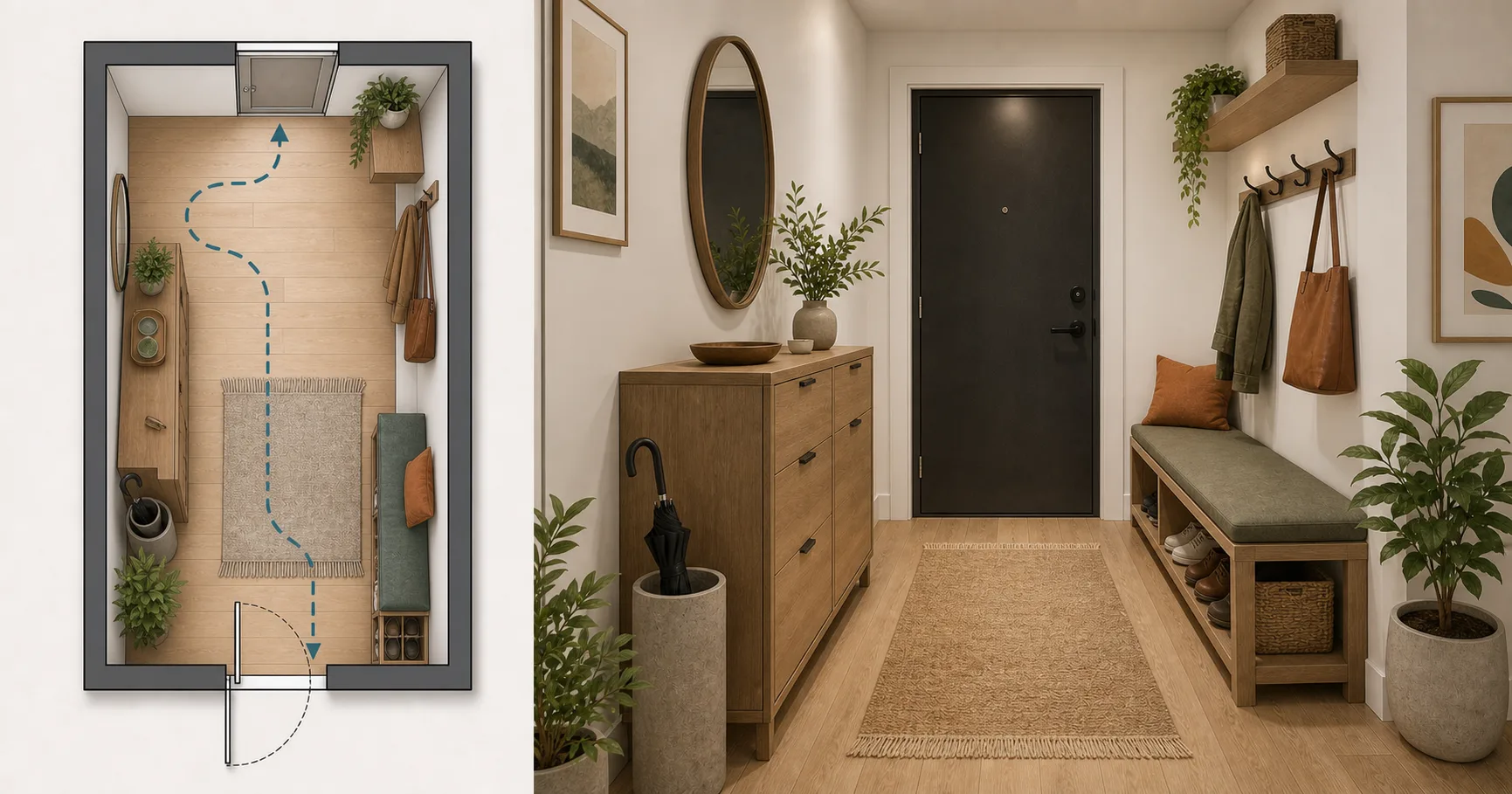
The entryway is small, but it carries heavy work. It has to handle shoes, coats, bags, keys, umbrellas, deliveries, guests, and the first impression of the home. If the layout is wrong, clutter spreads into the living room within a week.
Before buying a shoe cabinet or bench, test the entry in Aedifex. The door swing and walking path matter more than the cabinet style.
Map the Door Swing
Start with the front door. Mark the exact swing arc, handle side, and the space needed to stand while opening it. Storage should not force people to step backward into a wall or sideways around a bench.
If the entry is narrow, shallow storage beats deep storage. A 250mm shoe cabinet may work better than a 400mm cabinet that blocks the path.
Create Three Zones
A useful entry has three small zones:
- Drop zone for keys, wallet, mail, and small bags.
- Shoe zone for daily shoes, not every pair owned.
- Coat zone for the current season.
Avoid designing the entry as whole-home storage. Move rarely used shoes and coats elsewhere.
Bench or No Bench?
A bench is helpful only if it leaves a clear path. In very small entries, a wall-mounted stool, narrow ledge, or shoe cabinet with a sit-height top may be better.
If kids or older adults use the space, seating becomes more valuable. If the entry is mostly a pass-through, prioritize hooks and a shallow cabinet.
Mirror and Lighting
A mirror near the door helps with last checks and makes the entry feel larger. Place it where it does not reflect clutter. Good lighting matters because entries often have no window.
Use one clear overhead light plus optional wall lighting near the mirror. Avoid dark corners where shoes and bags accumulate.
Test the Morning Rush
In Aedifex, place the door, cabinet, bench, hooks, mirror, and rug. Then test:
- Open the door with a bag in hand.
- Remove shoes without blocking the door.
- Hang a coat while someone else enters.
- Put keys down without crossing the room.
- Walk from entry to living room cleanly.
If the path is clear, the entry will stay tidier. For broader small-space planning, compare Studio Apartment Layout Ideas and Furniture Arrangement Rules.
Size the Storage to the Real Household
Count the items that actually enter the home: daily shoes, guest shoes, coats, bags, keys, mail, umbrellas, sports gear, pet leashes, and returns waiting to leave. An entryway fails when it is designed for a styled photo instead of the real inventory.
For one or two people, a slim shoe cabinet, a few hooks, and a small tray may be enough. For a family, open hooks at different heights usually work better than a coat closet that children cannot reach. If the entry is used by guests, leave at least one obvious empty hook or shelf. Storage that is already full teaches visitors to drop things on the floor.
Closed shoe storage keeps the entry calmer, but it must ventilate. Wet shoes in a sealed cabinet create odor and damage. Use slatted doors, a boot tray, or one open lower shelf for rainy days.
Clearances and Door Conflicts
Measure the door swing before buying any console, bench, or cabinet. The door should open fully without hitting furniture. If that is impossible, the furniture must be shallow enough that the door still opens past 90 degrees.
Keep the main walking path clear. In a tight entry, even 10 cm of extra depth can change how the space feels. A 25 cm deep wall shelf may work where a 40 cm console would become a hip-height obstacle. Hooks should not stick out where bags can catch the door handle.
If the entry connects directly to a living room, treat the first meter as a transition zone. A rug, lighting change, or vertical panel can mark the entry without building a wall.
Better Drop Zones
A good drop zone has three parts: a surface for small objects, a place for items that leave again, and a visual limit. Without a limit, the drop zone becomes permanent storage.
Use a tray for keys and wallets, a shallow basket for mail, and a hook or shelf for outgoing bags. Review the basket weekly. If mail piles up for months, the problem is not storage capacity; it is the lack of a sorting routine.
Common Mistakes
The first mistake is choosing a bench without shoe storage when the household removes shoes at the door. Seating is helpful, but the shoes still need somewhere to go.
The second is placing a mirror where it reflects clutter from the kitchen or living room. A mirror should reflect light, a clean wall, or a controlled view.
The third is using only open hooks. Hooks are fast, but too many visible coats make the entry feel messy. Combine a few daily hooks with closed or off-season storage elsewhere.