Chair Mat Coverage: Keep Casters Inside When Rolling Back
Check a chair mat against seated and rolled-back caster positions, calculate edge margins, and record the full wheel path before choosing its usable size.
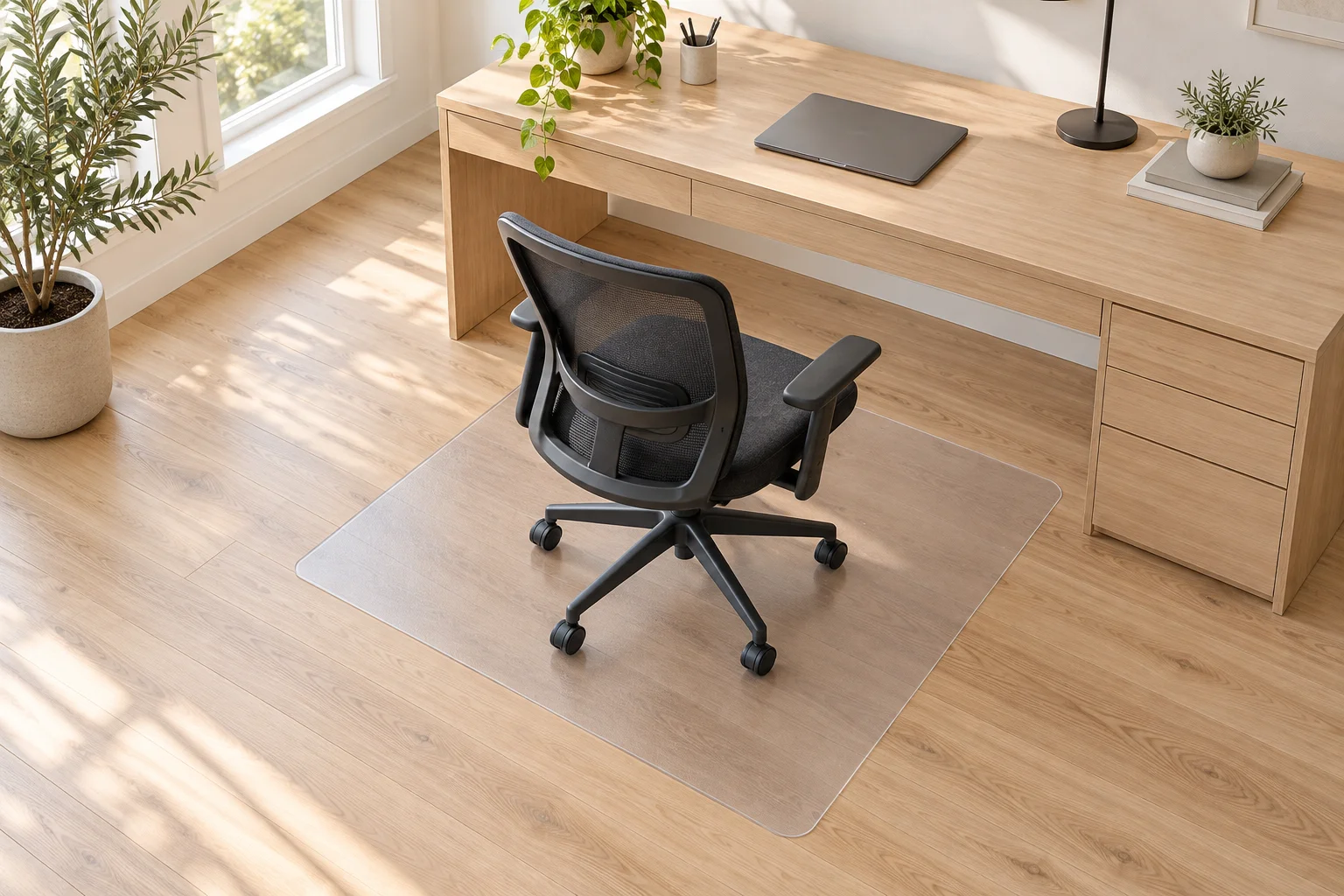
A mat that covers a chair while you type can be too short when you push away to stand. Make the buying decision from the caster path, including the swivel position of each wheel, rather than the seat width or the advertised mat area.
Establish a usable rectangle
Measure the flat supported part of the mat. Exclude curled edges and cut-outs. Put the origin at its desk-side left corner; increasing depth points away from the desk. A lip extending under the desk does not automatically add to the usable rolling rectangle. For a shaped mat, check each actual edge rather than treating its bounding box as usable material.
The hypothetical chair has a 650 × 650 mm outer caster envelope. On a 900 × 1200 mm usable mat, place it 125 mm from the left and 180 mm from the desk-side edge. The seated rear margin is 1200 − 180 − 650 = 370 mm. Both side margins are 125 mm. These figures concern wheels, not the person or armrests.
Compare sitting with standing up
Rolling straight back 420 mm changes the depth offset to 600 mm. The rear margin becomes 1200 − 600 − 650 = −50 mm: the envelope crosses the mat by 50 mm even though seated coverage passed. The two diagrams below answer different questions: where the seated envelope sits, and which boundary is crossed during withdrawal.
In the coverage exercise, compare A and B, then change mat depth to 1300. At the withdrawn position this leaves 1300 − 600 − 650 = 50 mm. Increasing width alone would not fix the rear failure. Moving the mat back by 100 mm can improve the rear edge but removes 100 mm of desk-side coverage, so recheck the seated state too.
Trace the transition before buying
- Mark a proposed boundary with removable tape beside the real chair path, without creating a raised wheel obstacle.
- Record the outermost wheels while sitting, reaching, rotating and standing. A diagonal exit can enlarge the envelope in both axes.
- Compare the entire trace with the proposed usable area. If any wheel reaches the edge, revise the mat or its location; do not deliberately roll over it to prove the failure.
A larger mat uses floor area and may meet a door or cabinet. A smaller chair base changes the furniture choice. Restricting normal movement just to stay within a small mat is a poor substitute for testing the user's actual routine. A rectangle test cannot establish mat stiffness, traction, floor protection or caster compatibility; follow the relevant product information for those decisions.
Keep a measurement record
Download the worksheet (CSV). Enter the mat’s usable dimensions and wheel offsets for sitting, turning and withdrawal. Keep a sketch of the outer caster trace with the CSV; choose a larger or repositioned mat only after comparing every state. The sample A/B rows are hypothetical and contain no live formulas. For the broader adjacent topic, see the related planning guide.
Geometry and assumptions
Original plan example in mm: a rectangular usable mat is 900 × 1200. The measured caster envelope is 650 × 650, starting 125 from the left and 180 from the desk-side edge. These are outer wheel positions, not seat dimensions.
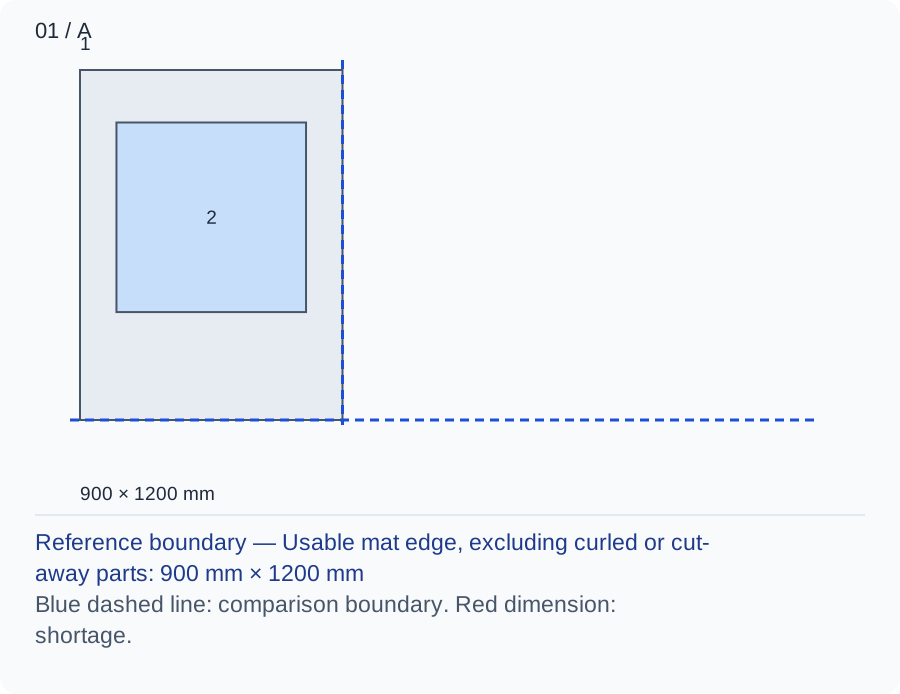
A tests seated coverage: left/right margins are 125/125, desk-side/rear margins 180/370. A generous-looking rear strip alone cannot tell you what happens when you stand up.
Numbers and marks identify the items described here; use the stated dimensions rather than measuring the screen.
1: usable mat rectangle; 2: outer caster envelope. Diagram top faces the desk; compass labels mean drawing edges, not geographic directions. Chamfers, rotation and mat movement are omitted.
| Input | A | B |
|---|---|---|
| Usable mat width (mm) | 900 | 900 |
| Usable mat depth (mm) | 1200 | 1200 |
| Caster envelope width (mm) | 650 | 650 |
| Caster envelope depth (mm) | 650 | 650 |
| Left offset (mm) | 125 | 125 |
| Desk-side offset (mm) | 180 | 600 |
Changed conditions and evidence
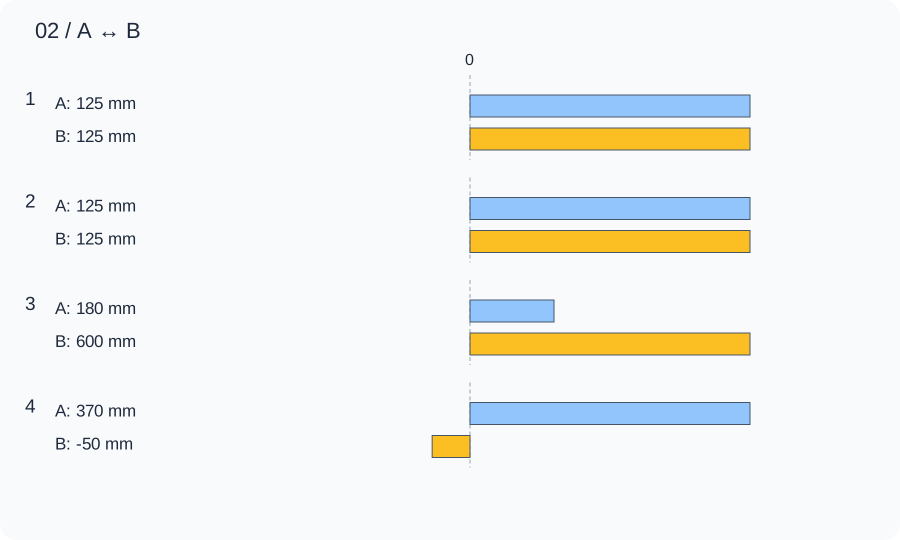
B keeps mat and caster size fixed but rolls back 420: offset becomes 600 and rear margin is 1200 − 600 − 650 = −50. To retain 50 at the rear in B, usable mat depth must be 1300; check that larger footprint against the room.
| Calculated relationship | A | B |
|---|---|---|
| 1. West remainder | 125 mm | 125 mm |
| 2. East remainder | 125 mm | 125 mm |
| 3. North remainder | 180 mm | 600 mm |
| 4. South remainder | 370 mm | -50 mm |
Mark the usable mat boundary and record every outer caster through seated, turning and exit motions. Stop before a wheel drops over an edge. Verify mat/floor/caster compatibility and edge flatness separately; this rectangle cannot certify rolling safety.
TRY THE EXAMPLE
Chair Mat Coverage: Keep Casters Inside When Rolling Back
Original plan example in mm: a rectangular usable mat is 900 × 1200. The measured caster envelope is 650 × 650, starting 125 from the left and 180 from the desk-side edge. These are outer wheel positions, not seat dimensions.
Allowed range: 1–10000 · Step: 1
Allowed range: 1–10000 · Step: 1
Allowed range: 1–10000 · Step: 1
Allowed range: 1–10000 · Step: 1
Allowed range: 0–10000 · Step: 1
Allowed range: 0–10000 · Step: 1
Positive remainder under these assumptions. Check the actual use and product requirements before choosing a layout.
- West remainder
- 125 mm
- East remainder
- 125 mm
- North remainder
- 180 mm
- South remainder
- 370 mm
Reference boundary — Usable mat edge, excluding curled or cut-away parts: 900 mm × 1200 mm
Blue dashed line: comparison boundary. Red dimension: shortage.
900 × 1200 mm
Mark the usable mat boundary and record every outer caster through seated, turning and exit motions. Stop before a wheel drops over an edge. Verify mat/floor/caster compatibility and edge flatness separately; this rectangle cannot certify rolling safety.
Teaching assumptions, not a surveyed home or a construction check. Results describe this simplified geometry or budget only. Changes stay on this page and reset on reload.