Kitchen Shelf Basket Fit: Allow the Lift Before Pulling
Measure the upward travel a kitchen shelf basket needs before pulling it out, compare two basket heights, and record where the removal path catches.
A kitchen basket may fit between shelves yet refuse to come out because a retaining lip requires lifting before pulling. Measure that first upward motion separately from the basket's resting height. This article concerns a straight lift-then-pull path, not the number of boxes that fit side by side.
Measure the obstruction over the removal path
Use the supporting shelf as the lower datum. In this hypothetical example the nominal upper underside is 330 mm above it, but a bracket drops 20 mm into the relevant path. Measure the loaded basket at its tallest point, including rigid handles and contents: 250 mm here. The lip geometry requires the whole basket to rise 75 mm before horizontal withdrawal.
The effective upper boundary is the actual lowest bracket face: 330 − 20 = 310 mm above the support. Enter 310 as clear height and 0 as additional intrusion, since the 20 mm bracket has already been deducted. The blue line in the diagram represents this actual face.
The resting top gap is 310 − 0 − 250 = 60 mm. Removal needs 75 mm, so the motion margin is 60 − 75 = −15 mm. Do not add the basket's height twice or count the lip itself as another deduction after measuring the required lift.
Choose a change that preserves the real motion
A 220 mm basket gives 310 − 0 − 220 − 75 = 15 mm. It sacrifices 30 mm of storage height. Keeping the original basket and raising the upper obstruction by 30 mm would produce the same margin, but requires checking shelf support, adjacent storage and installation permissions. Tilting is not assumed: contents, handles and depth can make that path much larger.
The first diagram shows the blocked lift above the stationary basket. The second tests a shorter basket with the same required motion. In the lift exercise, keep the 75 mm lift fixed while changing basket height. A zero margin means nominal contact, with no allowance for measurement error.
Gather evidence in a workable order
First measure the lip and identify when the basket bottom clears it. Then use a lightweight empty proxy to follow that path, noting the tightest upper bracket. Finally check the handle grip and full outward travel at an appropriate safe working height. A loaded trial is not justified merely because the arithmetic is positive; verify safe reach and load handling first.
Stop if the proxy catches above, its base still meets the lip, or fingers cannot grip without entering a pinch point. Record that location rather than increasing force. Shelf load capacity, fixing strength, food storage and access equipment are outside this dimensional calculation.
Keep a measurement record
Download the worksheet (CSV). Use the rows to record loaded height, the upper bracket and the lift required by the lip. Attach the first catching point from the empty-proxy test; decide whether a shorter basket solves that specific obstruction before accepting reduced storage. For the broader adjacent topic, see the related planning guide.
Geometry and assumptions
Original section in mm: nominal upper underside 330 minus bracket drop 20 gives 310 from support to the actual lowest bracket face. The diagram starts with that measured clear height; additional intrusion is 0 because the bracket is already included. Loaded basket height is 250 and the separately measured lift before pulling is 75.
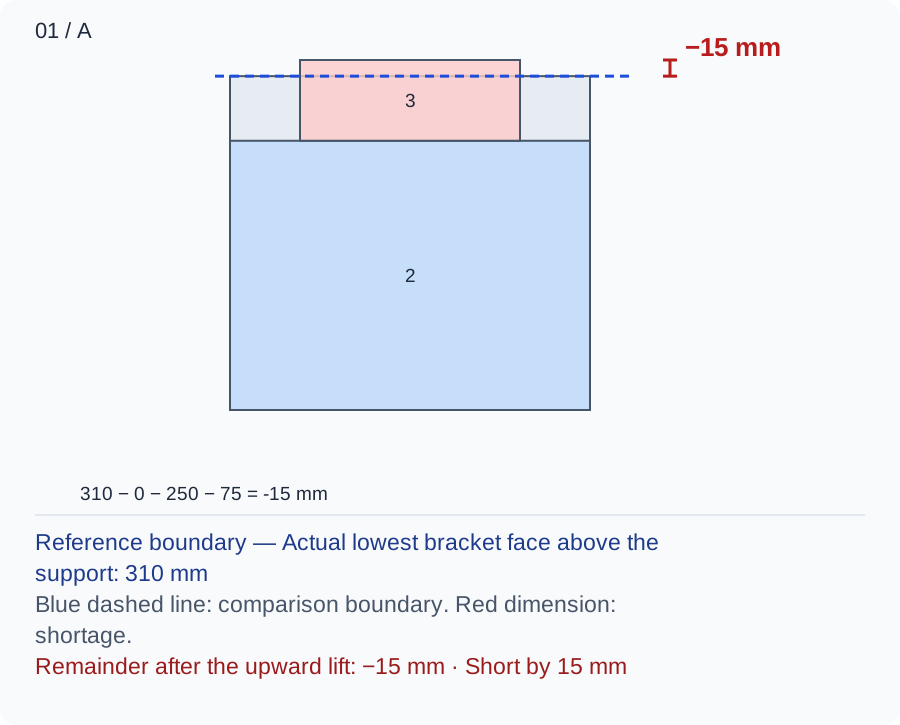
A has 310 − 0 − 250 = 60 above the basket, but the 75 lift leaves −15. The lift envelope crosses the blue line at the actual lowest bracket face, so a basket that fits at rest remains trapped during removal.
Numbers and marks identify the items described here; use the stated dimensions rather than measuring the screen.
1: additional upper intrusion, zero because the bracket is already included; 2: basket on the lower support; 3: upward lift envelope. Blue boundary is the lowest bracket face; horizontal pull distance and fingers are omitted.
| Input | A | B |
|---|---|---|
| Support to lowest bracket face (mm) | 310 | 310 |
| Additional intrusion not already included (mm) | 0 | 0 |
| Maximum loaded basket height (mm) | 250 | 220 |
| Required upward travel (mm) | 75 | 75 |
Changed conditions and evidence
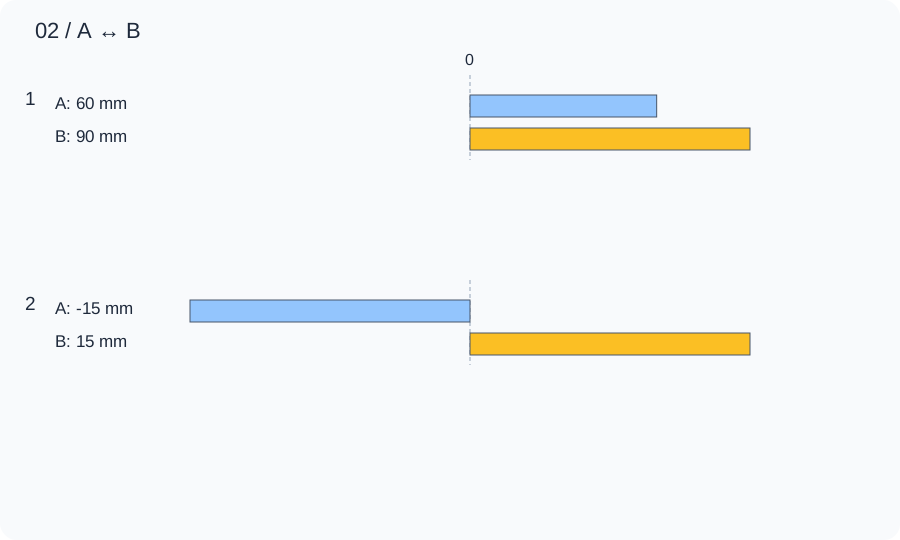
B uses a 220-high basket with the same lip and lift requirement: 310 − 0 − 220 − 75 = 15. The extra clearance costs 30 of storage height. Do not reduce the lift input unless the retaining geometry actually changes.
| Calculated relationship | A | B |
|---|---|---|
| 1. Space above the resting basket | 60 mm | 90 mm |
| 2. Remainder after the upward lift | -15 mm | 15 mm |
Use an empty lightweight proxy first, tracing the actual lift-then-pull path without tilting. Record the tightest upper point and handle access. Loaded weight, shelf capacity and safe reach remain separate checks; do not test overhead with a heavy filled basket.
TRY THE EXAMPLE
Kitchen Shelf Basket Clearance: Allow the Lift Before Pulling
Original section in mm: nominal upper underside 330 minus bracket drop 20 gives 310 from support to the actual lowest bracket face. The diagram starts with that measured clear height; additional intrusion is 0 because the bracket is already included. Loaded basket height is 250 and the separately measured lift before pulling is 75.
Allowed range: 1–10000 · Step: 1
Allowed range: 0–10000 · Step: 1
Allowed range: 1–10000 · Step: 1
Allowed range: 0–10000 · Step: 1
A negative remainder means the selected allocations overlap. Change the inputs or the proposal.
- Space above the resting basket
- 60 mm
- Remainder after the upward lift
- -15 mm
Reference boundary — Actual lowest bracket face above the support: 310 mm
Blue dashed line: comparison boundary. Red dimension: shortage.
Remainder after the upward lift: −15 mm · Short by 15 mm
310 − 0 − 250 − 75 = -15 mm
Use an empty lightweight proxy first, tracing the actual lift-then-pull path without tilting. Record the tightest upper point and handle access. Loaded weight, shelf capacity and safe reach remain separate checks; do not test overhead with a heavy filled basket.
Teaching assumptions, not a surveyed home or a construction check. Results describe this simplified geometry or budget only. Changes stay on this page and reset on reload.