Storage Boxes in a Shelf Bay: Count Gaps Before Buying
Calculate boxes and between-box gaps inside a clear shelf bay. Compare flared rims, end allowances and a two-box alternative before ordering matching storage.
Count inside one uninterrupted bay
Buying “three 24 cm boxes” for a shelf advertised as 80 cm wide is a gamble. The advertised shelf width may include side panels, and a box's label may describe its base rather than the flared rim. This decision is about how many identical boxes fit side by side in one clear bay while remaining removable.
Measure between inside faces after assembly. Check front and rear because fittings or a bowed panel can reduce the opening. A vertical divider creates separate bays: do not add their widths and pretend boxes can cross the divider. Record the narrowest relevant opening, not an average.
Why three boxes have only two internal gaps
In this original millimetre example, usable width is 764, maximum box width is 240, count is 3, and the selected gap between neighbours is 12. Required width is 240 × 3 + 12 × (3 − 1) = 744 mm. The 20 mm remainder can be shared as 10 mm at each end if the group is centered. These gaps are assumptions for a trial, not recommended finger clearance.
A rimmed version measuring 250 mm instead uses 250 × 3 + 12 × 2 = 774 mm, exceeding the bay by 10 mm. The extra 10 mm on each box accumulates to 30 mm. Reducing internal gaps to 7 mm gives 250 × 3 + 7 × 2 = 764 mm: exact arithmetic contact with no end allowance. That is not a successful purchase specification.
Two 250 mm boxes with one 12 mm gap use 512 mm, leaving 252 mm. This sacrifices one box, but the leftover could hold a differently sized object if it has its own measured envelope. The identical-box calculator does not size that second object for you.
Trial one box before ordering a set
A box may pass the opening when empty but bulge when filled. Include the normal lid and measure the widest rim; try pulling it with the intended contents. Handles cut into the front can work differently from side grips squeezed against a neighbouring box.
Check vertical removal space under the shelf above. A lid that must lift before the box can slide out can fail even when the box height fits. Check rear stops and depth, too: a box extending beyond the shelf can change support. Shelf loading and wall fixing remain product-specific checks, outside the width model.
Compare box dimensions using the A and B cases, then try a count of two. Counts are whole numbers; an unknown box width should remain unconfirmed rather than entered as zero. Reset returns the three-box example. Keep a note of the actual product's maximum dimensions and test result before buying the rest. For arranging the larger storage area, see pantry shelf depth planning; its depth decisions are separate from this single-bay width check.
Take the measurements with you
Download the measurement and evidence sheet (CSV). Write the box product reference beside its widest rim dimension. Keep the loaded pull-out and lid test separate from the width arithmetic, and leave shelf capacity unresolved until the product instructions establish it. The sheet has no formulas.
Geometry and assumptions
An original 764 mm clear shelf bay receives three boxes of 240 mm maximum width, with 12 mm between adjacent boxes. The model counts the two internal gaps, leaving the outer-edge allowance unallocated.
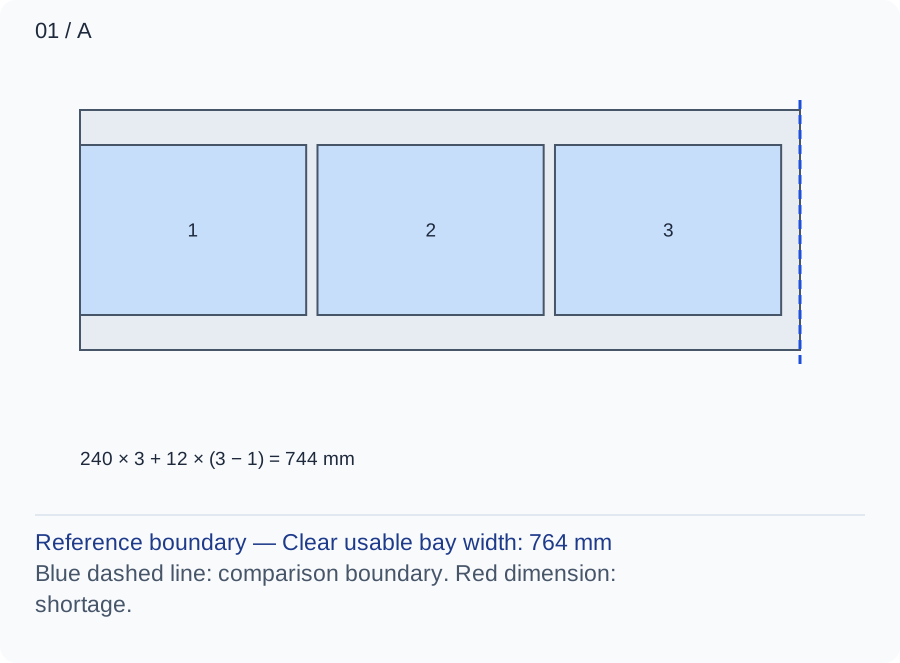
Figure 1 shows three boxes and only two between-box gaps: 240 × 3 + 12 × 2 = 744 mm, leaving 20 mm. Centering gives 10 mm at each end, but no result automatically establishes a usable grip.
Numbers and marks identify the items described here; use the stated dimensions rather than measuring the screen.
Numbers identify repeated modules. Gaps occur only between modules; end allowances must be accounted for separately.
| Input | A | B |
|---|---|---|
| Clear usable bay width (mm) | 764 | 764 |
| Maximum box width (mm) | 240 | 250 |
| Box count () | 3 | 3 |
| Gap between boxes (mm) | 12 | 12 |
Changed conditions and evidence
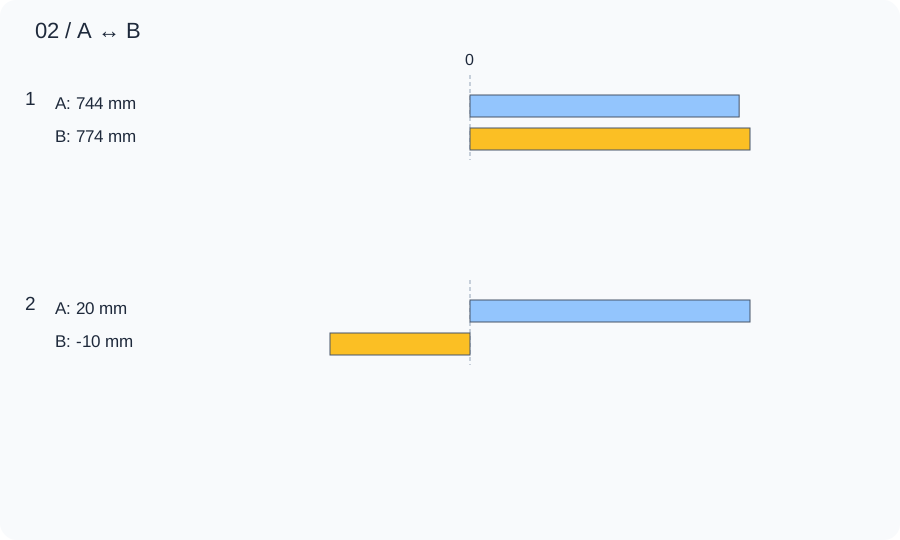
Figure 2 substitutes a 250 mm-wide rimmed box while keeping the count and gaps: used width is 774 mm and remainder −10 mm. A 10 mm increase per box consumes 30 mm, not 10 mm.
| Calculated relationship | A | B |
|---|---|---|
| 1. Allocated width | 744 mm | 774 mm |
| 2. Unallocated width | 20 mm | -10 mm |
Measure the narrowest usable opening at front and rear, then test one loaded box under the shelf above. Verify rim width, grip, depth and removal height; the calculation does not assess shelf load capacity.
TRY THE EXAMPLE
Storage Boxes in a Shelf Bay: Count Gaps Before Buying
An original 764 mm clear shelf bay receives three boxes of 240 mm maximum width, with 12 mm between adjacent boxes. The model counts the two internal gaps, leaving the outer-edge allowance unallocated.
Allowed range: 1–10000 · Step: 1
Allowed range: 1–10000 · Step: 1
Allowed range: 1–20 · Step: 1
Allowed range: 0–10000 · Step: 1
Positive remainder under these assumptions. Check the actual use and product requirements before choosing a layout.
- Allocated width
- 744 mm
- Unallocated width
- 20 mm
240 × 3 + 12 × (3 − 1) = 744 mm
Measure the narrowest usable opening at front and rear, then test one loaded box under the shelf above. Verify rim width, grip, depth and removal height; the calculation does not assess shelf load capacity.
Teaching assumptions, not a surveyed home or a construction check. Results describe this simplified geometry or budget only. Changes stay on this page and reset on reload.