Under-Desk Pedestal Fit: Keep Usable Space for Your Knees
Compare rolling pedestal width against desk support clearance, cable space and seated movement. Work through a measured example before choosing more storage.
Measure the opening you actually sit in
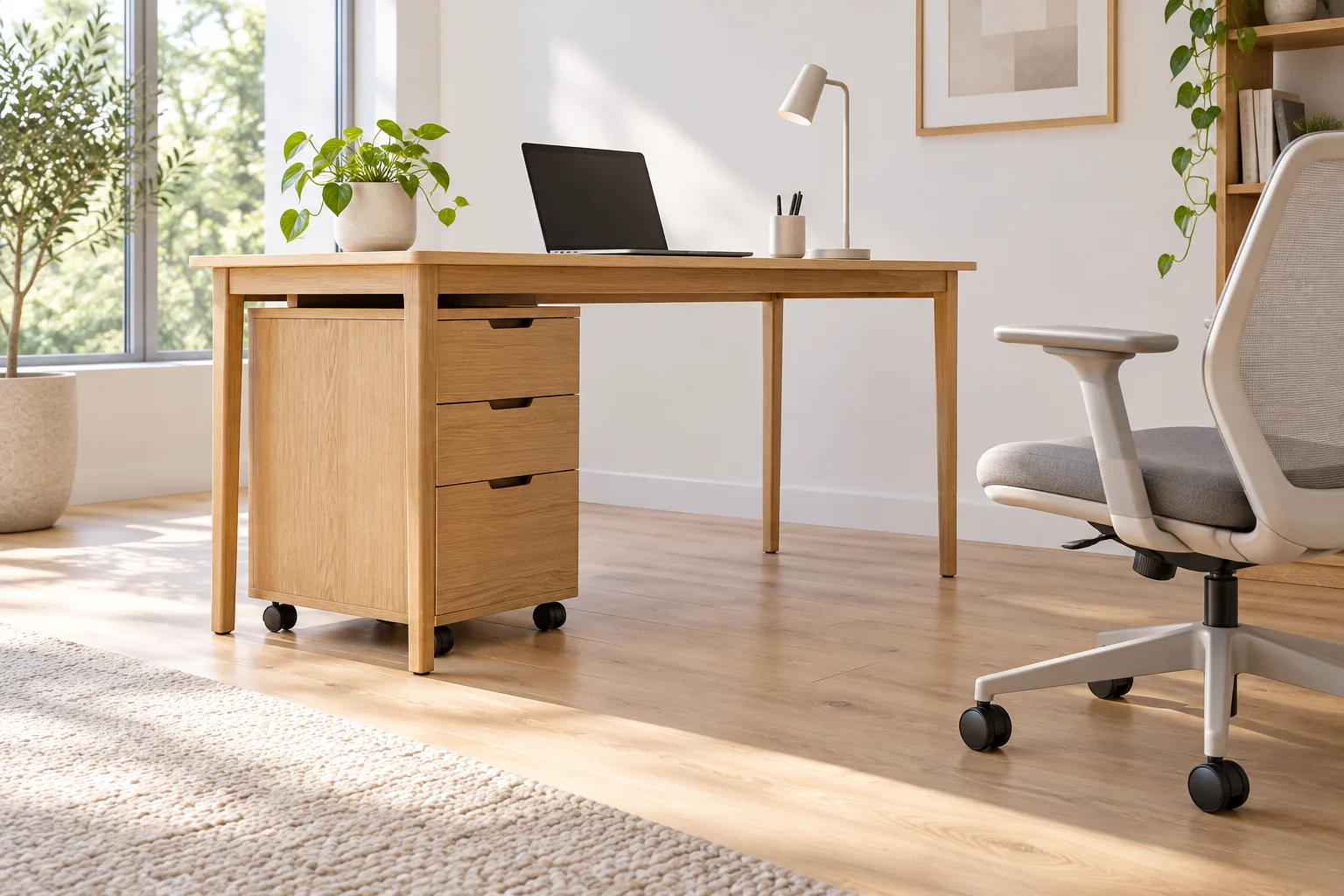
A drawer unit advertised as “under-desk” may fit under the top yet force you to sit off-center. Decide whether to keep it beneath the desk, choose a narrower model or park it beside the desk before buying. The relevant width runs between the inside faces of the desk supports at knee level. A 1400 mm desktop does not guarantee 1400 mm of usable space beneath it.
Measure the cabinet with projecting screw heads, handles and caster swivels in their normal positions. Record any crossbar, power supply or suspended tray separately. Do not subtract a cable strip twice: our example reserves an independent strip beside the cabinet, not cables already inside its footprint.
A 20 mm remainder is a reason to test
This invented example uses millimetres throughout. Supports leave 1180 mm, the cabinet takes 400 mm and a separate cable strip takes 80 mm. Thus 1180 − 400 − 80 = 700 mm remains. A hypothetical user's seated turning envelope is 680 mm, leaving 20 mm. That envelope is a planning assumption, not a recommended minimum or accessibility standard.
The extra-wide 460 mm cabinet changes the arithmetic to 1180 − 460 − 80 − 680 = −40 mm. Keeping the same chair and sitting sideways to avoid the drawer unit conceals the conflict; it does not resolve it. A 360 mm cabinet would leave 60 mm beyond the same envelope but reduces storage capacity. Moving the 400 mm cabinet outside the opening releases its width and consumes floor space elsewhere.
Test storage and sitting as different tasks
- Mark the inside support faces, cabinet and cable strip with removable tape. Use a box of the proposed width; a line alone does not reveal knee contact.
- Sit with the keyboard and screen in their intended positions, turn toward both sides and stand up. Record where knees, chair arms or wheels meet a boundary.
- Open the drawer while seated, then try retrieval standing up. The drawer projects forward; that motion is outside this width-only calculation.
- Roll the unit out over the real floor or rug. Check whether its usual parked position blocks the chair's route back.
If rolling the unit away every morning is part of the solution, identify its daytime parking location. “Movable” is not a location. Repeatedly moving a loaded cabinet may also be impractical for its intended user.
Use the comparison, then verify the missing dimensions
Open the width exercise. Change cabinet width from 400 to 460 mm to see the −40 mm result, then use reset to restore the original. Enter your own measured movement envelope rather than treating 680 mm as universal. Empty or out-of-range values require correction; do not fill an unknown with zero.
A taller pedestal can still hit the desktop or an adjustable desk mechanism. A deeper one can obstruct feet despite adequate width. Check those dimensions against the actual product instructions, and retain the normal sitting position when comparing options. For the surrounding chair and storage movements, continue with the home-office layout guide.
Take the measurements with you
Download the measurement and evidence sheet (CSV). Record the inside support width and the maximum caster width separately, then note the chair and posture used for the trial. Leave the underside height and drawer test unresolved until checked; this sheet does not calculate results automatically.
Geometry and assumptions
This original teaching example starts with 1180 mm between desk supports, not the desktop width. Allocate 400 mm to a rolling pedestal, 80 mm to a separate floor cable channel and 680 mm to a hypothetical seated movement envelope.
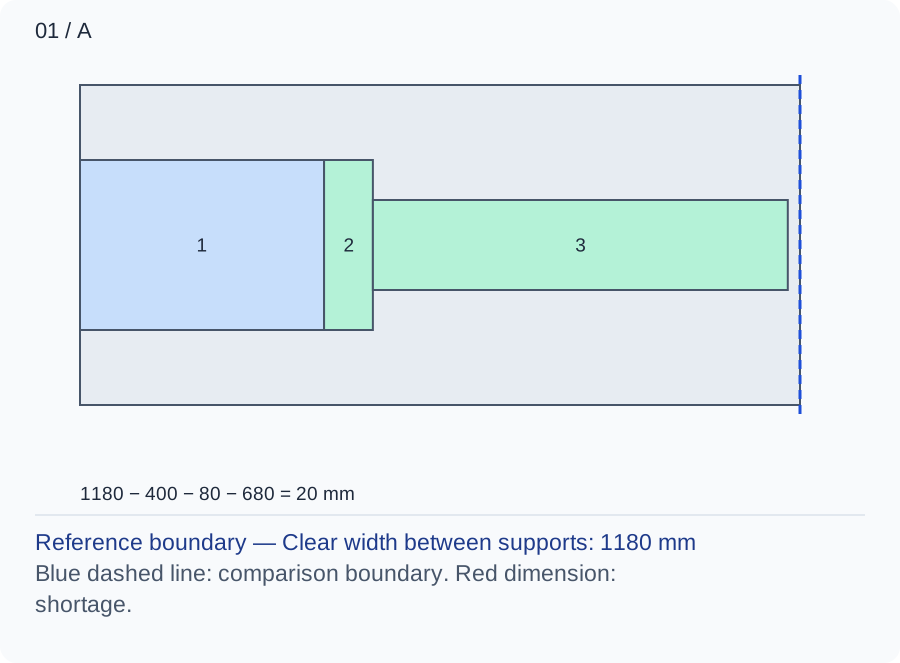
In figure 1, blue 1 is the pedestal, green 2 the separate cable strip, and 3 the movement allowance. Free width is 700 mm; the 680 mm envelope leaves only 20 mm. The drawing is a width allocation, not a chair shape.
Numbers and marks identify the items described here; use the stated dimensions rather than measuring the screen.
1: Pedestal overall width; 2: Separate cable strip width; 3: Seated movement envelope. Sequential width allocations, not exact furniture positions.
| Input | A | B |
|---|---|---|
| Clear width between supports (mm) | 1180 | 1180 |
| Pedestal overall width (mm) | 400 | 460 |
| Separate cable strip width (mm) | 80 | 80 |
| Seated movement envelope (mm) | 680 | 680 |
Changed conditions and evidence
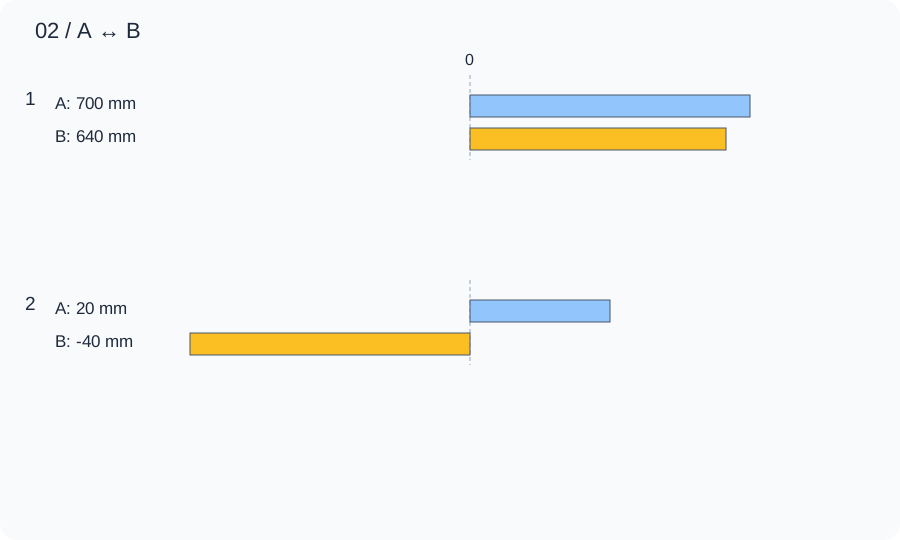
Figure 2 changes the pedestal to 460 mm while preserving the same user and cable allocation: free width falls to 640 mm and the movement margin becomes −40 mm. More drawer capacity is therefore not a neutral upgrade.
| Calculated relationship | A | B |
|---|---|---|
| 1. Unoccupied cross-section | 700 mm | 640 mm |
| 2. Remainder after the stated allowance | 20 mm | -40 mm |
Tape the actual support faces and cabinet width on the floor, sit in the normal chair, then turn and rise. Check height under crossbars and drawer reach separately; a positive width does not prove ergonomic suitability.
TRY THE EXAMPLE
Under-Desk Pedestal Fit: Keep Usable Space for Your Knees
This original teaching example starts with 1180 mm between desk supports, not the desktop width. Allocate 400 mm to a rolling pedestal, 80 mm to a separate floor cable channel and 680 mm to a hypothetical seated movement envelope.
Allowed range: 1–10000 · Step: 1
Allowed range: 1–10000 · Step: 1
Allowed range: 0–10000 · Step: 1
Allowed range: 1–10000 · Step: 1
Positive remainder under these assumptions. Check the actual use and product requirements before choosing a layout.
- Unoccupied cross-section
- 700 mm
- Remainder after the stated allowance
- 20 mm
1180 − 400 − 80 − 680 = 20 mm
Tape the actual support faces and cabinet width on the floor, sit in the normal chair, then turn and rise. Check height under crossbars and drawer reach separately; a positive width does not prove ergonomic suitability.
Teaching assumptions, not a surveyed home or a construction check. Results describe this simplified geometry or budget only. Changes stay on this page and reset on reload.