Door Handle Hits a Cabinet: Check the Whole Swing Path
Trace a door handle at its actual height before moving a nearby cabinet. Compare local gaps, the full swing and access without assuming a doorstop solves it.
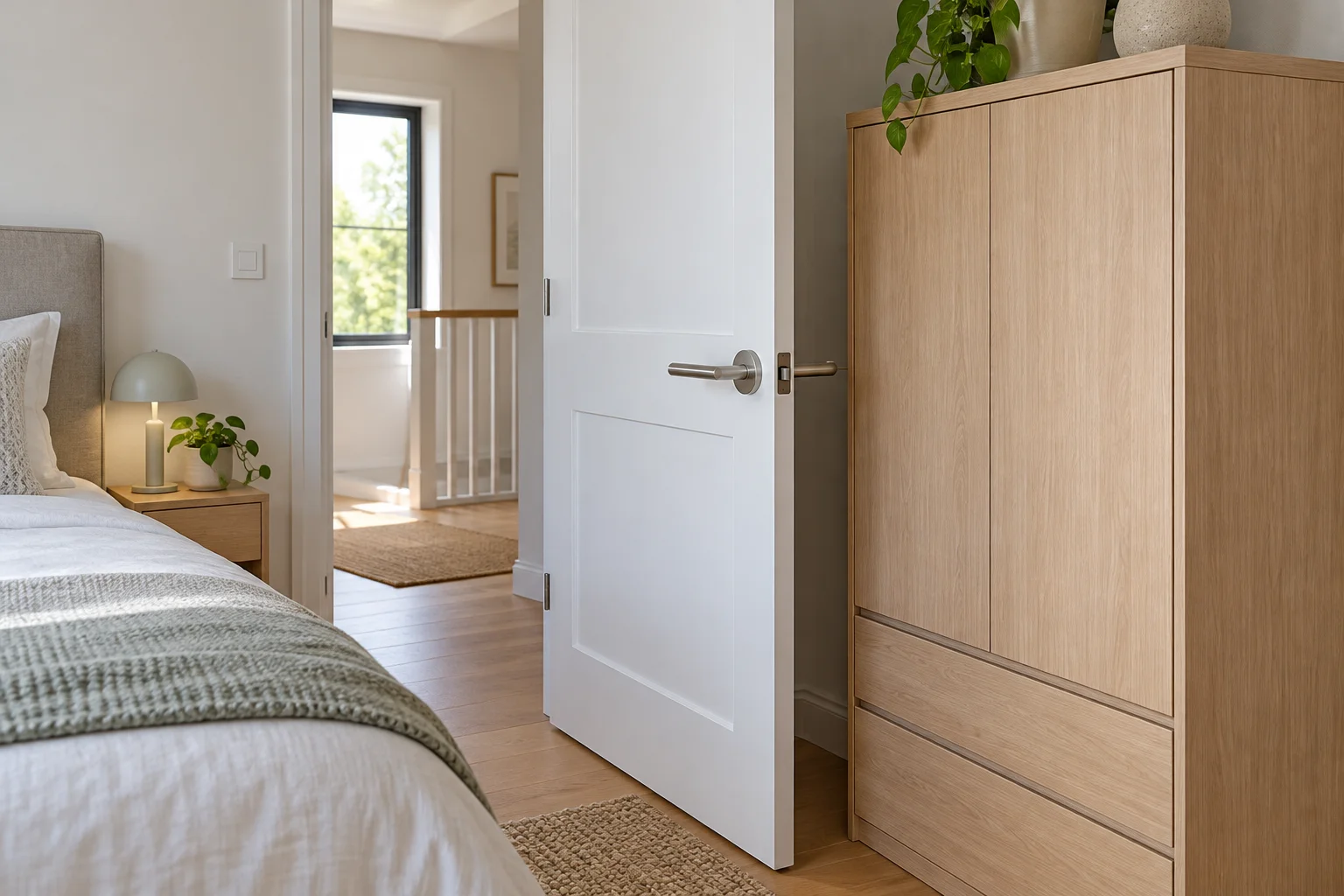
Find the part that touches before changing the door
When a room door handle strikes a tall cabinet, a plan showing a clear door leaf is incomplete. The handle projects away from the face and moves at a particular height. A nearby cabinet top, side panel or pull can intercept it before the door reaches its intended opening. This article helps decide whether moving storage is enough or whether hardware advice is needed; it does not approve door modifications.
Measure from finished floor to the lowest and highest parts of the handle and compare those heights with the cabinet. If their vertical ranges do not overlap, inspect the leaf edge, lock, cabinet handle or another contact instead. A gap measured at floor level cannot explain contact at handle height.
A local overlap, not a complete swing calculation
Use this invented example in millimetres: at a particular opening position, the handle extends 60 mm toward a parallel cabinet face, and that face is 45 mm from the door face. In this same direction, 45 − 60 = −15 mm. Those two features overlap by 15 mm in the simplified local view.
Moving the cabinet 30 mm away along that direction creates a 75 mm gap and 75 − 60 = 15 mm remainder at that position. This does not establish clearance at earlier or later angles. The door face rotates, so the local direction and closest point change. Do not use a leaf-width sine calculation as if it included lever length, door thickness and cabinet geometry.
Make the sweep review observable
Protect finishes without using padding as proof of clearance. Use a light cardboard proxy for the cabinet boundary, held independently of the moving door. Trace the handle's outermost point slowly from closed toward the required opening, stopping before contact. Record the approximate angle and height of the closest approach. Include pressing the lever to unlatch; its shape can move relative to the door.
Repeat with the cabinet's revised position. At the same time, check whether moving it narrows the approach to the door or prevents its own drawers opening. The required opening depends on real use and applicable requirements; this exercise does not set a universal angle.
Compare the intervention, not just the dent
Moving the cabinet preserves the door assembly but consumes adjacent space. A smaller cabinet sacrifices storage. Changing a handle may change grip, latch compatibility and access. A stop that prevents collision also limits the opening and transfers loads to its fixing. Ask the appropriate installer before altering a fire-rated, accessible or otherwise controlled door; do not assume any replacement is equivalent.
Use the three-stage review to move from height evidence to the sweep and revised access. Its checkboxes record only evidence you report collecting; they do not certify a collision test, and reset clears them. If a stage is unknown, leave it unchecked and identify the missing measurement. See 2D and 3D renovation drawings for coordinating the plan with the height view.
Take the measurements with you
Download the measurement and evidence sheet (CSV). Keep the handle-height range, the near-contact angle and the drawing or photo reference together. Mark which opening sequence was observed before and after moving the cabinet; a checked row is your evidence record, not a collision certificate.
Geometry and assumptions
A hypothetical 60 mm handle projection passes a cabinet face only 45 mm from the door face at one checked position. The local 15 mm overlap triggers a full movement review; it is not a formula for the entire swing.
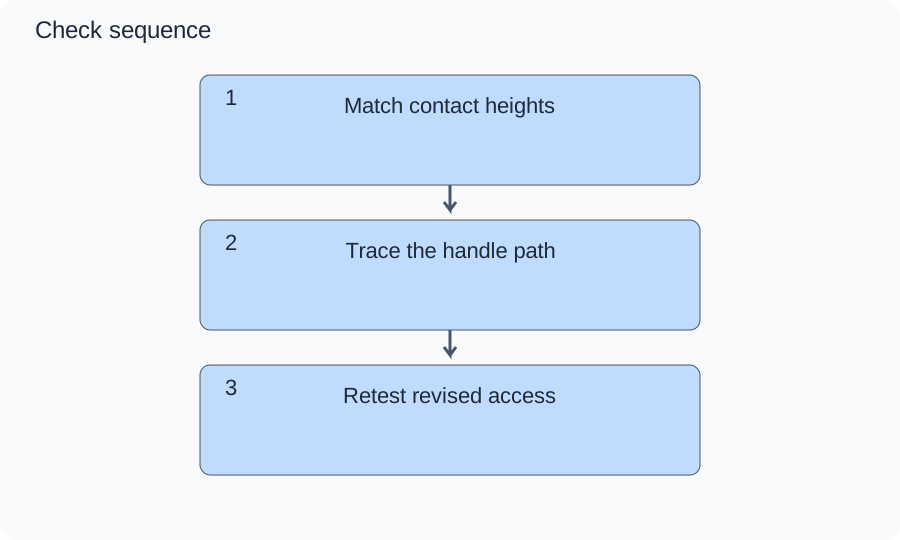
Figure 1 orders the work: locate handle height, trace slow movement, then compare a changed cabinet position. A door-leaf outline alone omits the protruding hardware.
Numbers and marks identify the items described here; use the stated dimensions rather than measuring the screen.
1–3 refer to the evidence steps below. A highlighted step is selected, not automatically verified.
| Step / option | What to check |
|---|---|
| 1. Match contact heights | Record handle top and bottom heights and the opposing cabinet feature. If ranges do not overlap, identify the actual contacting part before moving anything. |
| 2. Trace the handle path | Use a light boundary proxy and slow movement. Record first near-contact angle and lever operation; stop before a strike. Missing sweep evidence keeps this step unresolved. |
| 3. Retest revised access | Move the cabinet 30 mm in the example, then repeat the complete sweep and cabinet-drawer test. Keep a dimensioned sketch; reject an option that creates a new obstruction. |
Changed conditions and evidence
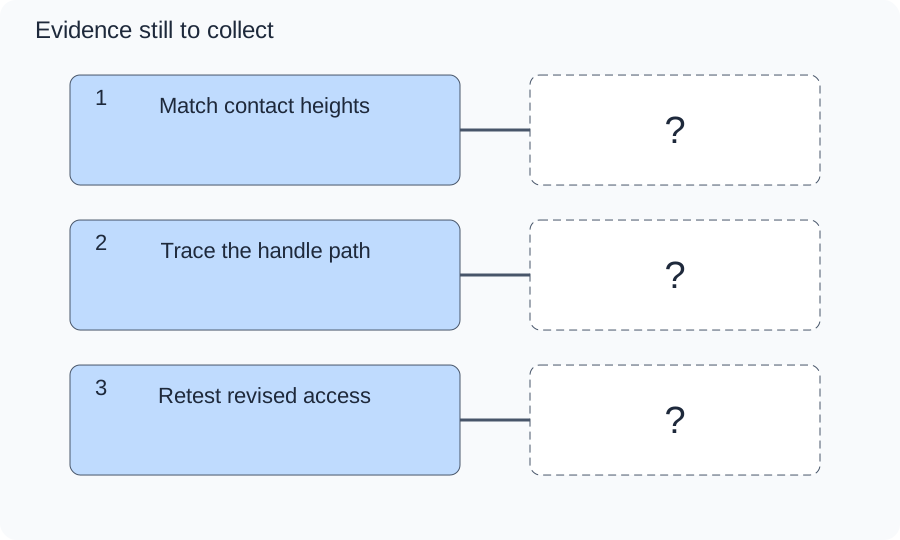
Moving the cabinet 30 mm away in this local direction changes the gap to 75 mm and the local remainder to 15 mm. Recheck every angle: the relocated cabinet can still meet another part of the handle path or reduce the usable doorway.
The question marks are evidence still to obtain, not a completed check.
Collect a height sketch, a marked sweep record and a revised access test. Stop on first contact; do not force the door against furniture. Hardware or stop changes need product and property approval where applicable.
TRY THE EXAMPLE
Door Handle Hits a Cabinet: Check the Whole Swing Path
A hypothetical 60 mm handle projection passes a cabinet face only 45 mm from the door face at one checked position. The local 15 mm overlap triggers a full movement review; it is not a formula for the entire swing.
Record handle top and bottom heights and the opposing cabinet feature. If ranges do not overlap, identify the actual contacting part before moving anything.
Collect a height sketch, a marked sweep record and a revised access test. Stop on first contact; do not force the door against furniture. Hardware or stop changes need product and property approval where applicable.
Teaching assumptions, not a surveyed home or a construction check. Results describe this simplified geometry or budget only. Changes stay on this page and reset on reload.