Bedroom Clothes Valet: Replace the Overflowing Chair
Create a place for worn-but-reusable clothes with a bedroom valet, short rail, or hooks, while preserving wardrobe access and a clear route beside the bed.
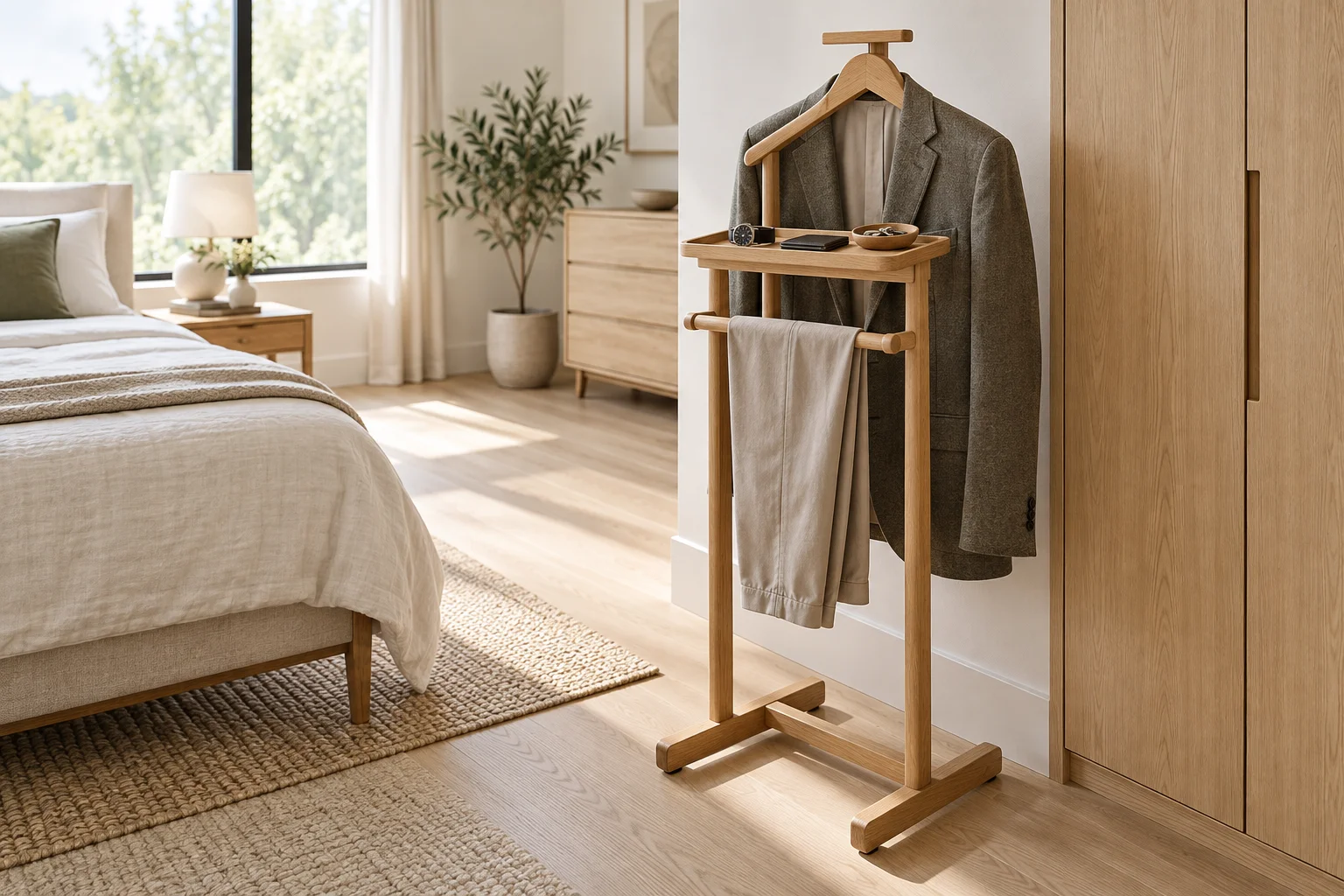
The bedroom chair often holds a category that the wardrobe and laundry basket do not acknowledge: clothing that has been worn but will be worn again. Replacing the chair with a smaller basket does not necessarily solve that problem. A useful clothes valet gives those items an explicit destination, enough separation to identify them, and a limit that prevents the temporary pile becoming permanent storage.
Start with the routine, then choose the object. A freestanding valet, short rail, or a few suitable hooks can all work. The best option is the one that accommodates actual garments without narrowing the bedside route or obstructing wardrobe doors.
Separate Three Clothing Decisions
At the end of the day, decide whether each item belongs in the wash, can be put away according to its care needs, or is being kept out for another wear. The valet serves only the last group. It should not become overflow for clean wardrobe stock, damp towels, and laundry simultaneously.
Damp items need an appropriate drying arrangement before ordinary enclosed storage. Garment care requirements and personal preferences determine what is suitable for reuse; the furniture cannot make that decision. Keep the laundry destination distinct, using the bedroom hamper placement guide for that separate route.
For three evenings, count the garments that genuinely remain out. Record their types, not just their number. Two jackets need different support from a pair of trousers and a knit top. This small inventory gives a more useful capacity target than choosing the largest rack that fits the corner.
Measure Clothing on the Proposed Support
An empty valet might be only 30 cm deep, while a jacket sleeve or trouser fold extends well beyond it. Hang representative garments and measure the resulting width, depth, and lowest edge. Include the base and any protruding hooks in the same outline.
For example, a support with a 35 cm deep base may occupy 52 cm once clothing is draped over it. In a 110 cm gap beside a wardrobe, that leaves 58 cm before accounting for the person using it. This does not establish whether the remaining space is adequate; it reveals why the catalog footprint alone is misleading.
Choose the passage needed by the actual room users, then compare the dressed valet against it. Mobility equipment, assistance, carrying bedding, and making the bed can all require more space than a casual sideways step.
Compare Three Chair Alternatives
A Freestanding Clothes Valet
A valet can provide separate support for a jacket and trousers, making the next day's outfit visible. Check the base stability and the manufacturer's load instructions. A narrow-looking post with an unstable or projecting base is not automatically suitable for a tight bedroom.
Place it where garments do not brush the floor, heating equipment, or a charging cable. Avoid hanging heavy bags on a support designed for clothing. If it must be moved every night to open a drawer, try a different location before deciding the room needs a different product.
A Short Open Rail
A small rail suits clothing that benefits from hangers and clear separation. Its capacity should match the temporary category, not invite another full wardrobe. Check the hangers themselves: their ends and the garments hanging from them define the real depth.
A rail placed beside a wardrobe can make changing efficient, but it should not cover a door handle or prevent the lower drawer opening. Keep the floor underneath accessible. Turning that floor into shoe storage often removes the very visual limit that made the arrangement useful.
A Few Appropriate Hooks
Hooks use little floor space and can work for garments suited to hanging from them. Follow garment care needs; not every fabric or shoulder shape belongs on a small point of support. Verify the fixing method and the wall or furniture's suitability before installation.
A behind-door location needs a full movement test. Clothes may project much farther than the bare hooks and become trapped between the door and wall. Do not compromise a door's intended operation, and do not modify a rated or otherwise restricted door without the necessary guidance.
Place the Station Where Changing Happens
Observe whether you change beside the wardrobe, near a dressing table, or at the foot of the bed. The destination should be close enough to use without crossing the room with half an outfit in your hands. That does not mean it belongs in the narrowest bedside gap.
Map the bedroom entrance, wardrobe opening, bed approach, and nighttime route. The valet should sit alongside this movement rather than in its middle. If the chair currently blocks a route, replacing it in exactly the same spot may preserve the underlying problem.
Consider visibility from the doorway as well. An open rail can look orderly when the garments have defined positions. Hiding it behind a curtain may reduce visual clutter but introduce another opening action or block access to a window. Compare the everyday routine, not only the view from the bed.
Give Temporary Storage a Visible Limit
Set a practical capacity based on the observed evening inventory. For example, one jacket position, one trouser support, and two hangers make four clear destinations. Those are household choices, not a prescribed number of garments.
When all positions are occupied, review the items before adding another. Decide whether to wear, wash, or put away each piece according to its condition and care needs. Adding a second chair whenever the first rail fills simply expands the unresolved category.
Keep accessories equally specific. A small tray for tomorrow's belt may be useful, while a wide shelf can quickly attract receipts, chargers, and unrelated possessions. If an object has another established home, keep that home instead of making the valet responsible for everything removed at night.
Test Morning and Evening Together
In the evening test, remove an outfit and put each garment in its intended destination. Open the wardrobe, reach the hamper, and return to the bed. In the morning test, select the reusable items, put them on, and reach the mirror or wardrobe without relocating the station.
Repeat with the bedroom shared by two people. Separate supports or clearly assigned positions can avoid one person's coat covering another person's trousers. Confirm both users can access their side without waking or stepping around the other.
For an overall furniture comparison, consult the room planner introduction. Measure the clothed support physically; a tidy outline cannot establish stability, garment care suitability, or how fabric spreads during daily use.
Keep the Chair Only If It Still Has a Job
A comfortable dressing chair may remain useful for putting on socks or resting briefly. If you need that seat, give reusable clothes a separate destination so the chair stays available. If nobody ever sits there, removing it from the arrangement may free more space than adding another object beside it.
The final test is simple: reusable garments are easy to see, the laundry route remains separate, and the room can be reset without making a new pile. A small, well-placed station succeeds when it makes those daily decisions easier.