C-Shaped Side Table Fit: Sofa Clearance and Easy Reach
Check a C-shaped side table against sofa clearance, base insertion, thigh space, and seated reach before buying, with a measured example and a home fit test.
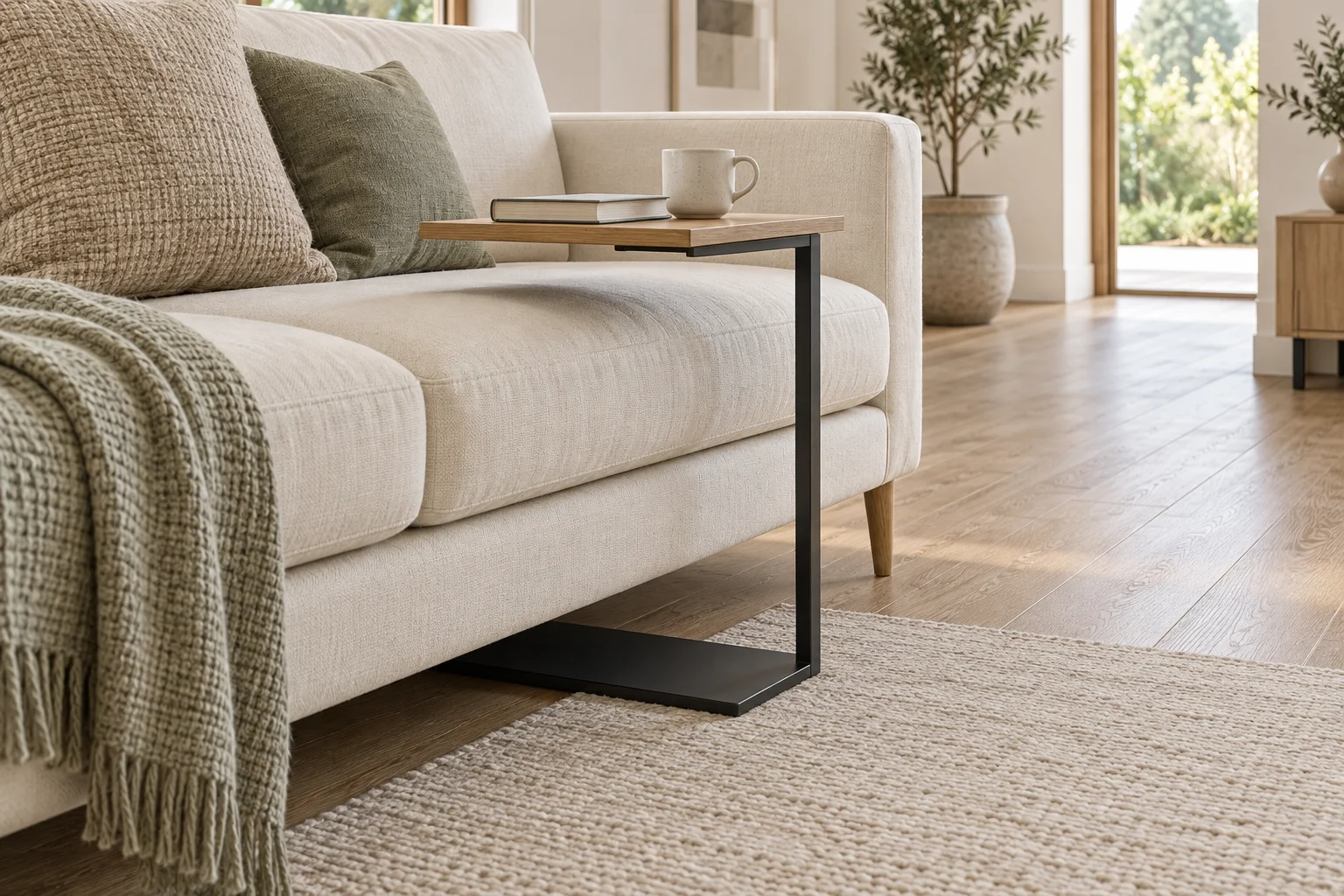
A C-shaped side table brings a small surface closer by sliding its base beneath a sofa. That simple idea depends on several hidden dimensions. The base must pass under the sofa, its upright must stop in a useful position, and the top must clear the user's legs without forcing an awkward reach. A slim product photograph cannot establish any of those relationships.
Measure the sofa and the table together, then test the intended activity. A surface for a cup is different from one used for a meal or a laptop. The dimensions here are examples for comparing furniture, not ergonomic standards or product approvals. Follow the table's loading instructions and the sofa manufacturer's restrictions, especially around moving mechanisms.
Start with the seat that will actually use it
Choose a specific sofa position. A table approaching from the front must negotiate the sofa's front rail, while one approaching from the side may encounter a different leg or structural member. A chaise, deep arm, or corner seat can change the approach entirely. Draw the direction of insertion rather than assuming the table can enter anywhere.
List the objects the surface should hold. Measure a tray, book, or laptop with its cables attached. Include a margin around a cup so that it does not sit on the edge beside a moving elbow. If the tabletop cannot accommodate the real objects without crowding, better under-sofa clearance will not make it suitable.
Measure the lowest obstruction under the sofa
The visible leg height is only a clue. Look for low rails, center supports, dust covers, staples, and reclining hardware along the entire insertion path. Measure from the finished floor or rug surface to the lowest relevant obstruction. Do not push a base against fabric simply because the sofa legs appear tall enough.
Compare that clearance with the highest part of the table base, including feet, glides, bolts, and welded joints. For example, a measured opening of 58 mm and a base assembly 32 mm high leave 26 mm before considering uneven flooring or soft fabric. That is a geometric comparison, not a guarantee of fit. Check the complete route with the actual base dimensions.
Check insertion depth separately from clearance height
Passing beneath the front edge is not enough. A cross rail may stop the base 140 mm inside the sofa even though the table needs 240 mm of insertion to bring its top close enough. Record the unobstructed horizontal distance and the point where each foot or rail interferes.
Use the product drawing to relate the base, upright, and top. Overall depth alone does not reveal how far the tabletop reaches beyond the upright. Some tops are centered; others project mainly toward the user. Ask for those dimensions if the listing omits them rather than estimating from a perspective photograph.
Consider a front approach where the upright remains 90 mm outside the sofa front and the top projects 220 mm inward from that upright. The top reaches 130 mm over the front edge. If an obstruction keeps the upright 160 mm out, overlap falls to 60 mm. This explains why a table can fit underneath yet still feel too far away.
Compare three heights while someone is seated
Record the compressed seat height, the top of the user's thighs, and the underside of the tabletop. The overall table height is insufficient when an apron or support bracket hangs beneath the top. Test the space while the user sits naturally, not while standing beside an empty cushion.
For a hypothetical setup, the seated thigh height is 535 mm and the table underside is 615 mm, leaving 80 mm vertically. Whether that feels comfortable depends on movement, posture, clothing, and the task. Try crossing or uncrossing legs if that is normal behavior, then stand up. Do not present the example as a universal target.
An approach over the sofa arm introduces another obstruction. Measure the arm's highest point and compare it with the underside of the table. A top that clears the arm may still be uncomfortably high for the seated user, so do not solve one measurement while ignoring posture.
Test reach without leaning on the table
Sit back in the normal position and place an empty cup on the mock surface. Retrieve it without twisting, raising the shoulder, or leaning heavily forward. Then try the actual task: turning a page, using a mouse, or cutting food on a plate. Different tasks expose different compromises.
A small occasional table should not become a support for standing up unless it is specifically designed for that purpose. Follow load limits and avoid placing heavy objects near an unsupported edge. If the user naturally braces on the top, change the arrangement or furniture type instead of relying on a reminder every time they stand.
For longer laptop sessions, assess the whole seated setup, including screen position and input devices. A C-shaped table that works well for a short email may not support a comfortable working posture for hours. A dedicated work surface may better match that use.
Include the rug and moving sofa parts
Measure with the real rug in place. A base straddling a rug edge can rock, while a thick pile can make sliding difficult. Check whether moving the table damages the rug or catches on its bound edge. Test both its working position and the place where it waits between uses.
Keep the table out of a recliner's operating envelope and follow the sofa instructions. A base hidden beneath a seat can contact hardware when the footrest moves even if the closed sofa looks clear. Do not operate powered furniture with an unverified obstruction underneath it.
Give the table a parking position
The table needs somewhere to go when the user stands, stretches, or shares the sofa. Mark that position without blocking a doorway or leaving a low base in the main route. Check that another person can sit down without stepping over the frame.
Avoid tethering a movable table with a charging cable across the floor. If power is necessary, plan an appropriate route and an unplugging sequence before moving it. A useful occasional surface should not make every change of position a cable-management task.
Make a fit test before ordering
Use cardboard to represent the top and floor tape for the base and upright. Support the cardboard safely for a seated reach test; do not use the mock-up as a load-bearing table. Reproduce the dimensions from the chosen product rather than a generic rectangle.
Compare the arrangement in the room planner, then verify the under-sofa path and posture physically. If you mainly want movable surfaces for several seats, the nesting-table layout guide explores a different solution. Buy the C-shaped table only after clearance, insertion, thigh space, reach, stability, and parking all work together.