Entryway Umbrella Stand: Plan a Wet Zone by the Door
Place an umbrella stand with room for door opening, wet handles, a removable drip tray, and the arrival routine, without carrying water through the entryway.
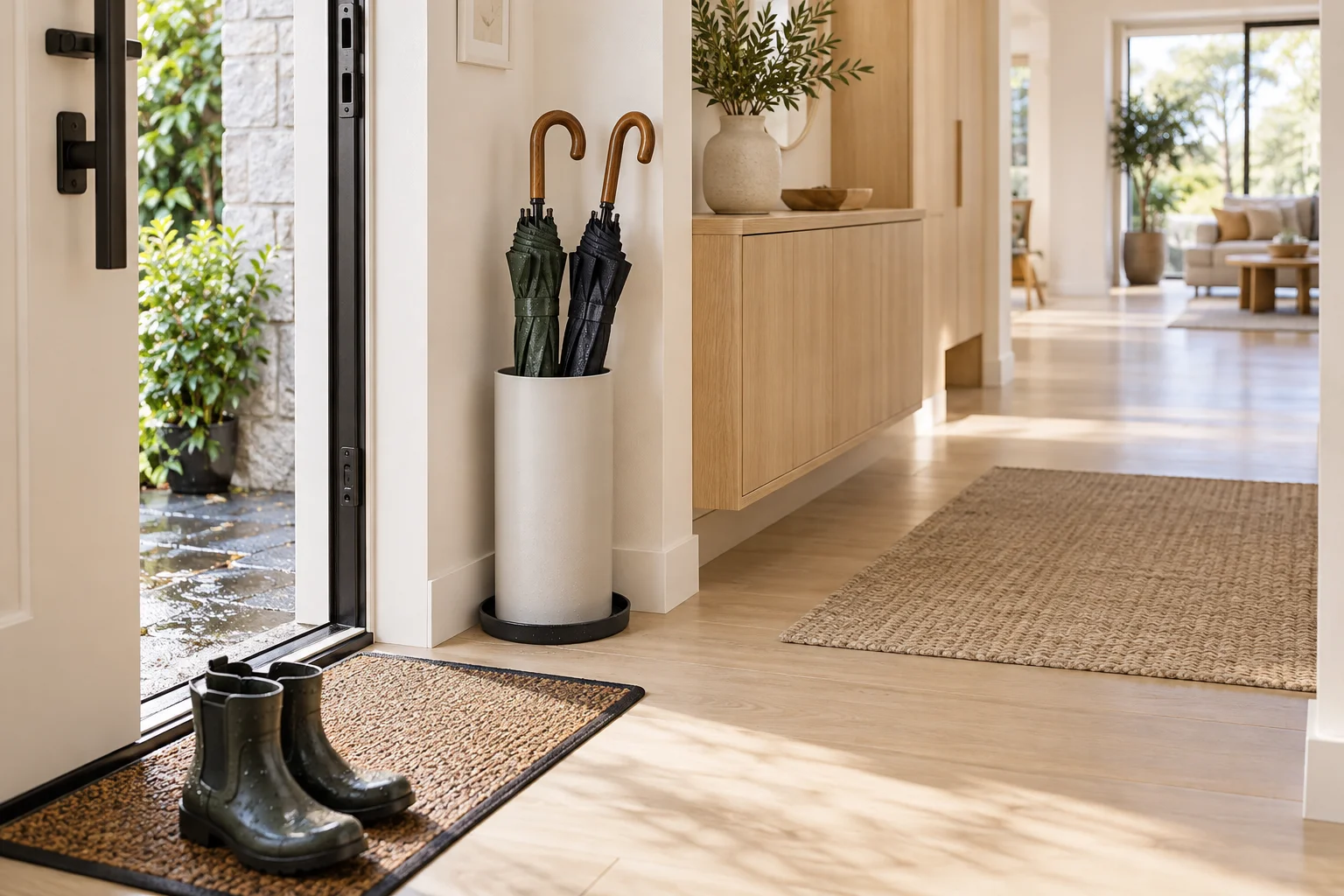
An umbrella stand is most useful during the few awkward seconds after coming home in the rain. You are holding a wet umbrella, opening a door, carrying a bag, and trying not to spread water over the floor. A stand chosen only for the dry corner where it fits may be unreachable during that sequence.
Plan a small wet zone around the arrival routine. It needs a receiving position for the closed umbrella, a contained place for drips, and access for emptying and drying the tray. The measurements below are examples for comparison, not door, accessibility, or building requirements. Preserve required access and follow the stand, flooring, and door manufacturers' instructions.
Follow the Umbrella From Outside to Storage
Rehearse the arrival sequence with a dry umbrella first. Where can it be closed without striking somebody or spreading water across a shared route? Which hand holds the keys? Does the door open inward toward the intended stand? Where does the shopping bag land while shoes are removed?
Keep the receiving point on the natural side of that sequence. A stand behind the open door may look hidden but require reaching around the leaf while balancing other belongings. A position farther inside can force the wet umbrella to cross the clean walking area.
This guide focuses on umbrellas and water handling. The entryway storage guide covers the larger arrangement of shoes, coats, benches, and small-item drop zones. The umbrella station should support that arrangement rather than occupy whatever gap remains.
Measure the Loaded Stand
Measure the base, the drip tray, and the widest point with the household's actual umbrellas inserted. Curved handles can protrude well beyond a narrow cylinder. Long umbrellas may lean outward, while compact umbrellas may need a separate appropriate holder rather than falling to the bottom.
Count the umbrellas likely to arrive wet together, not every umbrella the household owns. Two daily users and an occasional guest may need a different receiving capacity from a family arriving together. Keep dry spare umbrellas elsewhere if storing all of them here makes the wet zone overcrowded.
Check stability with the intended load and use the product as designed. Do not make an unstable stand acceptable by wedging it against a door or filling an unsuitable container with improvised ballast. Choose a product whose support and drainage arrangement suit the actual contents.
Trace the Door and Its Handle
Mark the full intended movement of the door, including the handle, closer, and any other projections. Then compare the loaded stand against that swept space. A base can sit outside the door leaf's arc while a hooked umbrella handle still catches the door handle.
For example, a 22 cm deep base may project 34 cm when the umbrellas lean normally. If a proposed wall strip provides 30 cm before the door's swept area begins, the loaded arrangement overlaps by 4 cm. The empty stand fitting there is irrelevant to the operating conflict.
Do not reduce the door's intended opening angle to accommodate the stand. Check adjacent closet doors and shoe cabinet panels as well. If two doors meet near the corner, trace both individually and together in the combinations used during arrival.
Give Water a Defined Destination
A removable drip tray makes inspection and emptying easier, but only when it can be taken out without tipping umbrellas across the passage. Determine whether the tray lifts upward, slides forward, or requires the whole stand to be moved. That motion belongs in the layout.
Suppose the stand is 28 cm deep and its tray slides another 25 cm forward. The service envelope reaches 53 cm from the wall before adding a standing position. Do not place a fixed bench immediately in front of it merely because the closed tray fits behind the bench legs.
Choose floor protection compatible with the floor finish and care requirements. A decorative absorbent mat is not automatically adequate for standing water. Keep the tray inspectable, and deal with persistent dampness rather than hiding it beneath a larger rug or cabinet.
Compare Three Small-Entry Positions
Beside the Door on the Latch Side
This can allow a direct handoff after entering, provided the stand does not occupy the space needed to open the door. Test the real hand sequence with bags and keys. A location that is convenient when empty-handed may be awkward during an ordinary grocery arrival.
Keep the loaded handles clear of switches, locks, and intercom access. The umbrella should have its own receiving position instead of borrowing the ledge used for keys and mail.
At the End of a Shoe Cabinet
The cabinet can create a visual boundary between wet and dry storage. Confirm that the stand does not block a tilting shoe compartment, a drawer, or the place where someone stands to change shoes. Keep drips from entering cabinet joints and the dry shoe area.
If the available strip is very narrow, compare an appropriately fixed holder with a freestanding stand. Installation requirements and wall suitability matter. A shallow wall attachment still needs room for the loaded umbrellas and a working drip collection method.
Inside a Purposeful Recess
A recess can contain the station visually, but it must remain reachable during arrival and accessible for cleaning. Do not use a closed cupboard as an assumed drying solution. Wet umbrellas need an appropriate drying step according to their care instructions before ordinary enclosed storage.
Check whether a shelf above the recess prevents a long umbrella from being lifted out. The vertical extraction path can fail even when the floor plan looks perfect. Use the longest actual umbrella for the test.
Separate Receiving, Drying, and Dry Storage
These can be three stages rather than one overloaded container. The entry receives wet umbrellas and catches drips. A suitable location allows them to dry according to their instructions. Dry spares then return to their designated storage if they are not used daily.
Avoid opening umbrellas across the essential entry route for drying. Do not use an enclosed shared corridor as overflow storage or assume a common area is available. Plan within the household's permitted space and retain the required passage and door operation.
Rehearse a Rainy-Day Arrival
Use a dry umbrella to test the motions, then inspect actual water handling during normal rainy use. Enter with a bag, close the door, place the umbrella, remove shoes, and leave the entry. Repeat while another person arrives or needs to go out. Nobody should have to move the stand to operate the door.
Finally, remove the tray, carry it to a suitable emptying point, clean it as instructed, and replace it. Consider the route with the tray containing water, not only empty. A manageable tray and a short service route are more useful than a decorative stand that is difficult to maintain.
For the overall furniture arrangement, use the room planner introduction as a starting point. Verify door movement and tray handling in the real entry. A successful wet zone keeps the arrival sequence short, contains drips where they can be seen, and leaves the main route available in rainy weather as well as dry weather.