Home Library Reading Room Layout: Shelves and Seating
Design a home library with safe bookshelf depths, comfortable reading seats, task lighting, daylight control, ladder clearance, and quiet circulation.
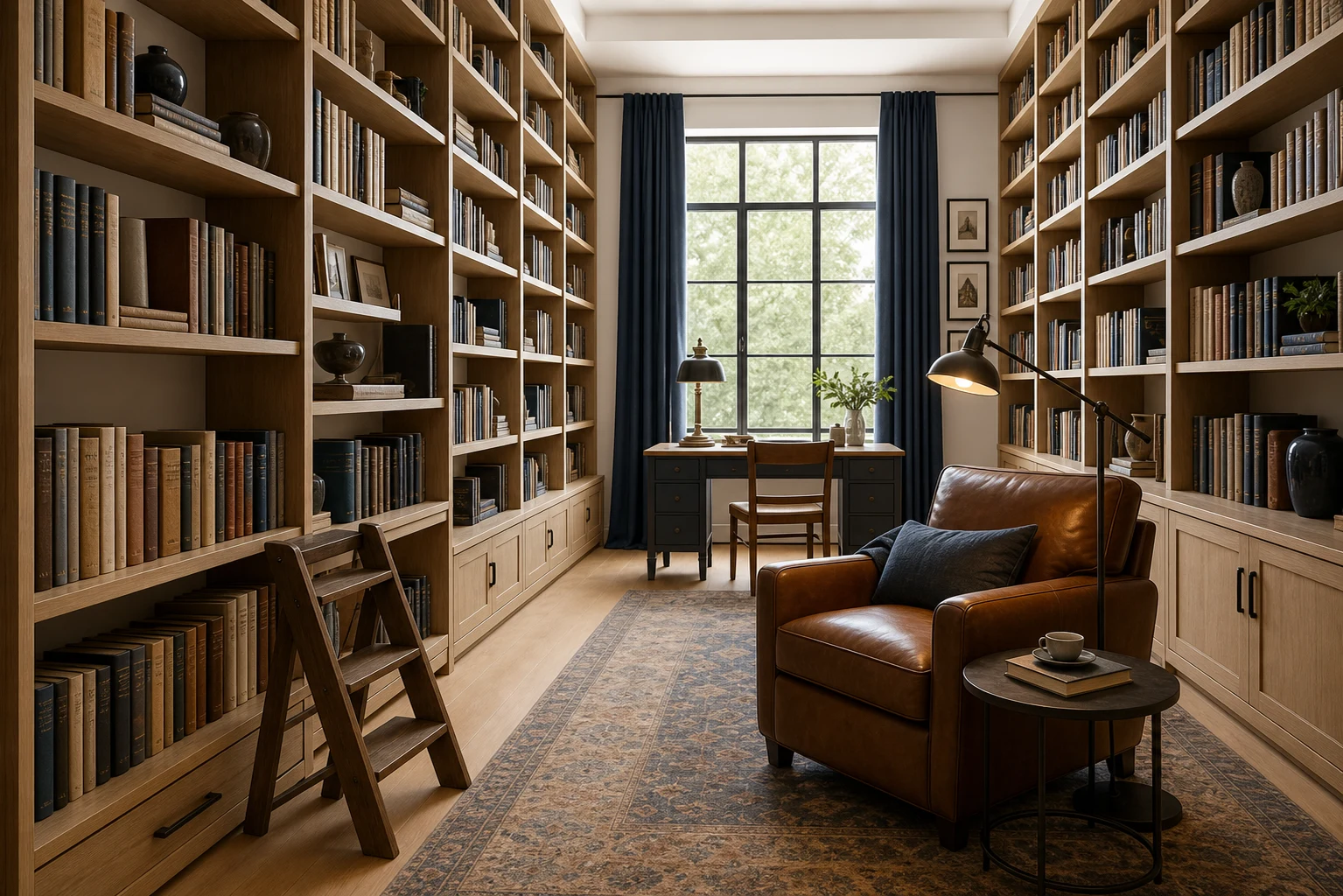
A home library should make books easy to find and reading easy to continue. Filling every wall with shelves can create impressive storage but poor light, narrow aisles, inaccessible upper rows, and no comfortable place to open a large book. Inventory the collection, choose reading modes, and plan weight, reach, and circulation before styling shelf objects.
Count Books by Format and Use
Measure representative paperbacks, hardbacks, art books, files, and objects. Standard books often fit 20–25 cm deep shelves, while large volumes may need 30–35 cm. Adjustable shelves prevent wasted vertical gaps. Keep frequently read books between knee and shoulder height, heavy volumes lower, and archival or decorative items higher. Reserve growth capacity instead of filling every shelf on opening day.
Verify Structure and Fixing
Books are heavy. Confirm floor capacity, shelf spans, wall construction, and anti-tip anchoring with appropriate professionals and manufacturers. Long shelves may sag even when their depth looks correct. Do not place an unanchored tall case near seating or a child’s climbing route. Draw skirting, outlets, vents, and door trim in Aedifex because these can prevent cases from sitting safely against the wall.
Create More Than One Reading Posture
Provide a supportive armchair for long reading, a desk or table for reference work, and perhaps a window seat for short sessions. Each position needs a surface for a book and drink. Leave about 45–55 cm between chair and side table, with enough room to stand without catching the shelf. A footstool should have a parking place outside the main aisle when unused.
Set Shelf and Furniture Clearances
Allow roughly 90 cm for a comfortable main aisle and more where people pass behind a chair. In front of lower cabinet doors or deep drawers, add their extension plus standing room. Keep chairs far enough from shelves that a reader’s head does not hit projecting books. If two parallel shelf walls create a narrow gallery, place seating at the end rather than choking the middle.
Light Pages, Spines, and Paths Separately
Ambient light supports movement, vertical shelf lighting helps identify titles, and an adjustable reading lamp illuminates the page from behind the reader’s shoulder. Avoid relying on downlights directly over the head, which cast body shadows. Choose high color quality and control glare on glossy pages. Conceal wiring safely without burying access or placing hot fixtures against paper.
Manage Daylight and Book Preservation
Direct sun fades covers and damages paper. Put valuable collections away from intense glazing or use UV-filtering and adjustable shades. A reading chair can enjoy daylight if the user can turn away from glare. Keep books off damp exterior walls and allow air movement. Stable humidity and temperature matter more than a dramatic sunlit shelf photograph.
Decide Whether a Ladder Is Justified
Library ladders require rail, parking, climbing, and fall-clearance zones. They should not cross doors, steps, or seating. For a modest collection, a stable step stool stored nearby is often safer and consumes less space. Keep daily books within normal reach. If a ladder is part of the design, follow the system manufacturer’s installation and loading requirements.
Organize for Retrieval and Return
Choose a system users will maintain: topic, author, language, or household member. Add a return shelf near the entrance so loose books do not accumulate on chairs. Provide space for current reading and a charging point for an e-reader without mixing cables through walking routes. Closed lower cabinets can hide games and devices while preserving calm above.
Run an Evening Reading Test
Enter carrying books, find a title, sit, turn on the lamp, place a drink, use a laptop, and return everything. Open cabinet doors and pull out the stool. Can another person pass without interrupting? Check the home office layout guide if the library must also support focused computer work.
Home Library Checklist
- Inventory book sizes, weight, frequency, and future growth.
- Verify structure, shelf spans, anchoring, vents, and outlets.
- Provide at least two reading postures with nearby surfaces.
- Separate aisle, shelf, cabinet, and chair operating zones.
- Layer ambient, shelf, and page lighting.
- Control sun, moisture, temperature, and unstable climbing access.
Build the room in the room planner before commissioning shelves. A useful library is measured by how often books leave and return to their places, not by the maximum number visible in a photograph. Safe storage, good page light, and a quiet path to a comfortable chair make the collection part of everyday life.
Verify the Shelf Rating Before a Sample Bay
Before ordering a whole wall, obtain the supplier’s load rating and installation requirements for the actual span, shelf material, fixings, and wall. Have a qualified professional resolve unknown floor or support capacity. Do not discover capacity by progressively adding heavy books and waiting for sag: visible deflection is not a safe pass/fail test. Once suitability is established, use one properly installed bay within its stated limits to check book retrieval, shelf spacing, cleaning reach, and visual density. Lightweight book-size templates can test geometry without an improvised load test.
Home Library Reading Room Layout: Shelves and Seating
Assume two facing shelf walls form a reading gallery 1900 mm wide. Each shelf is 300 mm deep, and a hypothetical 900 mm retrieval envelope represents a person carrying an open large book.
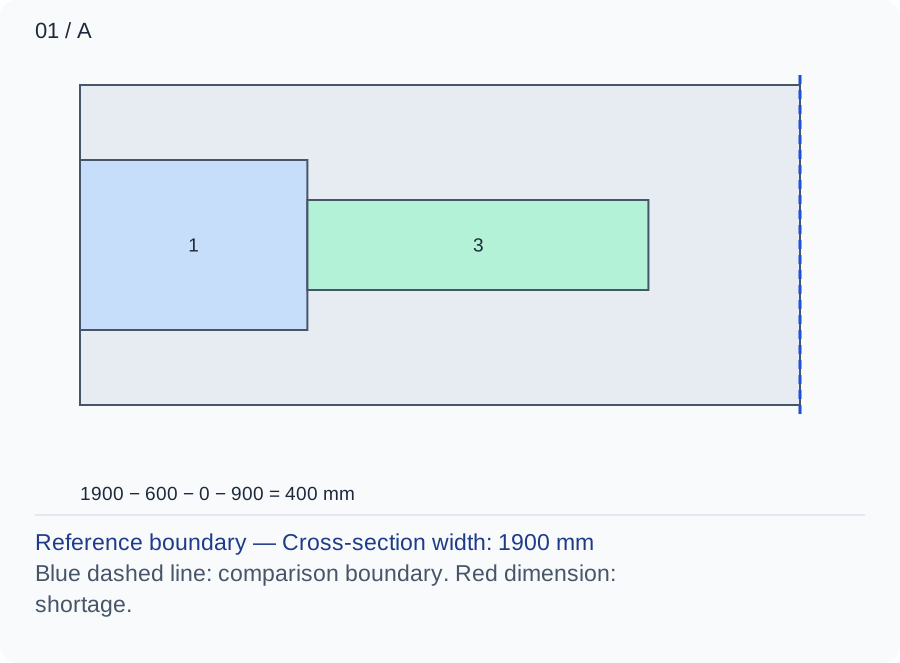
The section combines both fixed shelves as 600 mm. 1900 − 600 − 0 = 1300 mm, leaving 400 mm beyond the assumed retrieval envelope; shelf load is not part of that geometry.
Numbers and marks identify the items described here; use the stated dimensions rather than measuring the screen.
1: fixed occupation; 2: operating extension; 3: chosen user or route allocation. These are sequential allocations, not exact furniture positions.
| Input | A | B |
|---|---|---|
| Cross-section width (mm) | 1900 | 1900 |
| Fixed installed depth (mm) | 600 | 1100 |
| Additional operating projection (mm) | 0 | 0 |
| Measured task envelope (mm) | 900 | 900 |
Changed conditions and evidence
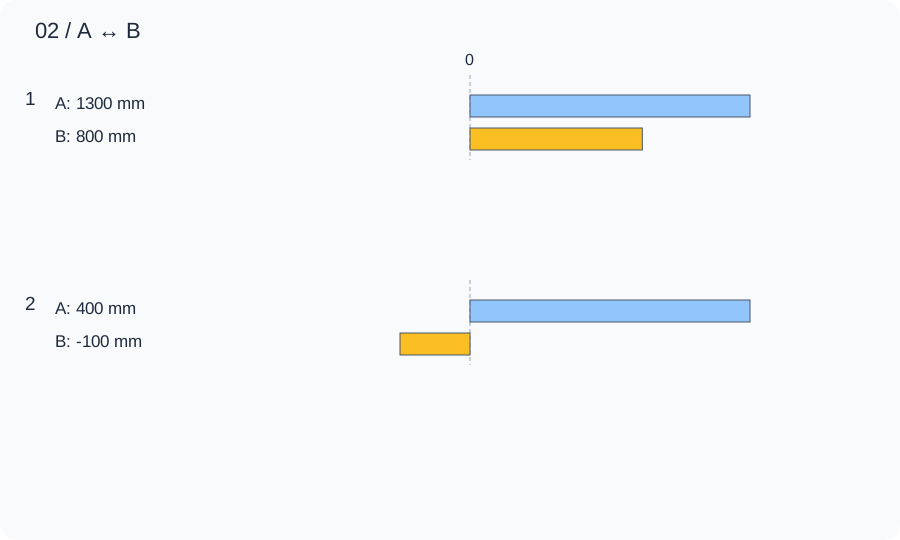
A footstool left in the gallery adds 500 mm of occupation and changes the result to −100 mm. Park it at the reading seat’s side or omit it, sacrificing convenience rather than assuming someone will move it for every book.
| Calculated relationship | A | B |
|---|---|---|
| 1. Unoccupied cross-section | 1300 mm | 800 mm |
| 2. Remainder after the stated allowance | 400 mm | -100 mm |
Carry the largest regularly used book through the taped aisle and return it to its shelf. Confirm shelf ratings, spans and anti-tip installation before loading; a successful retrieval trial does not establish structural capacity.
TRY THE EXAMPLE
Home Library Reading Room Layout: Shelves and Seating
Assume two facing shelf walls form a reading gallery 1900 mm wide. Each shelf is 300 mm deep, and a hypothetical 900 mm retrieval envelope represents a person carrying an open large book.
Allowed range: 1–10000 · Step: 1
Allowed range: 0–10000 · Step: 1
Allowed range: 0–10000 · Step: 1
Allowed range: 0–10000 · Step: 1
Positive remainder under these assumptions. Check the actual use and product requirements before choosing a layout.
- Unoccupied cross-section
- 1,300 mm
- Remainder after the stated allowance
- 400 mm
Reference boundary — Cross-section width: 1900 mm
Blue dashed line: comparison boundary. Red dimension: shortage.
1900 − 600 − 0 − 900 = 400 mm
Carry the largest regularly used book through the taped aisle and return it to its shelf. Confirm shelf ratings, spans and anti-tip installation before loading; a successful retrieval trial does not establish structural capacity.
Teaching assumptions, not a surveyed home or a construction check. Results describe this simplified geometry or budget only. Changes stay on this page and reset on reload.