Jigsaw Puzzle Table Layout: Keep, Cover, and Store It
Plan a jigsaw puzzle table for unfinished puzzles, sorting trays, protective covers, and a clear transfer route so shared rooms reset without lost pieces.
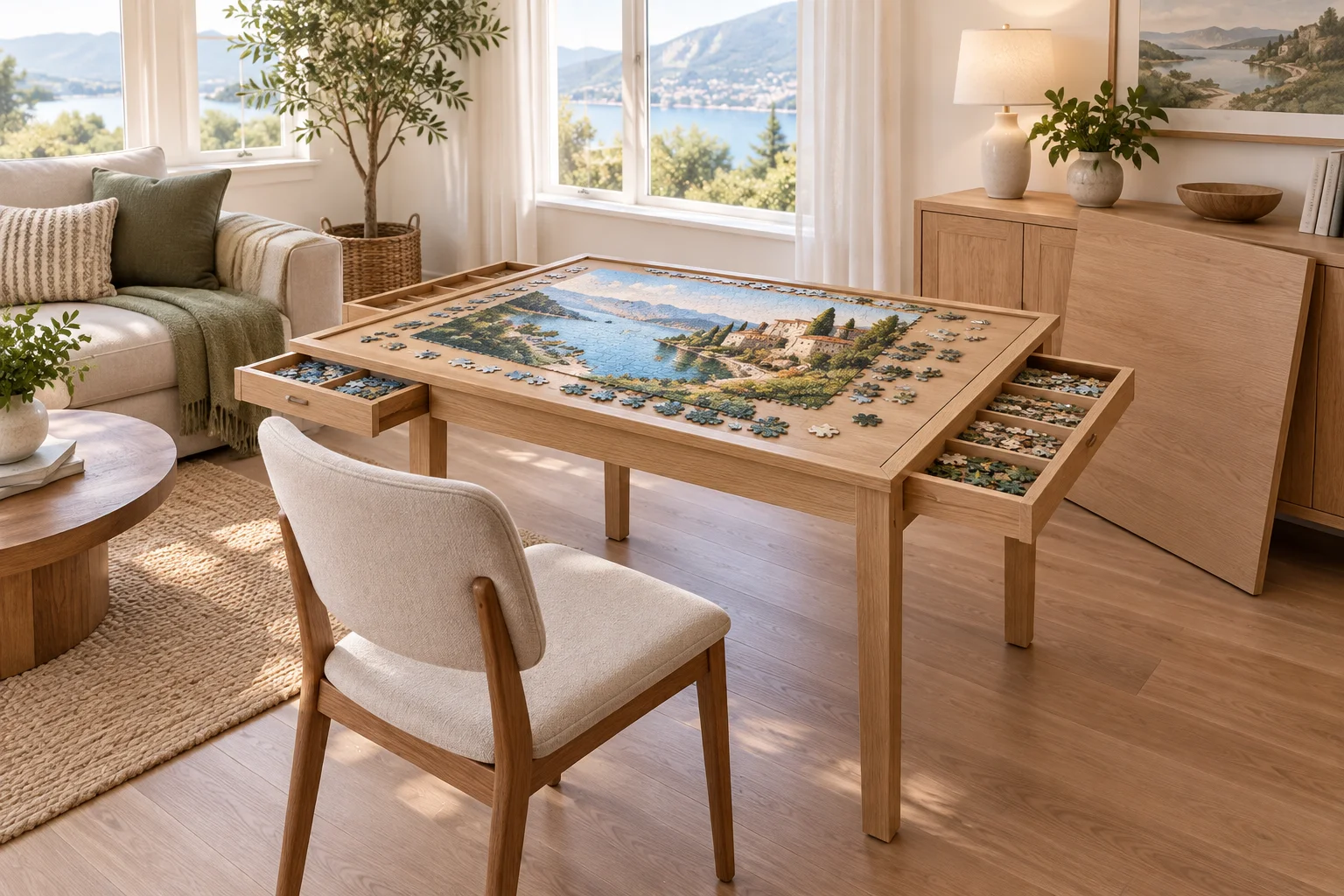
The difficult part of a puzzle corner is often the pause between sessions. An unfinished puzzle must survive dinner, cleaning, visitors, and the trip to storage. A table large enough for the finished picture can still fail if sorting trays occupy every spare surface or the loaded board cannot pass through the doorway. Plan the resting state and the transfer route before choosing the tabletop.
All measurements here are examples for testing your own equipment, not furniture standards or guaranteed puzzle sizes. Use the finished dimensions printed on your puzzle box and the storage product's instructions. Piece count alone does not establish the size of the assembled image.
Choose What Happens When the Session Ends
Decide whether the puzzle stays on a dedicated table, remains under a removable cover on a shared table, or travels on a board to another location. These are different room layouts, even if they use the same chair.
A dedicated table avoids repeated lifting but permanently occupies floor area. A covered surface keeps the work in place, provided the cover is designed to bridge and protect it without resting on the pieces. A transfer board returns the table to other uses but needs a suitable destination and a route that can be negotiated while keeping it supported.
Write down one realistic end-of-session sequence. For example: return loose pieces to trays, secure tray lids, cover the board, move it to a horizontal shelf, and tuck away the chair. If the sequence includes clearing a crowded cupboard first, the storage location is not yet ready.
Size the Board From the Picture Outward
Suppose the finished puzzle measures 70 by 50 cm. Adding a 4 cm working margin on each side produces a minimum example working rectangle of 78 by 58 cm. A raised edge, handle, or cover frame can make the outside dimensions larger. Use those outside dimensions for table support and storage calculations.
Now account for sorting. Two trays each measuring 25 by 35 cm cannot be assumed to fit around that rectangle on an 80 by 60 cm table. Choose between a larger surface, a separate stable tray stand, or stacked lidded trays that are opened one at a time. Avoid balancing trays on chairs that someone might move.
Make a paper template for the complete active arrangement. Include the box lid used as a picture reference and the task lamp base. The image alone is only one part of the working footprint.
Keep the Center Within Reach
A broad table can make the central pieces difficult to reach. Trial the proposed board with an empty cardboard template while seated in the actual chair. Reach toward the center without leaning heavily on the board or pulling the table toward you. Repeat from each side you expect to use.
If the table sits against a wall, all work must be possible from its accessible sides. Moving it into the room creates access but consumes circulation space. A rotating board may help if it is suitable for the puzzle, yet its corners need room to turn. A 78 by 58 cm rectangle rotates through an approximately 97 cm diameter circle when centered; nearby trays must stay outside that sweep.
Do not select a turning mechanism solely from this calculation. Check its supported load, stability, and instructions for retaining the puzzle during movement.
Give the Cover Its Own Storage Position
A cover that protects the puzzle overnight becomes a large loose object during play. Measure where it stands or lies while removed. Leaning an unsecured panel against a chair or glass door creates a new obstruction and risks falling onto the work.
Check the cover's internal clearance, including puzzle thickness and any raised board edges. Only use the covered table for other activities if the complete system is designed to support them. A light dust cover is not a dining surface, and placing hot dishes or drinks above a puzzle requires a system explicitly intended for that use.
In homes with children or pets, consider whether pieces and removable fasteners remain accessible around the edges. A cover that blocks dust may not prevent access. Choose storage appropriate to the household rather than treating every cover as a lockable enclosure.
Measure the Destination in Three Dimensions
For an illustrative board with outside dimensions of 82 by 62 cm, a horizontal storage shelf needs usable width and depth that accommodate the board plus handling space. Measure between hinges, brackets, door stops, and projecting handles, not just between cabinet walls.
Height matters too. Suppose the covered board is 5 cm thick and your chosen handling method needs another 4 cm to support and withdraw it. A 7 cm shelf opening fails that example even though the board alone is thinner than the gap. Test with an empty board before loading a puzzle.
Keep the board horizontal unless its storage system specifically supports another orientation. Sliding a loose puzzle vertically into a narrow gap may disturb it even when the board itself fits perfectly.
Rehearse the Transfer Route
Trace the route from table to storage with the full-size empty board. Include the space occupied by your hands and body, the door opening, and the turn into the storage bay. A straight doorway measurement does not prove that a long panel can make a nearby right-angle turn.
Keep the route clear before lifting. Decide whether one person can carry the board safely and level or whether it requires two people or another storage strategy. Do not plan on tilting an unfinished puzzle to get around furniture unless the retention system explicitly allows it.
If the route fails, the most useful change may be a storage bay beside the table rather than a smaller table. Compare the broader room organization with the craft room layout guide, while keeping this board transfer separate from general tool storage.
Design the Reset Around Loose Pieces
Allocate one tray for pieces currently being examined, lidded trays for sorted groups, and a defined place for the reference image. Label trays by a useful working category and keep a record of where they stack. Avoid deep containers that force you to pour everything out again next time.
Before covering the puzzle, inspect the floor and chair for stray pieces, then put the lamp and box lid into their resting positions. Keep liquids on a separate stable surface. Check evening lighting for glare without positioning a lamp where its cord crosses the transfer route.
Test a Complete Pause and Restart
Run one dry rehearsal: sit, reach the far section, open every tray, remove the cover, pack everything away, transfer the board, and return it. Record the first awkward step and revise that part of the layout.
Use a room plan to compare table and storage locations, but verify the loaded system and handling method physically. A successful puzzle space preserves unfinished work while allowing the room to return to everyday life without a search for missing pieces or a complicated furniture shuffle.