Laundry Room Layout Ideas: Washer, Dryer, Sink, Folding Counter
Compare side-by-side and stacked machines in a 2.2×2.4 m example, calculating open-door and basket space while preserving drying and maintenance access.
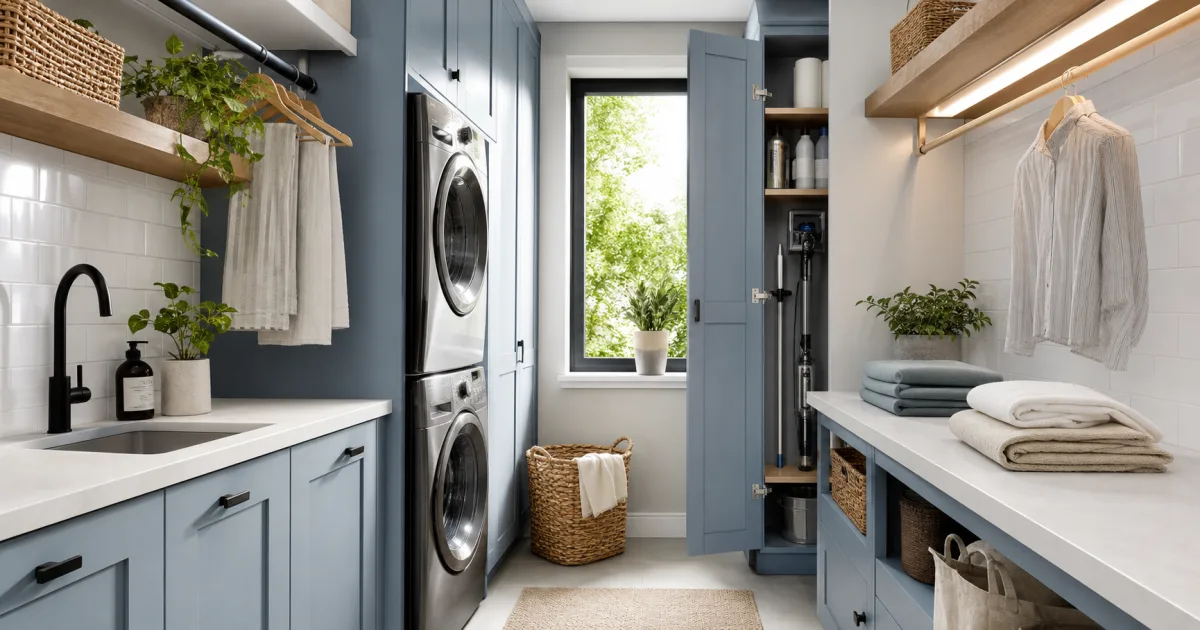
Plan a laundry room around one complete load: arrive, sort, wash, transfer, dry, fold and return. Machine arrangement matters, but the basket, open doors and eventual repair route decide whether the plan works. A stacked pair is not automatically the best answer for a small room.
Compare two arrangements in one measured shell
Use a hypothetical room 220 cm wide and 240 cm deep. Assume each machine's installed envelope is 65 cm wide and 85 cm deep, including the rear allowance for this example. These are invented dimensions, not specifications. Obtain actual machine and connection drawings before designing cabinetry.
| Arrangement along the 220 cm wall | Width used by machines | Unallocated width |
|---|---|---|
| Two side by side | 65 + 65 = 130 cm | 90 cm |
| Approved stacked pair | 65 cm | 155 cm |
The leftover width is not automatically a cabinet opening. Installation gaps, side panels, plumbing, wall irregularities and the room door still need allocation. Stacking is an option only when the exact models, kit and support are approved. The upper controls and drum must be usable by the intended person.
For side-by-side machines, test a 60 cm-wide basket bay in the remaining 90 cm. That leaves 30 cm unassigned, not permission to squeeze in another narrow cupboard. An independently supported counter must respect machine movement, access and manufacturer instructions; do not simply rest a worktop on vibrating equipment.
Draw the depth with a door open
Opposite the 85 cm-deep installed machines, a 40 cm-deep storage unit leaves 240 − 85 − 40 = 115 cm between fronts. If the selected washer door projects 50 cm, the remainder at that cross-section is 65 cm before the user. A basket projecting another 45 cm into the same section leaves 20 cm. This demonstrates a blocked operating arrangement, not a recommended clearance.
Move the basket into its side bay or remove the opposite unit, then repeat the actual loading and turning task. Put the doorway on the drawing: a clear strip can still be a dead end if the room door swings across it. Test open detergent drawers and filter access separately.
Make drying and folding explicit
Write where a full wet load goes if it cannot use the dryer. A folding rack needs its deployed footprint, loaded garments, a carrying route and a storage destination. Room ventilation and appliance ventilation are separate requirements; one cannot be inferred from the other.
Keep clean folding away from dirty shoes or incoming laundry. A basket landing should hold the real basket without blocking the next action. A high shelf is not a general solution for heavy detergent, and a pedestal can improve one person's reach while putting controls too high for another.
Keep a service state alongside the laundry state
Before fixing a counter, record how each appliance is disconnected and removed by a qualified person. Check shutoffs, drain, electrical access, filter, any dryer duct, and the replacement route through the room door. Follow the chosen dryer's duct or ventilation requirements rather than designing for an unspecified machine type.
Rehearse the routine with empty baskets. Use the room planner for alternative furniture envelopes and the demo to explore the interface. Geometry cannot certify stacking, electrical work or plumbing. The laundry closet guide addresses enclosure doors; the accessible laundry guide adds personal reach and approach checks.
A useful handoff includes actual model numbers, installed envelopes, open-door positions, basket parking, drying area and a service-removal sketch. If one of those is unresolved, mark it before ordering joinery.
Laundry Room Layout Ideas: Washer, Dryer, Sink, Folding Counter
The original laundry example has 2400 mm depth, an 850 mm installed machine and 400 mm opposite cabinet. Their combined fixed depth is 1250 mm; the door projects 500 mm and the original basket uses 450 mm.
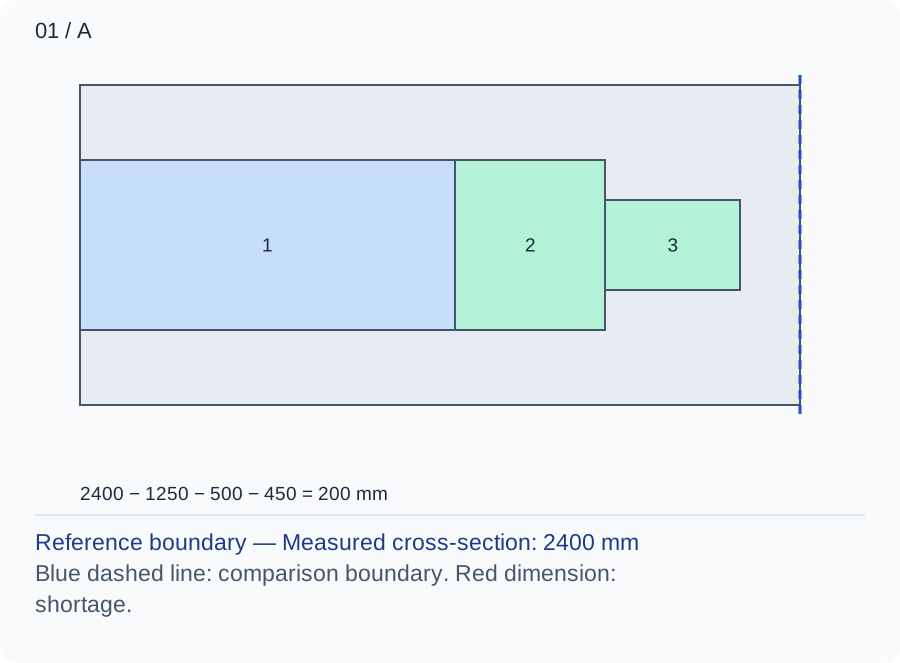
The closed-front gap is 1150 mm and the open-door remainder is 650 mm. With the basket it becomes 200 mm, before adding any separate operator.
Numbers and marks identify the items described here; use the stated dimensions rather than measuring the screen.
1: fixed occupation; 2: operating extension; 3: chosen user or route allocation. These are sequential allocations, not exact furniture positions.
| Input | A | B |
|---|---|---|
| Measured cross-section (mm) | 2400 | 2400 |
| Combined fixed occupation (mm) | 1250 | 1250 |
| Operating projection (mm) | 500 | 500 |
| Chosen user or route allowance (mm) | 450 | 650 |
Changed conditions and evidence
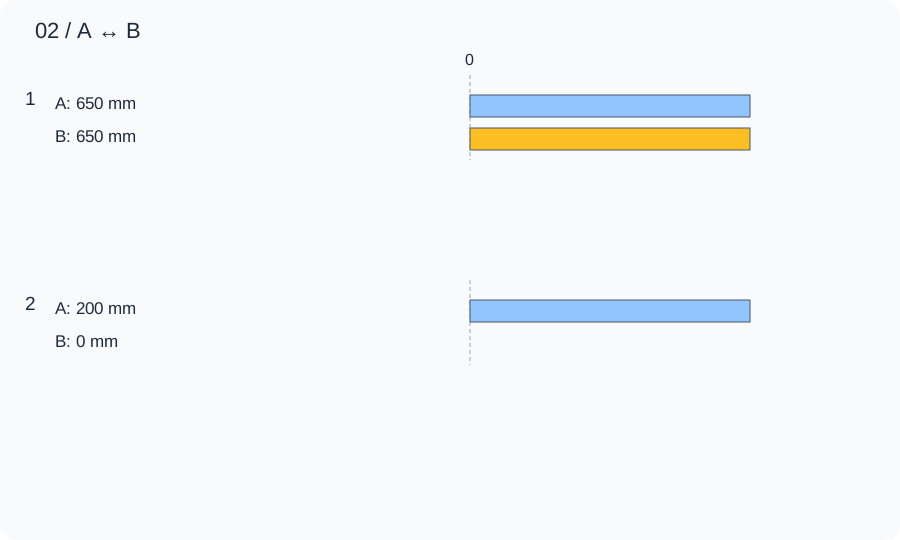
Using a 650 mm user allocation instead of the basket leaves zero. Because these are alternatives in this control, use 1100 mm to represent both basket and user together, yielding a −450 mm combined balance.
| Calculated relationship | A | B |
|---|---|---|
| 1. Unoccupied cross-section | 650 mm | 650 mm |
| 2. Remainder after the stated allowance | 200 mm | 0 mm |
Place the actual basket beside the full-open machine rather than behind it and repeat loading. Keep a separate service arrangement for pulling machines out; a working laundry state does not prove replacement access.
TRY THE EXAMPLE
Laundry Room Layout Ideas: Washer, Dryer, Sink, Folding Counter
The original laundry example has 2400 mm depth, an 850 mm installed machine and 400 mm opposite cabinet. Their combined fixed depth is 1250 mm; the door projects 500 mm and the original basket uses 450 mm.
Allowed range: 1–12000 · Step: 1
Allowed range: 0–12000 · Step: 1
Allowed range: 0–12000 · Step: 1
Allowed range: 0–12000 · Step: 1
Positive remainder under these assumptions. Check the actual use and product requirements before choosing a layout.
- Unoccupied cross-section
- 650 mm
- Remainder after the stated allowance
- 200 mm
Reference boundary — Measured cross-section: 2400 mm
Blue dashed line: comparison boundary. Red dimension: shortage.
2400 − 1250 − 500 − 450 = 200 mm
Place the actual basket beside the full-open machine rather than behind it and repeat loading. Keep a separate service arrangement for pulling machines out; a working laundry state does not prove replacement access.
Teaching assumptions, not a surveyed home or a construction check. Results describe this simplified geometry or budget only. Changes stay on this page and reset on reload.