Narrow Hallway Design Ideas: Storage, Lighting, Mirrors, Flow
Calculate a hallway cabinet’s closed and open clearance, account for radiators and turning objects, and choose storage from the actual blocked action.
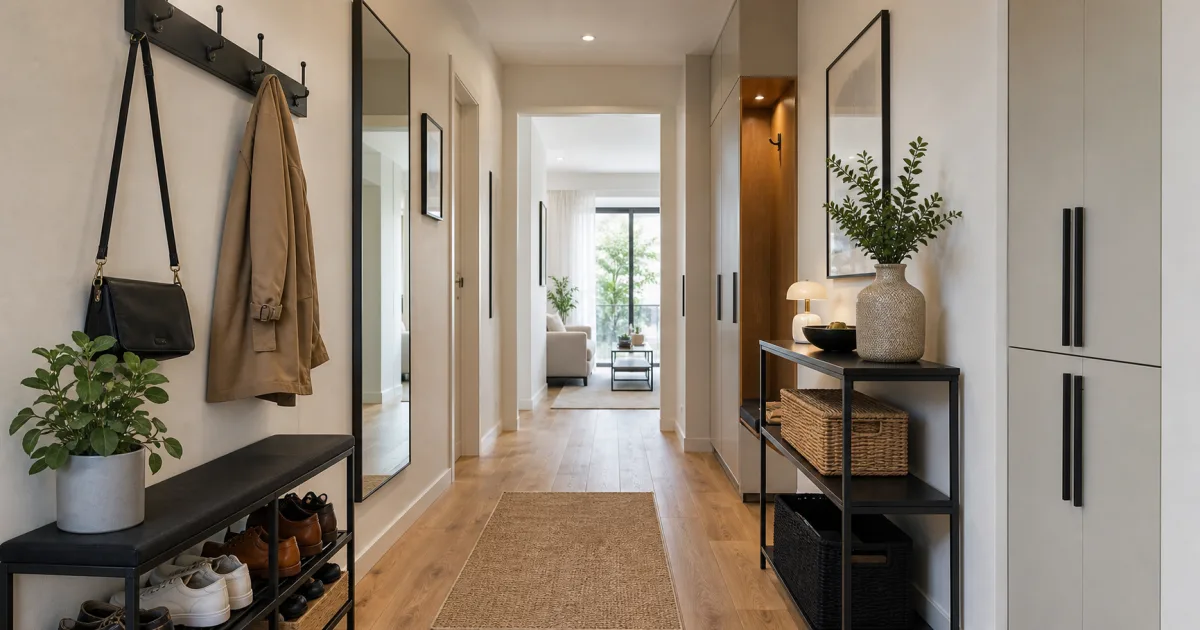
A hallway's wall-to-wall width does not tell you what furniture it can accept. The usable route changes at a radiator, a door handle and an open shoe cabinet. Survey those cross-sections before choosing a console or bench; a wider-looking mirror cannot recover lost passing space.
Make a strip-by-strip survey
Measure the corridor at floor, handle and shoulder height. Record skirting, radiators, controls and door leaves, including the farthest projection. Mark the route used with groceries, laundry, a stroller or the household's mobility equipment. Check required clear widths and egress with the applicable authority; the examples below are not standards.
A cabinet that fits closed can fail open
Take an illustrative 110 cm-wide hall. A cabinet body is 24 cm deep, with a handle projecting another 2 cm. Its full installed projection is 26 cm, leaving 110 − 26 = 84 cm. Suppose the supplier's fully open drawing shows 46 cm from the wall, including the handle. Subtract 46 directly; do not add the body again.
| Cross-section and state | Calculation | Remaining width before the person |
|---|---|---|
| Plain opposite wall, cabinet closed | 110 − 26 | 84 cm |
| Plain opposite wall, cabinet open | 110 − 46 | 64 cm |
| Opposite radiator projects 12 cm, closed | 110 − 26 − 12 | 72 cm |
| Same radiator, open | 110 − 46 − 12 | 52 cm |
These remainders are not recommendations. Add the person bending to retrieve shoes and the entry-door movement. If this is the only route, temporary opening can still be a serious conflict. Do not decide that “a 90–110 cm hall accepts a shallow cabinet” without doing the subtraction.
Choose the storage response from the failed action
If opening storage blocks arrival, move daily shoes to a recess outside the corridor or reduce the number stored there. If the problem is a projecting handle, changing only cabinet depth will not address the full installed envelope. If a bench user blocks the route, a shorter bench in the same narrow section may not help: sitting and standing need depth, not just length.
A wall ledge avoids floor legs but still projects into shoulder and bag space. A hook with a coat on it is deeper than an empty hook. Record the loaded condition. Shallow tall cabinets and mirrors may need anchoring; in rentals, confirm mounting requirements and permission before selecting them.
Inspect the corner as well as the straight strip
Two straight widths can look adequate while a turn fails for a rigid suitcase. Tape a rectangle matching the actual object and trace its full outline around the corner. Include the carrier's position. Do not substitute the object's diagonal for a complete turning test or use it as an egress approval.
Open each room door while the entrance door is in its normal state. Look for handle collisions, a hidden person behind a leaf and a cabinet that prevents a door reaching its intended opening.
Add light and decoration after the route works
Use lighting that reveals thresholds and stored objects without projecting into the route. Check glare in mirrors from both ends of the hall. Color and reflectance can change perception, but they do not increase the measured width. Keep rugs flat and preserve door operation; proposed wiring or fixture changes need appropriate installation review.
Use the room planner or a full-size floor outline for alternatives. For the cabinet mechanism, see tilt-out shoe cabinet clearance; for household arrival routines, see entryway storage. Keep the final record specific: location, closed projection, open projection, competing obstacle and tested action.
Narrow Hallway Design Ideas: Storage, Lighting, Mirrors, Flow
The article’s 1100 mm hall has a closed cabinet projection of 260 mm and opposite radiator of 120 mm. Combine them as 380 mm fixed use; a chosen 600 mm retrieval-person allocation is an independent addition.
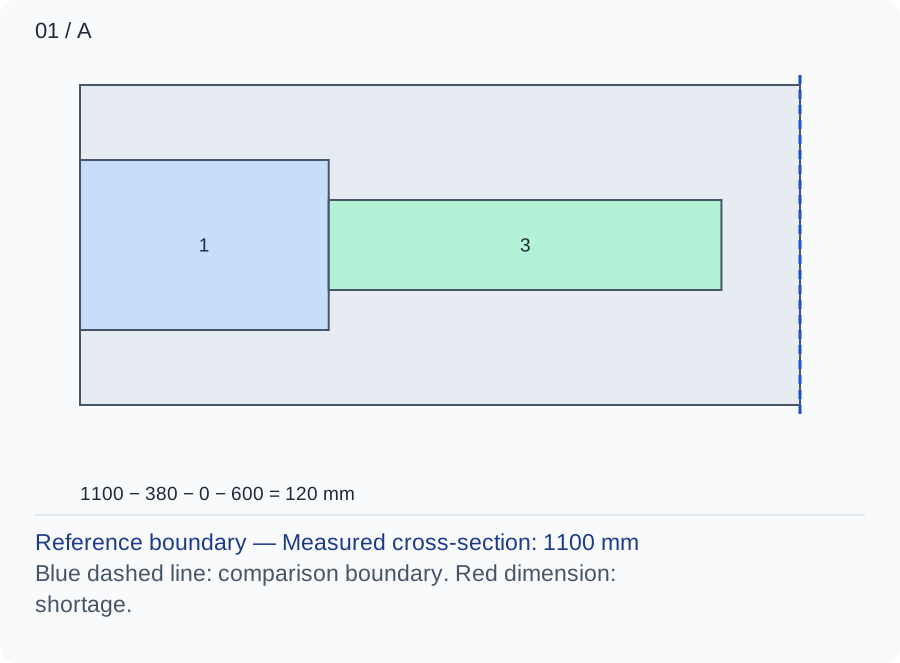
The closed state leaves 720 mm before the person and 120 mm beyond the chosen allocation. The chart groups opposite occupations rather than drawing their exact physical side.
Numbers and marks identify the items described here; use the stated dimensions rather than measuring the screen.
1: fixed occupation; 2: operating extension; 3: chosen user or route allocation. These are sequential allocations, not exact furniture positions.
| Input | A | B |
|---|---|---|
| Measured cross-section (mm) | 1100 | 1100 |
| Combined fixed occupation (mm) | 380 | 380 |
| Operating projection (mm) | 0 | 200 |
| Chosen user or route allowance (mm) | 600 | 600 |
Changed conditions and evidence
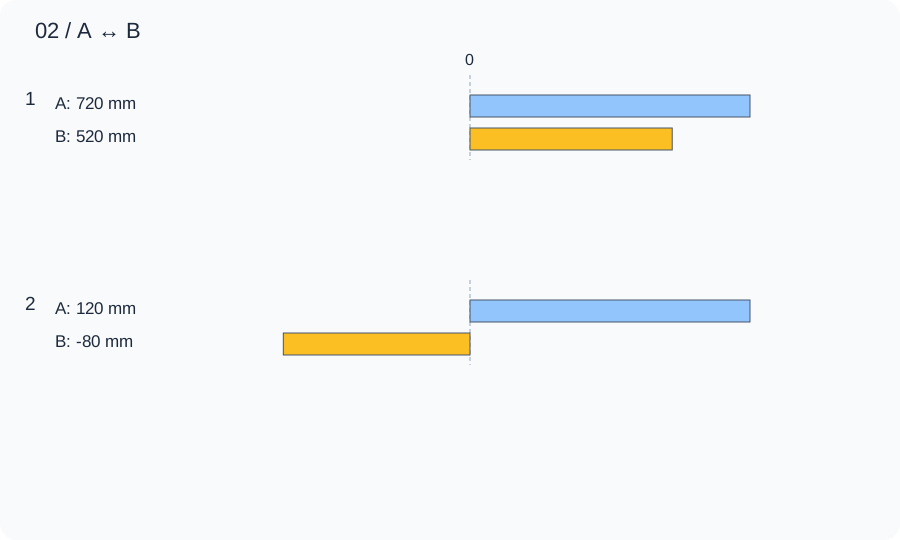
The cabinet’s full-open wall projection is 460 mm, so add only 200 mm beyond its closed 260 mm. The result is 520 mm before the person and −80 mm after; adding 460 again would double-count the cabinet.
| Calculated relationship | A | B |
|---|---|---|
| 1. Unoccupied cross-section | 720 mm | 520 mm |
| 2. Remainder after the stated allowance | 120 mm | -80 mm |
Use the supplier’s full-open envelope and rehearse bending for shoes with the actual door in operation. Check the turn separately with a carried box; straight-strip arithmetic cannot prove access around a corner.
TRY THE EXAMPLE
Narrow Hallway Design Ideas: Storage, Lighting, Mirrors, Flow
The article’s 1100 mm hall has a closed cabinet projection of 260 mm and opposite radiator of 120 mm. Combine them as 380 mm fixed use; a chosen 600 mm retrieval-person allocation is an independent addition.
Allowed range: 1–12000 · Step: 1
Allowed range: 0–12000 · Step: 1
Allowed range: 0–12000 · Step: 1
Allowed range: 0–12000 · Step: 1
Positive remainder under these assumptions. Check the actual use and product requirements before choosing a layout.
- Unoccupied cross-section
- 720 mm
- Remainder after the stated allowance
- 120 mm
Reference boundary — Measured cross-section: 1100 mm
Blue dashed line: comparison boundary. Red dimension: shortage.
1100 − 380 − 0 − 600 = 120 mm
Use the supplier’s full-open envelope and rehearse bending for shoes with the actual door in operation. Check the turn separately with a carried box; straight-strip arithmetic cannot prove access around a corner.
Teaching assumptions, not a surveyed home or a construction check. Results describe this simplified geometry or budget only. Changes stay on this page and reset on reload.