Suitcase Storage in a Closet: Plan Access and Shelf Space
Plan long-term suitcase storage with real case dimensions, closet door access, shelf limits, nesting choices, and a retrieval routine that works at home.
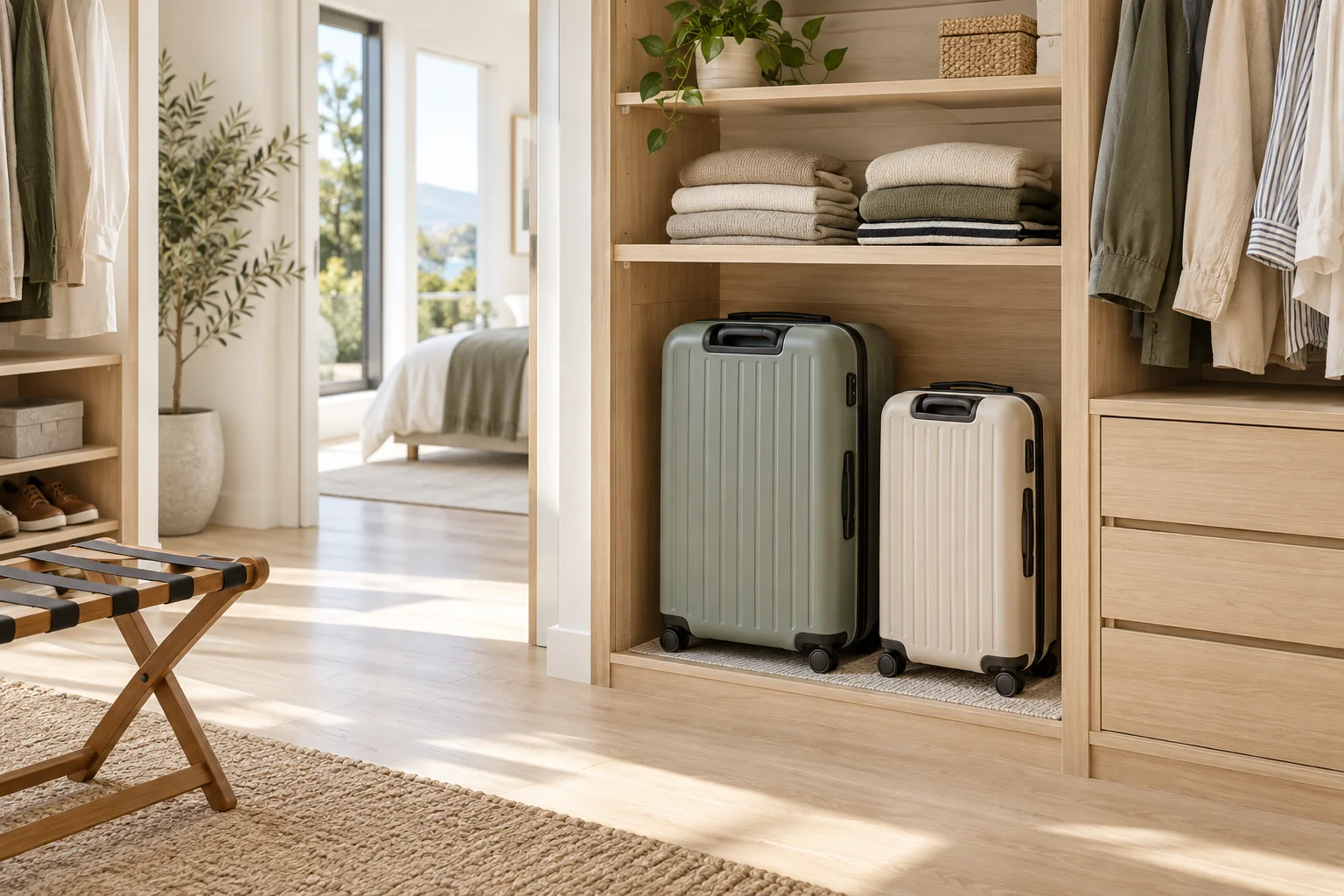
A suitcase can spend more time in a wardrobe than on a journey. Yet it is often assigned whatever gap remains after the clothes are organized. The case then blocks a drawer, traps a smaller bag behind it, or needs an awkward overhead lift before every trip. Plan its storage around the closed case, the route through the closet opening, and the person who retrieves it.
This is a guide to long-term home storage. It is different from keeping an open suitcase ready for a visitor, covered in the guest room luggage rack guide. The objective here is an accessible home for empty or intentionally stocked travel equipment between trips.
Inventory the Cases You Actually Keep
List each suitcase, carry-on, duffel, and travel accessory bag. Record how often each is used and whether it can genuinely nest inside another.
Measure the closed outer dimensions with wheels, handles, feet, and expansion panels in their storage position. A product's advertised body size may exclude protrusions. Note the empty weight and the weight of anything you intend to keep inside. A case filled with other bags is no longer the same lifting task as an empty shell.
Make a small inventory label for a nested set.
Measure the Opening, Not Just the Interior
Record the closet's usable width, depth, and height, then measure the actual entry opening. Hinged doors, sliding panels, hinges, drawer fronts, and a projecting hanging rail can all narrow the route into a compartment. A cavity that accepts the suitcase on paper may not allow it to be turned into place.
For example, a closet bay might be 80 cm wide, 60 cm deep, and 90 cm high while a closed case is 52 cm wide, 32 cm deep, and 78 cm tall. It fits upright within the bay. However, if a sliding panel exposes only 45 cm of width, the case cannot simply pass straight through in that orientation. Rotation might help, but requires clearance both outside and inside the wardrobe.
Tape the opening on the floor or use the actual empty case to test gently. Do not force handles through a tight gap or assume flexible door seals and clothing can always be compressed. These measurements are illustrative, not a recommended closet specification.
Choose an Orientation Deliberately
Upright on the Closet Floor
Upright storage often makes a frequently used case easier to retrieve without lifting it above the waist. Confirm that it stands securely in the intended position and does not roll into a door or lean against hanging clothes. Follow the case manufacturer's storage guidance.
Protect the closet floor as appropriate for its finish, but avoid adding a loose layer that catches the wheels or bunches beneath them. Leave the handle reachable from the opening. A suitcase wedged behind shoes remains inconvenient even if the floor space is technically available.
Flat on a Suitable Low Shelf
Horizontal storage can suit a shallow case or a compartment beneath short hanging clothes. Measure both the case depth and the space required to grip it. A shelf flush against the case on all sides may leave no practical way to lift it out.
Verify shelf capacity, support spacing, and fixing requirements with the furniture documentation. Do not assume a shelf intended for folded clothing can support several loaded cases. Where the capacity is unknown, move the luggage to an appropriate supported floor position rather than inventing a safe load.
Inside Another Suitcase
Nesting reduces the number of outer footprints but increases retrieval steps. Test the actual fit without forcing zippers, distorting the shell, or stressing wheels and handles. Include a simple list of contents and keep items needed regularly in a separate accessible pouch.
If the largest case travels rarely but the nested cabin bag travels every week, this arrangement may be poorly matched to the routine. Side-by-side storage consumes more floor area yet can save repeated unpacking. Choose based on access frequency, not just the smallest storage volume.
Reserve a Retrieval Zone Outside the Door
Draw the closed storage position and a second position where the case lands after removal. The space between them must allow the person to grasp, turn, and set the case down without stepping onto the bed or moving a heavy chest of drawers.
For a simple example, a case projecting 32 cm from the wardrobe front during removal and a chosen 60 cm standing zone require 92 cm in that direction for that particular maneuver. This arithmetic describes one mock-up, not an ergonomic minimum. Test the real user and case, especially where mobility, balance, or lifting limits affect the movement.
Check the bedroom door and nearby drawers during retrieval. It may be acceptable to close a wardrobe door after removing the case, but the only exit should not depend on climbing past stored luggage.
Avoid Turning High Shelves Into Heavy Storage
A high shelf can look like unused capacity while creating the hardest lift in the room. Heavy or awkward cases belong where the intended user can handle them safely. Do not plan routine luggage retrieval while balancing on furniture or reaching across a hanging rail.
If an upper compartment is considered, confirm the shelf and access method are appropriate before using it. Lighter, infrequently used accessories may be a better match than the largest suitcase. Moving a small storage category upward can free a lower bay without changing the wardrobe itself.
Give Drying and Cleaning Their Own Step
After a trip, inspect and clean luggage according to its care instructions. Let any damp material dry appropriately before enclosing the case or nesting bags inside it. A closed wardrobe is not a drying chamber, and a cover does not solve trapped moisture.
Leave enough access to inspect the surrounding floor and wall. If the compartment repeatedly becomes damp, address that condition rather than covering it with luggage. Keep strong cleaning products and unrelated liquids elsewhere so a leak does not turn travel storage into a cleanup problem.
Test a Real Departure and Return
Take out the bag you use most often, carry it to the packing location, and return it empty. Repeat with the nested set if applicable. Count the other objects moved along the way. A layout requiring five separate relocations for every short trip is probably too tightly packed.
Compare the closet's broader organization with the walk-in closet layout guide, or use the room planner introduction when reviewing the bedroom arrangement. Confirm shelf strength and lifting suitability through the actual furniture and users, not a visual layout alone.
Storage Checklist
- All external projections are included in the case dimensions.
- The closet opening admits the case through the whole movement.
- Frequently used luggage is independently accessible.
- Nested contents and total weight are known.
- Shelves have verified suitability for the intended load.
- A clear landing position exists outside the wardrobe.
- Cases are clean and dry before enclosed storage.
The best luggage storage is easy to reset after a tiring journey. Keep the return routine as simple as the departure routine, and the suitcase is less likely to become a permanent object beside the bedroom door.